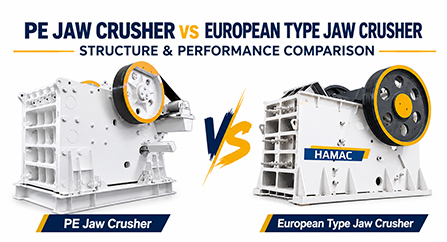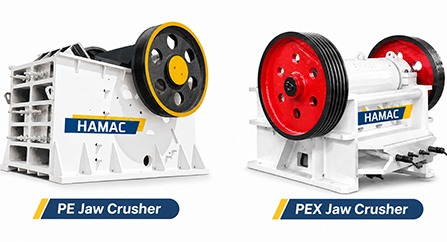




PE Jaw Crusher vs. European Type Jaw Crusher: Structure and Performance Comparison
The PE series jaw crusher and the European type jaw crusher use the same crushing principle but differ in chamber, bearing and adjustment design. The differences are measurable in the spec sheets: chamber geometry, bearing arrangement, discharge adjustment method and model coverage. This article compares the two lines using HAMAC model data, and lists the cost-per-ton drivers that decide the selection.
Working Principle: Same Compression, Different Execution
Both machines crush by compression: an eccentric shaft drives the movable jaw toward the stationary jaw, and material breaks under the closing force. The PE series is the conventional design — simple structure, proven in long-term operation, broad model coverage. The European type applies the same principle with an upgraded chamber, bearing and adjustment system. Industry references describe the European design as an evolution of the traditional crusher: a V-shaped chamber instead of a shallow one, wedge-type discharge adjustment instead of shims, and larger rolling bearings (Zoneding technical manual).
Structure Comparison
| Structure | PE Series | European Type (6CX) | Effect in Operation |
|---|---|---|---|
| Crushing chamber | Standard chamber geometry | Symmetrical V shape — even force distribution, more uniform particle size | Product consistency; liner wear spreads evenly |
| Movable jaw assembly | Conventional cast design | Robust steel castings, FEM-optimized body, heavy-load rolling bearings | Higher mechanical forces sustained over longer service |
| Discharge adjustment | Gasket (shim) type — stop the machine, add or remove plates | Double-wedge system — stepless adjustment, no parts handled | Adjustment time and downtime per CSS change |
| Motor base | Separate foundation | Integrated directly on the crusher | Installation footprint and layout cost |
| Belt tensioning | Conventional arrangement | Pin-shaft articulated tensioning | Power transmission stability, easier maintenance |
| Jaw plates | High-manganese steel | High-manganese steel in an optimized construction | Liner replacement frequency |
The adjustment method is the most practical difference. Shim-type adjustment requires releasing the tension assembly and adding or removing spacer plates to change the discharge opening. Wedge systems convert a horizontal screw movement into toggle-seat displacement, giving continuous stepless adjustment without adding parts (SBM crusher knowledge). Major manufacturers apply the same logic in European-type machines with hydraulic-assisted wedge adjustment (SBM PEW series). HAMAC's 6CX uses a mechanical double-wedge system — simpler, safer and faster than gasket adjustment (6CX product page).
Performance and Model Coverage
The PE line spans eleven models from small quarry duty to 800 tph mine duty. The 6CX line spans eight models with a capacity maximum of 650 tph.
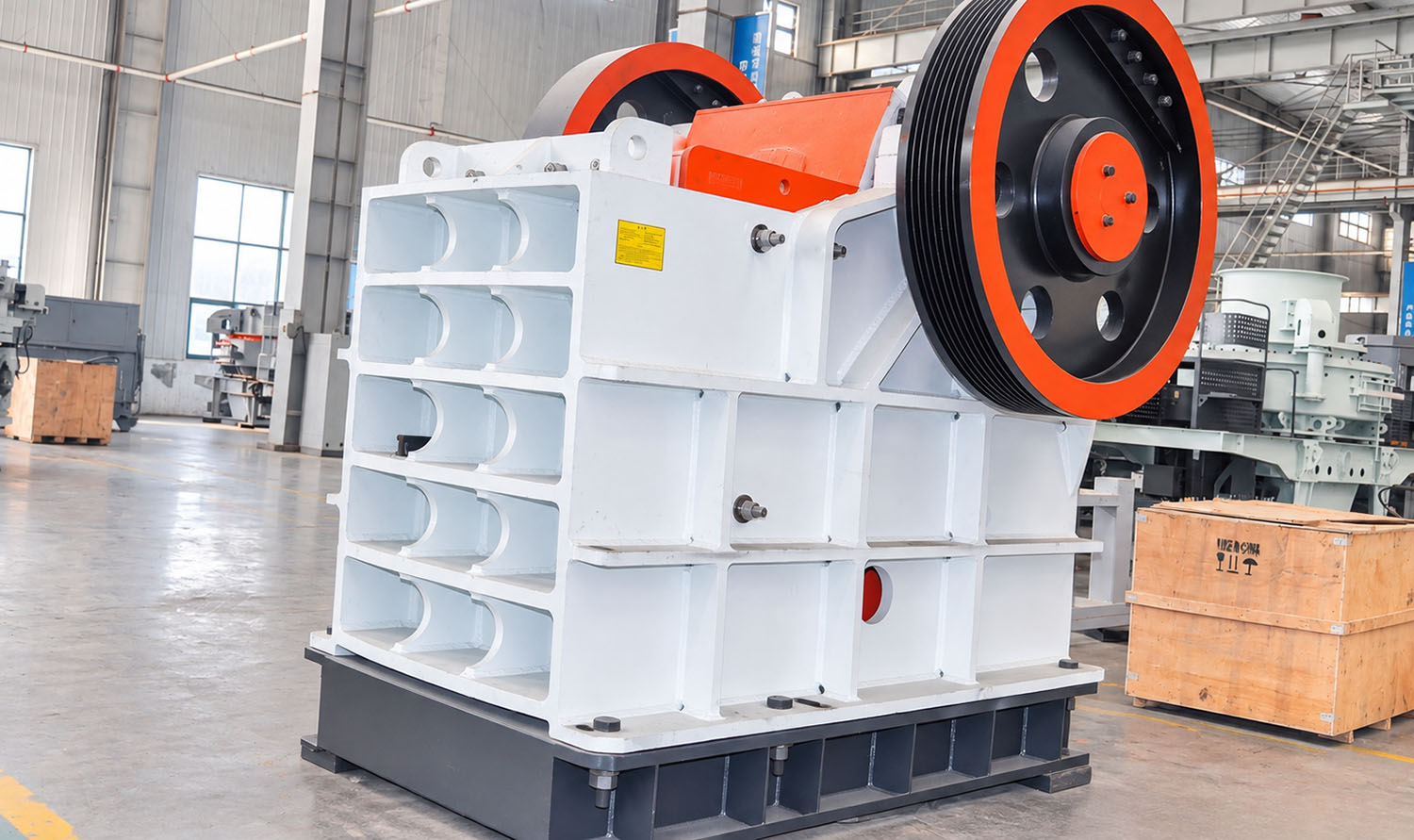
PE / PEX series specifications (HAMAC):
| Model | Feed Opening [mm] | Max Feed [mm] | Output Range [mm] | Capacity [t/h] | Power [kW] | Weight [t] |
|---|---|---|---|---|---|---|
| PEX250×750 | 250×750 | 210 | 25–60 | 13–35 | 30 | 5.5 |
| PEX300×1300 | 300×1300 | 250 | 20–90 | 16–105 | 75 | 15.6 |
| PE400×600 | 400×600 | 340 | 40–100 | 16–60 | 30 | 6.7 |
| PE500×750 | 500×750 | 425 | 50–100 | 40–110 | 55 | 11.7 |
| PE600×900 | 600×900 | 500 | 65–180 | 80–180 | 55–75 | 16.1 |
| PE750×1060 | 750×1060 | 630 | 80–180 | 110–320 | 90–110 | 30.1 |
| PE900×1200 | 900×1200 | 780 | 95–225 | 220–450 | 110–132 | 49.0 |
| PE1000×1200 | 1000×1200 | 850 | 195–280 | 280–550 | 110–132 | 51.2 |
| PE1200×1500 | 1200×1500 | 1020 | 150–300 | 400–800 | 160–220 | 100.9 |
All PE models handle material up to 320 MPa compressive strength — limestone, granite, marble, basalt, iron ore and copper ore. PEX models (finer discharge, smaller feed) serve secondary duty; see our PE vs PEX selection guide.
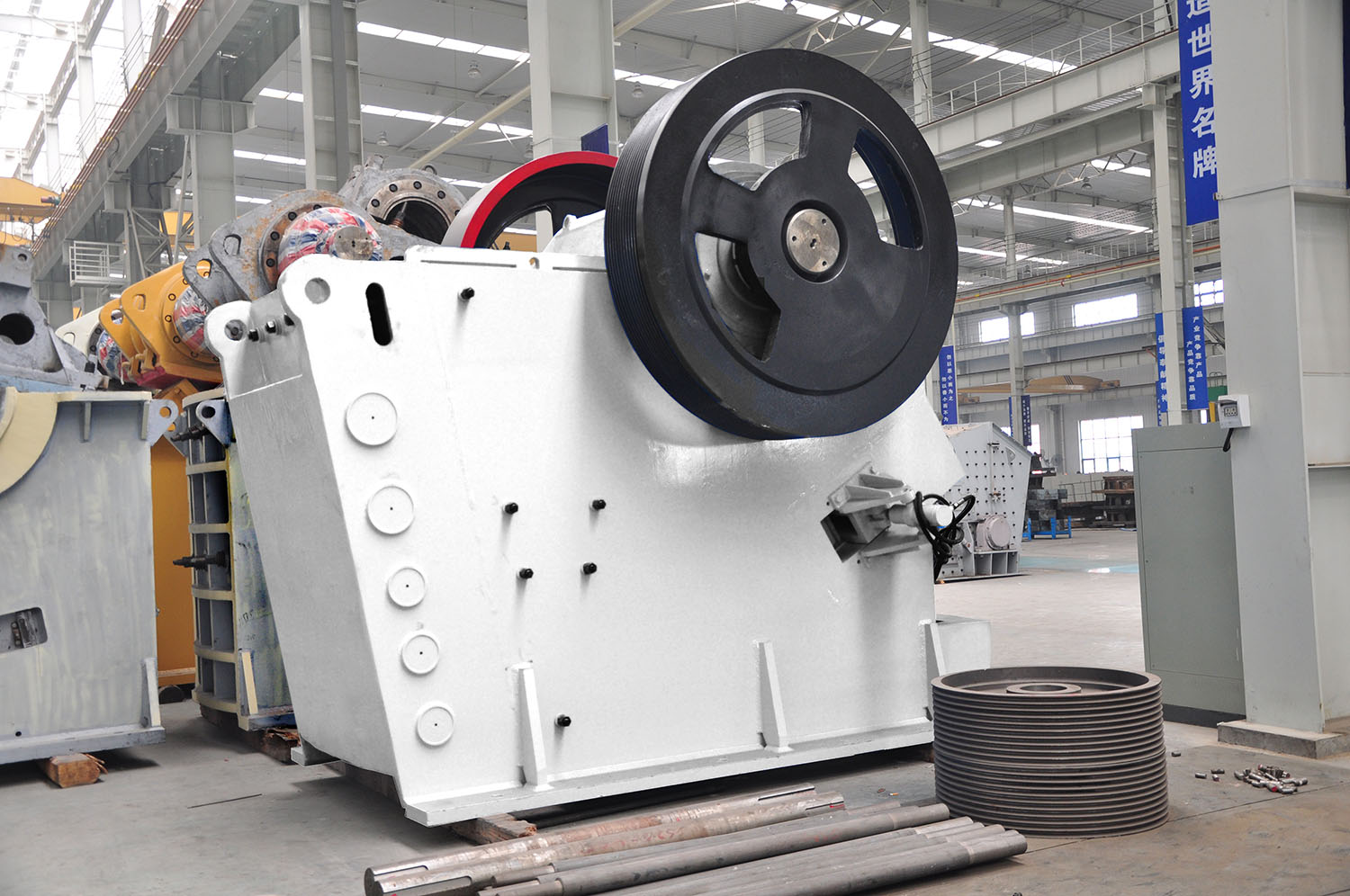
6CX European type specifications (HAMAC):
| Model | Feed Opening [mm] | Power [kW] | Speed [rpm] | Max Single Part Weight [kg] | Total Weight [kg] |
|---|---|---|---|---|---|
| 6CX80 | 800×510 | 75 | 350 | 2,870 | 7,520 |
| 6CX96 | 930×580 | 75 (90) | 300 | 4,500 | 12,000 |
| 6CX106 | 1060×700 | 110 | 280 | 7,800 | 19,000 |
| 6CX110 | 1100×850 | 132 (160) | 230 | 9,000 | 25,060 |
| 6CX125 | 1250×950 | 160 (132) | 220 | 12,960 | 36,700 |
| 6CX140 | 1400×1070 | 200 (160) | 220 | 15,950 | 45,300 |
| 6CX145 | 1400×1100 | 200 | 220 | 18,600 | 53,800 |
| 6CX160 | 1600×1200 | 250 (200) | 220 | 21,380 | 68,600 |
Coverage: PE reaches both smaller capacities (from 13 t/h) and a higher maximum (800 t/h); 6CX concentrates on the mid-to-large band with a maximum of 650 t/h. In the overlap band, compare power and machine weight at your target capacity — both are cost-per-ton inputs. For reference on European-type chamber efficiency — symmetrical V stress distribution and deeper cavity design — see JXSC's PEV European jaw crusher overview.
Adjustment and Maintenance
Every CSS adjustment stops production. Shim adjustment: longer stop — release, add or remove plates, reassemble, verify. Double-wedge adjustment: shorter stop, no parts handled. Over a year of liner wear compensation and product-size changes, the total time difference is production time.
Two maintenance parameters are readable from the spec tables. Maximum single part weight: the 6CX table lists it explicitly (up to 21,380 kg on the 6CX160), which sets the workshop crane requirement for liner and jaw changes. Liner metallurgy: both lines use high-manganese steel; the 6CX pairs it with the V chamber's even force distribution, which spreads wear instead of concentrating it.
Cost Per Ton Drivers
Machine price depends on configuration and market. Request it in your quotation. The cost structure is evaluable now, from the data above:
| Cost Per Ton Driver | Where It Comes From | How the Designs Differ | What to Check Before Ordering |
|---|---|---|---|
| 1. Adjustment downtime | Every CSS change stops production | Shim: add/remove plates. Wedge: stepless, faster, no parts handled | How often you change product size or compensate liner wear |
| 2. Liner consumption | Jaw plate wear rate | V chamber distributes force evenly — wear spreads instead of concentrating | Expected liner set life on your material's abrasiveness |
| 3. Power per tonne | Motor kW at working capacity | Compare kW against tph in the same capacity band across the two tables | Local electricity price × operating hours |
| 4. Bearing reliability | Unplanned stoppages | 6CX: heavy-load rolling bearings for sustained mechanical force | Supplier's bearing specification and maintenance interval |
| 5. Installation footprint | Civil works and layout | 6CX integrated motor base saves space and simplifies installation | Foundation drawings against your plant layout |
| 6. Rigging and spares logistics | Heaviest single part | 6CX max part weight up to 21.4 t — sets crane capacity and spares planning | Workshop crane rating and spares stocking plan |
Which One for Which Project
| Project Requirement | Recommended Equipment |
|---|---|
| Broadest model coverage, 13 to 800 tph | PE series |
| Small plant, tight budget, classic duty | PE or PEX series |
| Hard, abrasive rock with frequent product-size changes | 6CX European type |
| Constrained installation footprint | 6CX — integrated motor base |
| Primary crusher that follows the working face | Mobile jaw crusher plant / modular crusher plant |
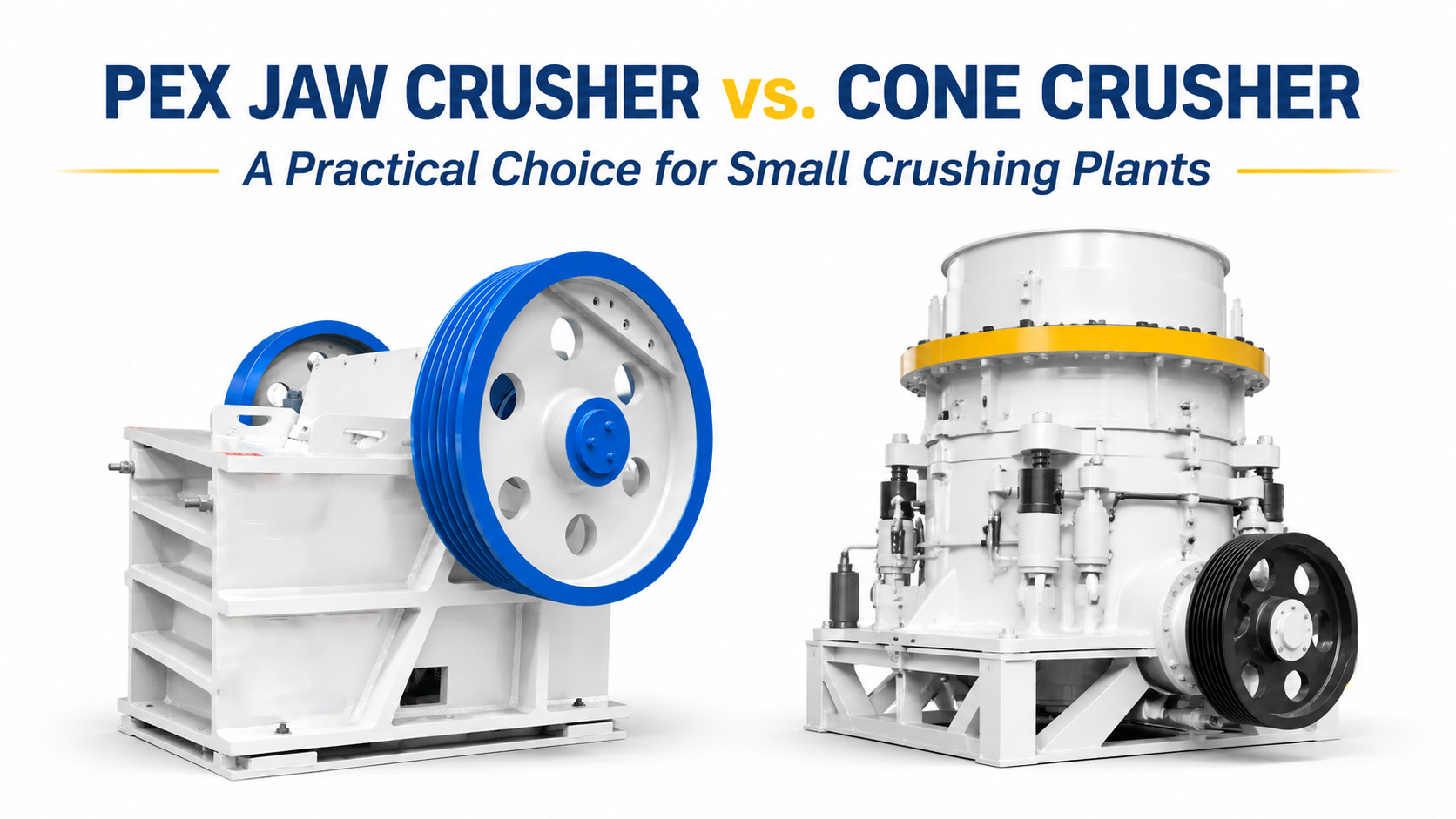
For secondary-stage planning, see PEX jaw crusher vs cone crusher for small plants and HAMAC's cone crusher range.
Send your material hardness, feed size and target capacity — the HAMAC team returns a jaw crusher configuration with model, power and cost drivers specified. Reach us via the contact page.