





PE vs. PEX Jaw Crusher: Differences & Selection Guide | HAMAC
PE vs. PEX Jaw Crusher: What Is the Difference and Which Do You Need?
When choosing a jaw crusher for a mining or quarry project, one of the most common questions is whether to select a PE or PEX jaw crusher. Both machines use compression crushing to reduce rock and ore, but they are generally designed for different crushing stages and feed conditions.
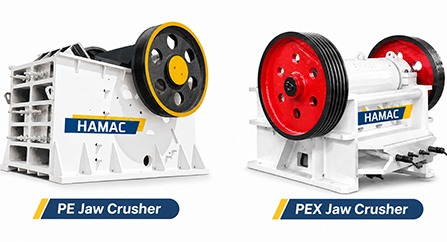
PE jaw crushers are commonly used for primary crushing, where large rocks from blasting or excavation need to be reduced to a manageable size. PEX jaw crushers are generally used for secondary or finer crushing, processing material that has already been reduced by a primary crusher.
However, selecting the right model involves more than comparing the PE and PEX names. Maximum feed size, required output range, hourly capacity, material properties and downstream equipment all affect the final decision.
This guide compares PE and PEX jaw crushers using HAMAC model specifications and practical crushing-line considerations, helping quarry operators, mining contractors and equipment buyers choose the right machine for their projects.
1. What Is a PE Jaw Crusher?
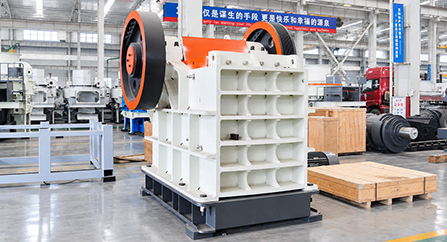
A PE jaw crusher is a primary crushing machine commonly used in quarrying, mining and aggregate production. It reduces large rocks and ores through compression between a fixed jaw plate and a movable jaw plate.
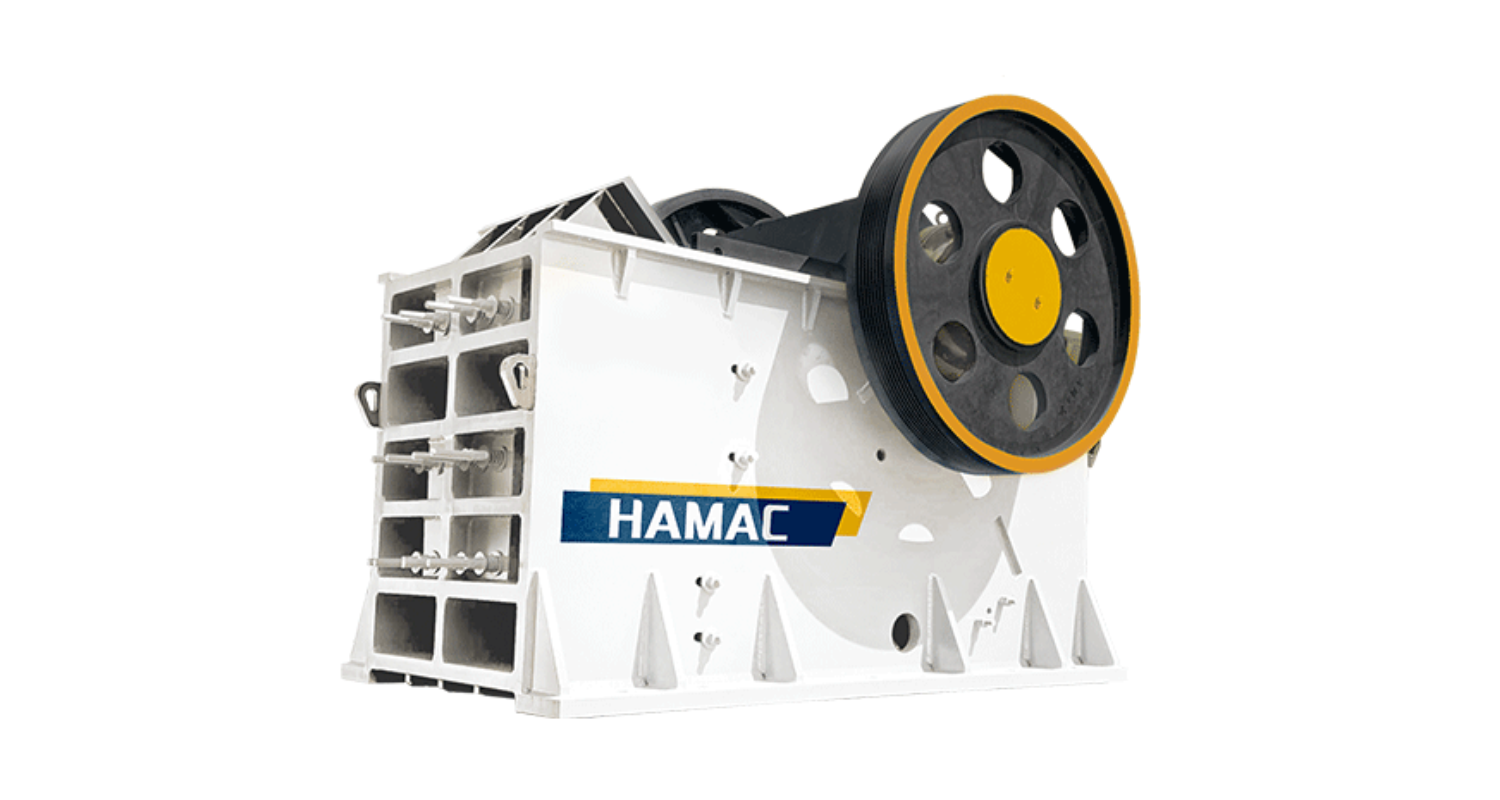
The PE series is generally designed with a larger feed opening to accept relatively large raw materials. It is commonly installed at the beginning of a crushing line, reducing run-of-mine (ROM) material or blasted rock before secondary crushing.
Typical applications include:
- Primary crushing of granite, basalt and limestone.
- Iron ore and copper ore crushing.
- Quarry operations producing construction aggregates.
- Highway, railway and infrastructure aggregate production.
- Fixed and mobile stone crushing plants.
For example, HAMAC's PE600×900 jaw crusher has a 600×900 mm feed opening, a listed maximum feed size of 500 mm and a reference capacity of 80–180 t/h. This makes it a potential option for projects requiring primary reduction of relatively large rock, subject to material and operating conditions.
Explore the HAMAC PE Series Jaw Crusher for model specifications and product information.
2. What Is a PEX Jaw Crusher?
A PEX jaw crusher is generally used for secondary or finer jaw crushing. Compared with typical large PE primary models, PEX machines usually have a narrower feed opening and are designed to process material that has already passed through a primary crushing stage.
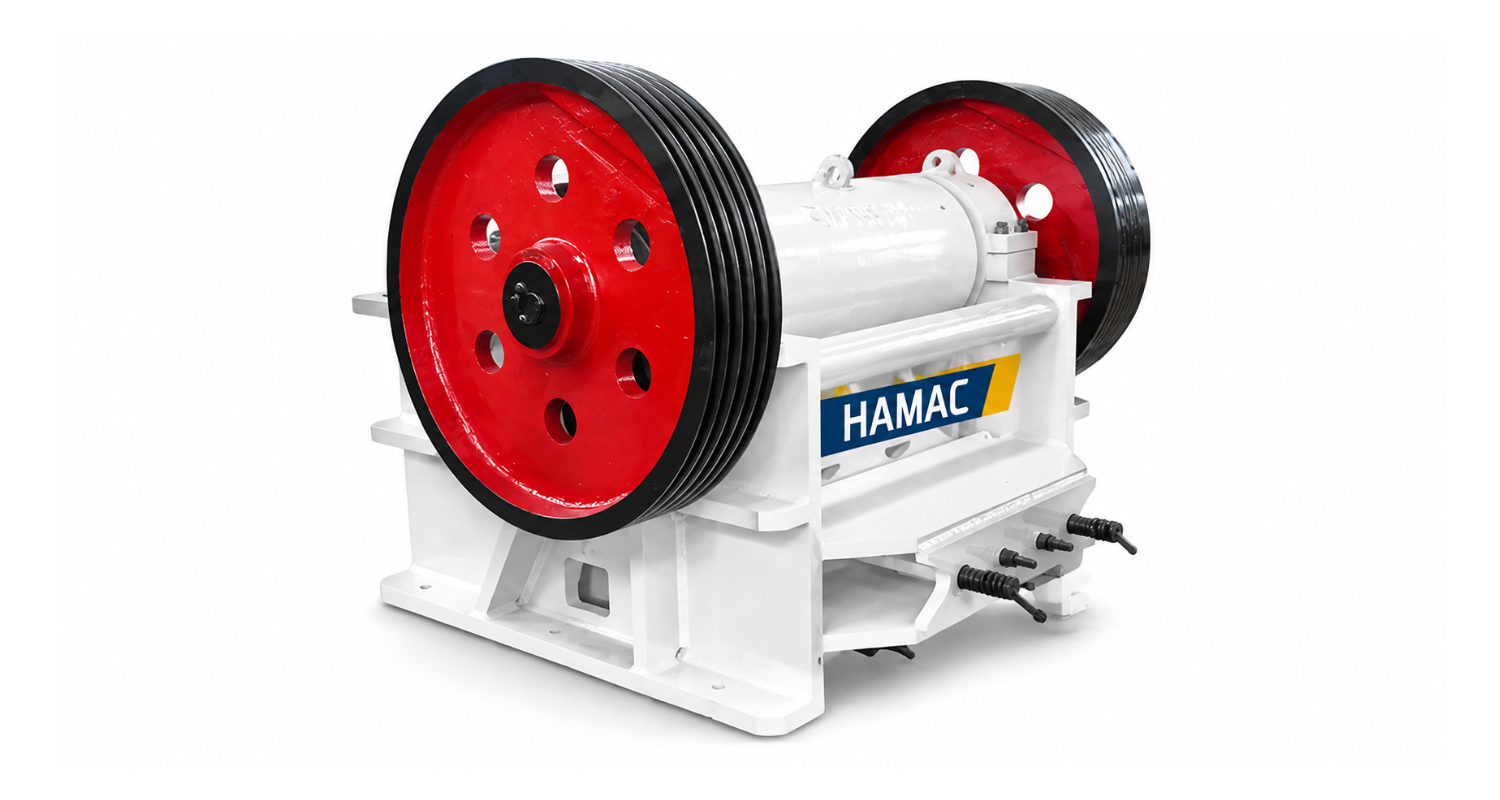
The PEX series is often selected when a project needs to reduce the size of pre-crushed rock before screening, further crushing or another processing stage.
Typical applications include:
- Secondary crushing of pre-crushed stone.
- Further size reduction in small and medium crushing plants.
- Processing feed material for a downstream cone crusher.
- Producing smaller crushed stone within the machine's specified output range.
- Aggregate and mineral processing projects with suitable feed conditions.
For example, the HAMAC PEX250×1200 has a maximum feed size of 210 mm, a listed output range of 25–60 mm and a reference capacity of 20–61 t/h.
It is important to remember that PEX is not suitable for every large-rock primary crushing application. The actual feed must remain within the selected model's maximum feed size and operating requirements.
3. PE vs. PEX Jaw Crusher: What Are the Main Differences?
The main difference between PE and PEX jaw crushers is their typical role in a crushing circuit. PE models are commonly selected for primary crushing of larger feed material, while PEX models are generally used for secondary or finer jaw crushing.
| Comparison | PE Jaw Crusher | PEX Jaw Crusher |
|---|---|---|
| Typical crushing stage | Primary crushing | Secondary or finer crushing |
| Feed opening | Generally larger | Generally narrower |
| Feed material | Large raw rock and ore | Pre-crushed rock |
| Maximum feed size | Depends on model; larger PE models accept larger feed | Depends on model; typically smaller than large PE primary models |
| Output range | Generally suited to primary size reduction | Generally suited to further size reduction |
| Typical production-line position | First crushing stage | Second crushing stage or additional jaw crushing stage |
| Common applications | Quarries, mines and primary aggregate production | Secondary crushing and smaller-size material production |
These are typical series-level differences, not absolute rules for every machine. Individual PE and PEX models can have overlapping output ranges and different capacity ratings. Always compare the specifications of the exact models under consideration.
4. PE vs. PEX Jaw Crusher: Technical Specifications
Technical specifications provide a more practical basis for comparing jaw crushers. The following figures are taken from HAMAC's published PE Series Jaw Crusher product data.
4.1 PE Jaw Crusher Models and Specifications
| Model | Feed Opening (mm) | Max. Feed Size (mm) | Output Range (mm) | Capacity (t/h) | Motor Power (kW) |
|---|---|---|---|---|---|
| PE400×600 | 400×600 | 340 | 40–100 | 16–60 | 30 |
| PE500×750 | 500×750 | 425 | 50–100 | 40–110 | 55 |
| PE600×900 | 600×900 | 500 | 65–180 | 80–180 | 55–75 |
| PE750×1060 | 750×1060 | 630 | 80–180 | 110–320 | 90–110 |
| PE900×1200 | 900×1200 | 780 | 95–225 | 220–450 | 110–132 |
| PE1200×1500 | 1200×1500 | 1020 | 150–300 | 400–800 | 160–220 |
PE models cover a wide range of feed sizes and production requirements. Smaller models can serve compact crushing plants, while larger models are designed for higher-volume primary crushing applications.
4.2 PEX Jaw Crusher Models and Specifications
| Model | Feed Opening (mm) | Max. Feed Size (mm) | Output Range (mm) | Capacity (t/h) | Motor Power (kW) |
|---|---|---|---|---|---|
| PEX250×750 | 250×750 | 210 | 25–60 | 13–35 | 30 |
| PEX250×1000 | 250×1000 | 210 | 25–60 | 16–52 | 37 |
| PEX250×1200 | 250×1200 | 210 | 25–60 | 20–61 | 55 |
| PEX300×1300 | 300×1300 | 250 | 20–90 | 16–105 | 75 |
The PEX models listed above have smaller maximum feed sizes than the large PE primary models. Their output ranges are suitable for projects that require additional size reduction, provided the incoming material is properly prepared.
Important specification note: The values in these tables are published reference specifications. The term "Output Range" follows the HAMAC product page and should not automatically be interpreted as a guaranteed finished-product grading or a specific CSS value. Actual production depends on the material, feed grading, moisture, discharge setting, feeding consistency and operating conditions.
5. How Does a Jaw Crusher's Feed Size Affect Model Selection?
Maximum feed size is one of the first specifications to check when selecting a jaw crusher. The machine must accept the largest individual rock entering the crushing chamber, not just the average size of the material.
For example, HAMAC lists the following maximum feed sizes:
- PE400×600: maximum feed size of 340 mm.
- PE600×900: maximum feed size of 500 mm.
- PE900×1200: maximum feed size of 780 mm.
- PEX250×1200: maximum feed size of 210 mm.
This means that a PEX250×1200 should not be selected to receive 400–500 mm blasted rock directly. The material would need to be reduced to a suitable size by an upstream crusher or another preparation process.
Also, do not confuse feed opening dimensions with maximum feed size. For example, the PE600×900 has a 600×900 mm feed opening, while its listed maximum feed size is 500 mm.
Correct feed sizing helps reduce bridging, choking, uneven wear and unnecessary equipment downtime.
6. How Do PE and PEX Jaw Crushers Work?
Both PE and PEX jaw crushers use the same basic compression-crushing principle. A motor drives the eccentric shaft through a belt and pulley system, causing the movable jaw to swing toward and away from the fixed jaw.
The crushing process generally follows these steps:
- Feeding: Rock or ore enters the crushing chamber through the feed opening.
- Compression: The movable jaw moves toward the fixed jaw, compressing the material.
- Size reduction: The material fractures under compressive force as the crushing chamber narrows toward the bottom.
- Discharge: Material small enough to pass through the discharge opening falls from the bottom of the chamber.
- Continuous operation: The repeated movement of the movable jaw allows the machine to process material continuously.
The key difference is not a completely different crushing principle. It is the machine size, crushing chamber configuration, feed requirements and intended application.
Learn more about the jaw crusher working principle and main components.
7. Which Materials Can PE and PEX Jaw Crushers Process?
Both PE and PEX jaw crushers can be used for various types of rock and ore, provided the selected model is suitable for the material's feed size, hardness and abrasiveness.
| Material | Typical Project | Selection Consideration |
|---|---|---|
| Granite | Quarry and aggregate production | High hardness and abrasiveness; check feed size and wear-part requirements. |
| Basalt | Road construction and aggregates | Hard rock; stable feeding and suitable capacity are important. |
| Limestone | Cement and aggregate production | Check required output size and production capacity. |
| Iron Ore | Metal mining and mineral processing | Consider ore hardness, abrasiveness and downstream processing requirements. |
| Copper Ore | Mining and beneficiation | Match the crusher to the ROM feed size and required throughput. |
| River Pebbles | Sand and aggregate production | Consider feed grading, particle shape and final product requirements. |
The material name alone does not determine whether PE or PEX is the correct choice. For example, both machines may process granite, but the correct model depends on whether the granite is entering as large blasted rock or as pre-crushed feed.
8. When Should You Choose a PE Jaw Crusher?
A PE jaw crusher is generally the better starting point when a project needs to process large raw material in the primary crushing stage.
Choose a PE jaw crusher when:
- Your raw material contains large rocks from blasting or excavation.
- You need a primary crusher with a relatively large feed opening.
- Your project requires higher primary crushing capacity.
- The crushed material will be transferred to a cone crusher, impact crusher or another downstream processing stage.
- You are planning a quarry, mine or aggregate production line that requires primary size reduction.
For example, a project receiving rock with a maximum feed size of around 450 mm may consider a PE600×900, which has a listed maximum feed size of 500 mm. However, the final model must also meet the required throughput and output specifications.
9. When Should You Choose a PEX Jaw Crusher?
A PEX jaw crusher is generally more suitable when the feed material has already been reduced and the project requires further size reduction through jaw crushing.
Choose a PEX jaw crusher when:
- The material has already passed through a primary crusher.
- The incoming feed size is within the selected PEX model's maximum feed limit.
- You need a smaller output range than the upstream crushing stage provides.
- Your production line requires an additional jaw crushing stage.
- The required capacity matches the selected PEX model's operating range.
For example, a PEX250×1200 has a listed maximum feed size of 210 mm and a reference capacity of 20–61 t/h. It may be considered for a secondary crushing application when the incoming material and production target are within these limits.
10. Can PE and PEX Jaw Crushers Work Together?
Yes. PE and PEX jaw crushers can be used together in a multi-stage crushing line when the feed and capacity requirements are properly matched.
A typical arrangement is:
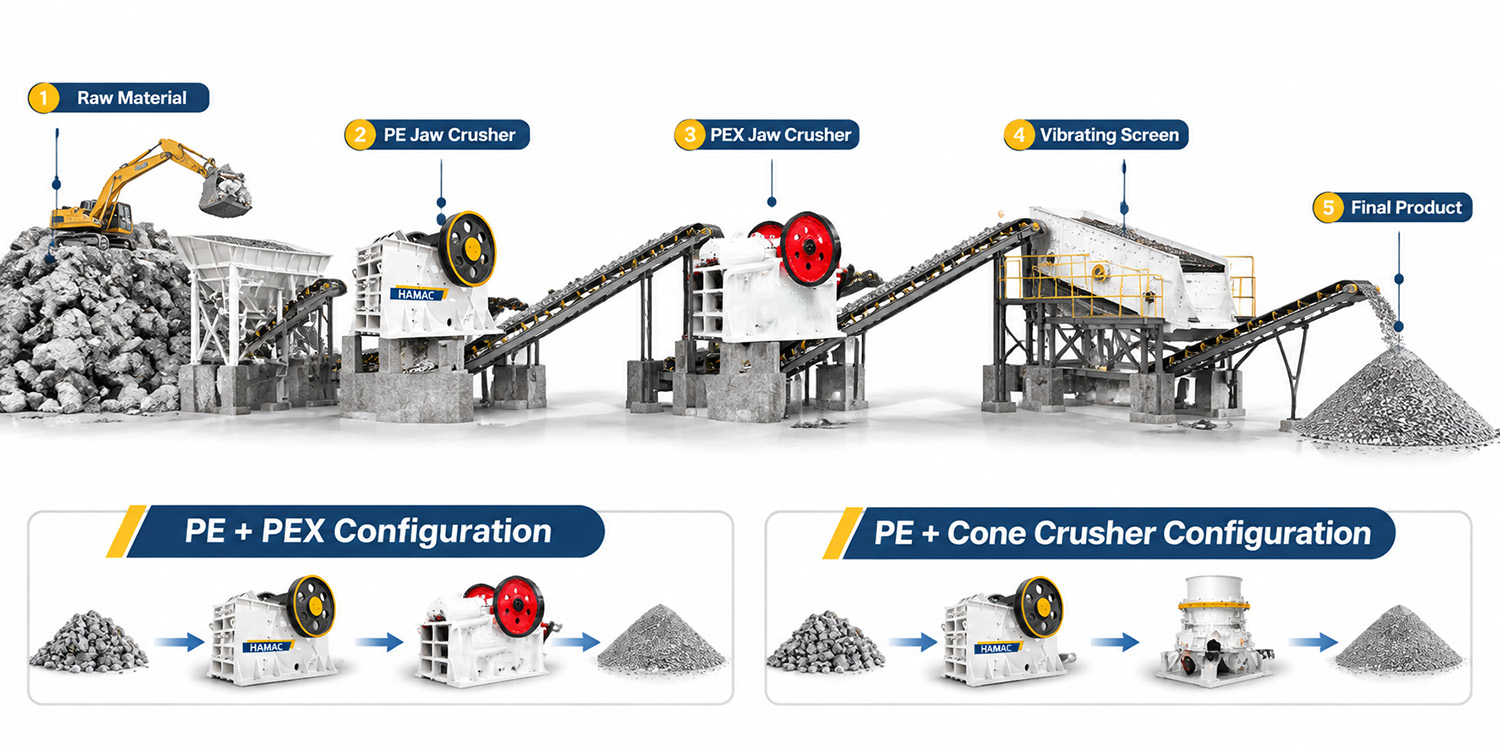
Raw Material → Vibrating Feeder → PE Jaw Crusher → Intermediate Conveyor / Screening → PEX Jaw Crusher → Vibrating Screen → Final Products
In this configuration:
- The vibrating feeder delivers material at a controlled rate to the primary crusher.
- The PE jaw crusher reduces large raw rock into smaller material.
- The intermediate conveyor transfers the crushed material to the next stage.
- The PEX jaw crusher performs additional size reduction on suitable feed material.
- The vibrating screen separates the crushed material into different product sizes.
This configuration is not required for every project. The number of crushing stages should be determined by the required capacity, feed size, final product grading and equipment investment.
For some hard-rock aggregate plants, a PE jaw crusher followed by a cone crusher may be a more suitable configuration. A cone crusher is commonly used for secondary or tertiary crushing when the project requires higher throughput or a specific aggregate product grading.
Explore HAMAC's compound cone crusher and vibrating feeder for possible production-line configurations.
11. PE + PEX vs. PE + Cone Crusher: Which Configuration Is Better?
Both configurations can be used in crushing plants, but they serve different production requirements. The right choice depends on the material, required output, capacity and downstream processing process.
| Comparison | PE + PEX | PE + Cone Crusher |
|---|---|---|
| Primary stage | PE jaw crusher | PE jaw crusher |
| Secondary stage | PEX jaw crusher | Cone crusher |
| Typical purpose | Further size reduction using jaw crushing | Secondary crushing of suitable hard and medium-hard materials |
| Feed requirements | PEX must receive material within its specified feed limit | Cone crusher must receive material within its feed limit |
| Selection factors | PEX capacity, output range and feed size | Cone chamber, feed size, capacity and product grading |
| Best decision basis | Project-specific crushing requirements | Project-specific crushing requirements |
There is no universal winner. For smaller production requirements or a project with suitable pre-crushed feed, PE + PEX may be worth evaluating. For many hard-rock aggregate plants, PE + cone crusher is a common configuration to consider.
Before selecting either arrangement, check whether the secondary crusher can handle the actual output of the primary crusher. The capacity of the entire production line is limited by its bottleneck stage, not simply by the largest capacity number in the equipment list.
12. How to Choose the Right PE or PEX Jaw Crusher for Your Project
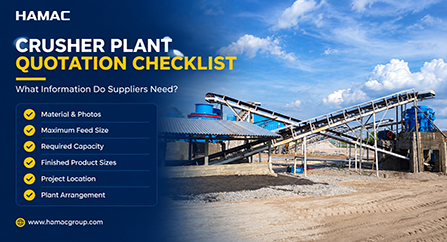
Before requesting a quotation, prepare the following project information. These details help equipment suppliers recommend a suitable model instead of relying on a general capacity estimate.
| Information Required | What to Confirm | Why It Matters |
|---|---|---|
| Raw material | Granite, basalt, limestone, iron ore, copper ore or other material | Determines crushing conditions and wear-part requirements. |
| Maximum feed size | Largest individual rock entering the crusher | Determines the required feed opening and suitable model. |
| Required capacity | Target production in tons per hour (t/h) | Helps determine the machine size and production-line arrangement. |
| Required output size | Target size range after crushing | Helps determine the crushing stage and discharge setting. |
| Material condition | Hardness, abrasiveness, moisture and clay content | Affects throughput, wear and operating stability. |
| Downstream equipment | Cone crusher, impact crusher, screen or other equipment | Ensures the crusher output is suitable for the next stage. |
| Operating conditions | Daily operating hours, power supply and installation conditions | Supports equipment and plant configuration. |
Practical example: A quarry receives granite with a maximum feed size of 450 mm and needs approximately 100 t/h of primary crushing. A PE600×900 may be a candidate because its listed maximum feed size is 500 mm and its reference capacity is 80–180 t/h. However, the final selection still requires checking the actual feed grading, required output range, material abrasiveness and downstream equipment capacity.
By contrast, if the material has already been reduced to below 210 mm and the required output range is around 25–60 mm, a PEX250×1200 may be worth evaluating. Its published reference capacity is 20–61 t/h, so it would not automatically meet a 100 t/h production target.
These examples illustrate how to screen potential models. They are not substitutes for a project-specific capacity calculation or engineering confirmation.
13. Frequently Asked Questions About PE and PEX Jaw Crushers
Q1: What is the main difference between PE and PEX jaw crushers?
PE jaw crushers are generally used for primary crushing of larger feed material, while PEX jaw crushers are commonly used for secondary or finer jaw crushing. The exact difference depends on the model specifications.
Q2: Is PE or PEX better for primary crushing?
PE is generally the preferred series for primary crushing because its models include larger feed openings and higher maximum feed sizes. The selected model must still match the actual feed and capacity requirements.
Q3: Can a PEX jaw crusher crush large rocks?
PEX models can crush rock within their specified maximum feed size. For example, HAMAC's PEX250×1200 lists a maximum feed size of 210 mm. Larger blasted rocks should be reduced before entering this machine.
Q4: Can PEX jaw crushers process granite and basalt?
Yes, provided the feed size and operating conditions are suitable. Granite and basalt are hard, abrasive materials, so model selection, jaw plate wear and actual capacity should be carefully evaluated.
Q5: Can a PEX jaw crusher replace a cone crusher?
Not in every application. Both machines can perform secondary size reduction, but their crushing chamber designs, capacity ranges and product characteristics differ. The correct choice depends on material properties and final product requirements.
Q6: Can PE and PEX jaw crushers work in the same production line?
Yes. A PE jaw crusher can perform primary crushing, followed by a PEX jaw crusher for additional size reduction. The feed size and capacity of the PEX must match the actual output from the PE crusher.
Q7: How do I calculate the capacity needed for a jaw crusher?
Start with the required hourly production in tons per hour, then consider the material type, feed size distribution, operating hours, discharge setting and downstream equipment. Published capacity ranges should be treated as reference values rather than guaranteed production.
Q8: What information should I provide when requesting a jaw crusher quotation?
Provide the material type, maximum feed size, required capacity, target output size, operating hours and downstream equipment. Photos or a feed-size analysis can also help the supplier evaluate the project.