





Eccentric Roll Crusher: Working Principle & Applications | HAMAC
What Is an Eccentric Roll Crusher?
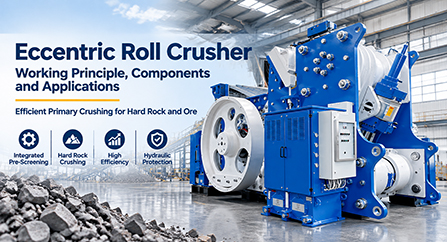
An Eccentric Roll Crusher (ERC) is a type of primary crushing equipment designed to reduce large pieces of hard rock and mineral ore into smaller, more manageable sizes. It is mainly used in mining operations, underground mines, open-pit mines, and hard rock quarries where reliable primary size reduction is required.
Unlike conventional double roll crushers, an eccentric roll crusher uses an eccentric shaft to drive the crushing roll in a periodic oscillating motion. The roll works together with a stationary crushing wall, creating a continuously changing crushing gap. As large rocks enter the crushing chamber, they are compressed and broken into smaller particles.
Many mining-grade ERC designs also integrate a static grizzly screen above the crushing chamber. This allows smaller particles to bypass the crushing zone, helping reduce unnecessary crushing and improve the overall efficiency of the primary crushing process.
For mining companies processing hard rock and run-of-mine (ROM) ore, understanding the eccentric roll crusher working principle, components, advantages, and applications is important when evaluating primary crushing equipment.
How Does an Eccentric Roll Crusher Work?
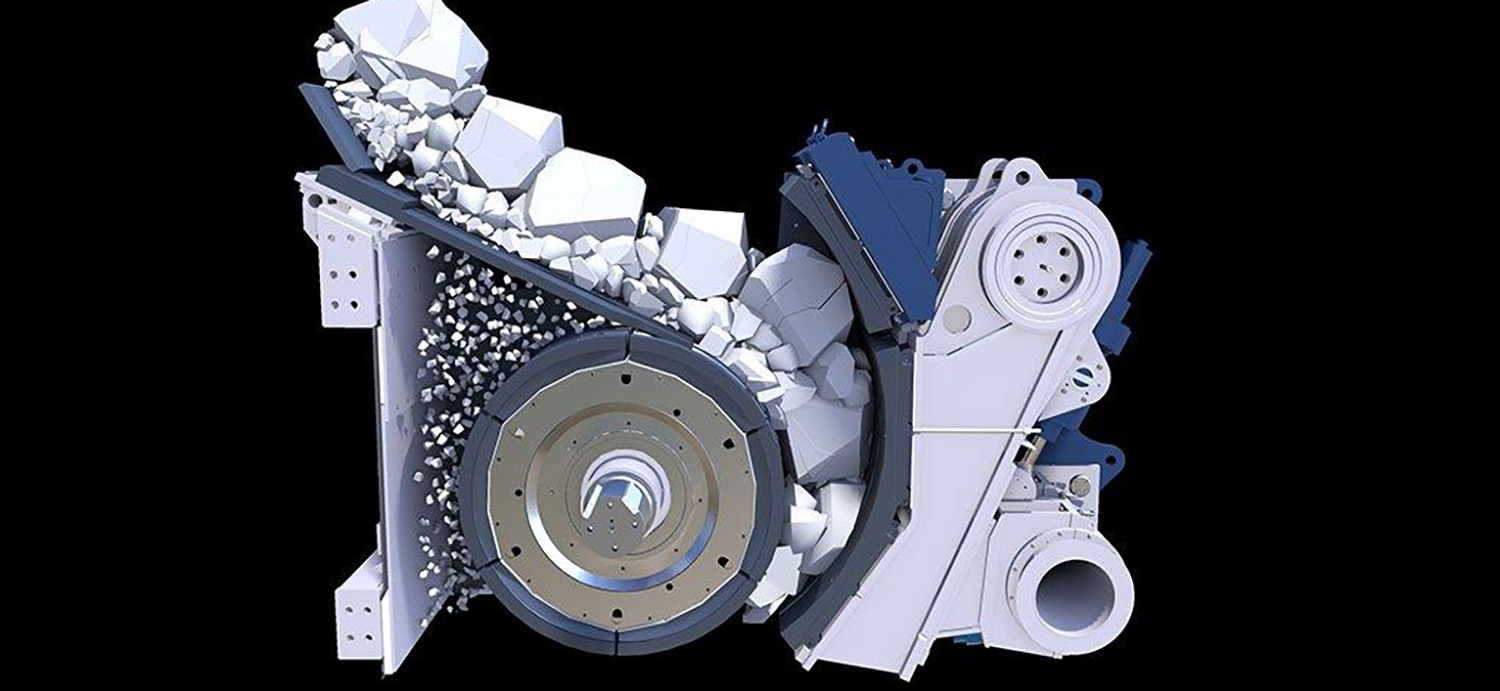
The eccentric roll crusher operates mainly through compression, with additional shear forces occurring during material breakage. Its eccentric shaft drives the crushing roll toward and away from the stationary crushing wall, creating a changing gap that gradually reduces the size of incoming rocks.
The working process of an eccentric roll crusher can be divided into five main stages.
1. Material Feeding and Pre-Screening
Large rocks and run-of-mine ore enter the crusher through the feed opening. A static grizzly screen separates smaller particles from oversized material. Fines that meet the screening requirements bypass the crushing chamber, while larger rocks continue into the primary crushing zone.
2. Eccentric Shaft Rotation
An electric motor transfers power through a belt drive to rotate the eccentric shaft. The shaft generates an eccentric movement that causes the crushing roll to oscillate inside the crusher frame. The roll itself can rotate freely as material passes through the crushing chamber.
3. Crushing Gap Changes
As the eccentric roll moves toward the stationary crushing wall, the gap becomes smaller. As it moves away, the gap becomes larger. This continuous movement creates the compression action required to break large rocks and mineral ore.
4. Compression and Progressive Size Reduction
Material moves downward through the crushing chamber under gravity. As it passes between the roll and the fixed crushing wall, repeated compression and shear forces break the rock into smaller particles.
5. Discharge of Crushed Material
Material that reaches the required discharge size leaves through the bottom of the crushing chamber. It then combines with the pre-screened fines and moves to the next stage of the crushing and screening process.
The combination of eccentric roll movement and integrated pre-screening makes the ERC a distinctive solution for hard rock primary crushing.
Main Advantages of Eccentric Roll Crushers
Why do mining operators consider eccentric roll crushers for hard rock primary crushing? The main advantages are related to their integrated screening design, eccentric crushing motion, compact configuration, and hydraulic adjustment capabilities.
1. Integrated Pre-Screening
The integrated static grizzly screen separates fines before they enter the crushing chamber. This reduces unnecessary size reduction and helps prevent smaller particles from occupying crushing capacity that could be used for oversized material.
2. Designed for Hard Rock Primary Crushing
The eccentric roll crushing mechanism applies strong compression forces to large rocks and mineral ores. It is designed for demanding primary crushing applications involving hard rock and abrasive materials, subject to the equipment's material specifications.
3. Efficient Use of Crushing Energy
The oscillating roll mechanism and the rotational inertia of the roll and flywheels help maintain the crushing process under fluctuating material loads. Together with pre-screening, this can improve energy utilization in suitable applications.
4. Compact Equipment Configuration
By combining crushing and pre-screening functions in one machine, an ERC can reduce the need for separate screening equipment at the primary crushing stage. Its compact configuration can be particularly useful in underground and semi-mobile crushing installations.
5. Hydraulic Gap Adjustment
The hydraulic gap setting system allows operators to adjust the crushing gap according to production requirements. It can also compensate for wear on crushing liners and help maintain the required operating setting.
6. Adaptability to Mining Installations
Depending on the machine model and plant configuration, eccentric roll crushers can be considered for underground mines, open-pit mining operations, and semi-mobile primary crushing systems.
Actual energy consumption, throughput, installation height, and operating costs depend on the machine model, material properties, feed conditions, and the complete crushing circuit. Performance improvements should always be evaluated using application-specific data.
Key Components of an Eccentric Roll Crusher
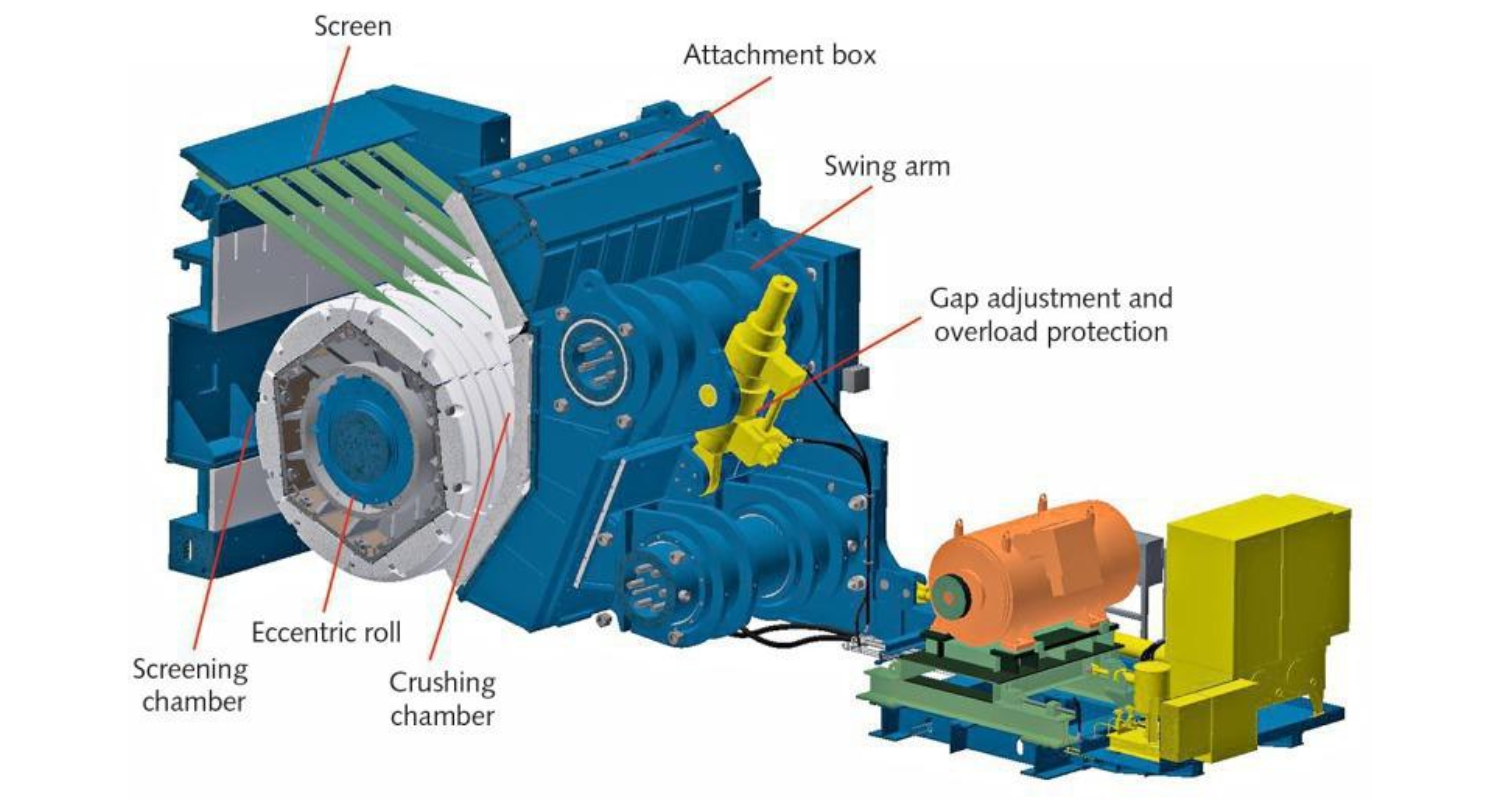
Understanding the main eccentric roll crusher components helps explain how the equipment performs primary crushing and manages heavy operating loads in mining environments.
| Component | Main Function |
|---|---|
| Frame / Housing | Supports the crusher assembly and withstands mechanical loads during crushing operations. |
| Static Grizzly Screen | Separates smaller particles before they enter the crushing chamber, reducing unnecessary crushing. |
| Eccentric Shaft | Generates the eccentric movement that drives the crushing roll toward and away from the stationary wall. |
| Crushing Roll | Works against the stationary crushing wall to compress and break large rocks and ore. |
| Roll Liner | Protects the roll body from direct contact with abrasive materials and withstands wear during crushing. |
| Stationary Crushing Wall | Forms the opposite side of the crushing chamber and provides the reaction surface for compression. |
| Flywheel | Stores rotational energy and helps compensate for load fluctuations during the crushing process. |
| Hydraulic Gap Setting System | Adjusts the crushing gap, compensates for liner wear, and supports the crushing adjustment process. |
| Hydraulic Power Unit | Provides hydraulic power for gap adjustment and, depending on the design, overload protection. |
| V-Belt Drive | Transfers power from the electric motor to the eccentric shaft. |
Among these components, the eccentric shaft, crushing roll, liners, and hydraulic gap adjustment system play particularly important roles in crushing performance and maintenance requirements.
Some mining-grade eccentric roll crushers also feature a hydraulic tramp release system. When uncrushable materials such as large pieces of metal enter the crushing chamber, the system can allow the gap to expand to help reduce the risk of serious mechanical damage. The actual protection mechanism depends on the specific machine design.
What Materials Can an Eccentric Roll Crusher Process?
An eccentric roll crusher is mainly designed for primary size reduction of hard rock and mineral ore. It can be considered for different mining materials, but the suitability of each application depends on rock strength, abrasiveness, feed size, moisture content, and required production capacity.
| Material | Typical Application | Selection Considerations |
|---|---|---|
| Granite | Hard rock quarrying and aggregate production. | High compressive strength and abrasive characteristics. |
| Basalt | Hard rock mining and construction aggregate production. | Rock strength, abrasiveness, and feed size distribution. |
| Gabbro | Hard rock primary crushing. | Material strength and crushing chamber configuration. |
| Iron Ore | Primary size reduction before mineral processing. | Ore hardness, lump size, and moisture content. |
| Copper Ore | Primary crushing in copper mining operations. | Ore characteristics, feed conditions, and required throughput. |
| Other Mineral Ores | Mining and mineral processing applications. | Material testing and equipment-specific performance verification. |
Before selecting an eccentric roll crusher for a mining project, operators should evaluate the following material and production parameters:
- Compressive Strength: The resistance of the rock to crushing forces.
- Abrasiveness: The potential of the material to wear crushing rolls and liners.
- Maximum Feed Size: The largest rock size entering the crusher.
- Feed Size Distribution: The proportion of fines, medium-sized particles, and oversized rocks.
- Moisture Content: The amount of water in the feed material, which can influence screening and material flow.
- Required Capacity: The target production rate, usually measured in tons per hour (TPH).
- Target Discharge Size: The required product size for downstream crushing, conveying, or mineral processing.
These factors help determine whether an eccentric roll crusher is suitable for a particular hard rock crushing application.
What Is the Discharge Size of an Eccentric Roll Crusher?
The main purpose of an eccentric roll crusher is to reduce large run-of-mine rocks into smaller particles suitable for downstream processing. Its output is generally a primary crushed product rather than a finished, precisely graded aggregate.
The discharge particle size is influenced by several operating and material factors:
- Closed Side Setting (CSS): The minimum crushing gap between the roll liner and stationary crushing wall. A smaller CSS generally produces a finer product, although actual results depend on other operating conditions.
- Feed Particle Size: The initial size and distribution of incoming rocks affect the crushing process.
- Rock Properties: Hardness, fracture characteristics, and abrasiveness influence particle breakage.
- Crusher Configuration: The crushing chamber geometry, roll dimensions, and operating conditions affect the final product.
- Pre-Screening: The static grizzly allows suitable fines to bypass the crushing chamber.
One important point is that CSS does not represent the exact size of every discharged particle. The final product size distribution must be verified through material testing and operating data.
After primary crushing, the material may be transported to a secondary crushing stage, screening equipment, or a mineral processing plant, depending on the project requirements.
Where Are Eccentric Roll Crushers Used?
Eccentric roll crushers are primarily associated with mining applications where hard rock and mineral ore require reliable primary size reduction. Their compact design and integrated screening function make them relevant to several types of mining installations.
1. Underground Mining
Underground mines often have strict limitations on installation space, excavation height, and equipment transportation. The compact configuration of an eccentric roll crusher can help simplify primary crushing layouts in suitable underground mining projects.
2. Open-Pit Mining
In open-pit mining, large quantities of run-of-mine ore must be reduced before transportation to downstream processing facilities. An eccentric roll crusher can serve as a primary crushing unit to reduce oversized material into a more manageable size.
3. Hard Rock Quarries
Granite, gabbro, and other hard rocks require suitable primary crushing equipment before secondary crushing and aggregate screening. ERC technology can be evaluated for these applications according to material characteristics and production requirements.
4. Semi-Mobile Crushing Systems
Some mining operations use semi-mobile crushing stations to process material closer to the excavation area. The compact design of an eccentric roll crusher can support integration into selected semi-mobile crushing and conveying systems.
For projects requiring a complete crushing and screening configuration, explore HAMAC's jaw crusher equipment, cone crusher solutions, and mining and crushing plant case studies.
Eccentric Roll Crusher vs. Jaw Crusher vs. Gyratory Crusher
Choosing the right primary crusher is an important decision in mining plant design. Eccentric roll crushers, jaw crushers, and gyratory crushers all use compression-based crushing principles, but their structures and operating characteristics are different.
| Comparison | Eccentric Roll Crusher | Jaw Crusher | Gyratory Crusher |
|---|---|---|---|
| Main Structure | Eccentric roll and stationary crushing wall. | Moving jaw and stationary jaw. | Moving mantle and stationary concave. |
| Crushing Principle | Compression with additional shear forces. | Compression. | Compression. |
| Typical Application | Hard rock and ore primary crushing. | Primary crushing in mining and quarrying. | Large-scale primary crushing in mining. |
| Pre-Screening | Integrated static grizzly in many mining-grade designs. | Usually requires separate screening or grizzly equipment. | Usually requires separate screening or grizzly equipment. |
| Installation | Compact configuration, suitable for selected underground and semi-mobile installations. | Flexible installation options and widely used in stationary and mobile plants. | Commonly used in large-scale fixed primary crushing installations. |
| Key Consideration | Integrated screening and eccentric crushing mechanism. | Mature technology and a wide range of machine sizes. | High-capacity primary crushing for large mining operations. |
Eccentric Roll Crusher vs. Conventional Double Roll Crusher
Although both machines use rollers, they are not the same type of crushing equipment. A conventional double roll crusher generally uses two counter-rotating rolls to pull material into the gap between them. An eccentric roll crusher uses an eccentric shaft to generate oscillating movement of the crushing roll against a stationary crushing wall.
Mining-grade ERC designs also commonly integrate a static grizzly screen and hydraulic gap adjustment features. Conventional double roll crushers are frequently used for softer to medium-hard materials, while ERC technology is specifically developed for demanding hard rock and ore primary crushing applications.
The selection between these machines should be based on material properties, feed size, capacity, product requirements, and the complete plant configuration.
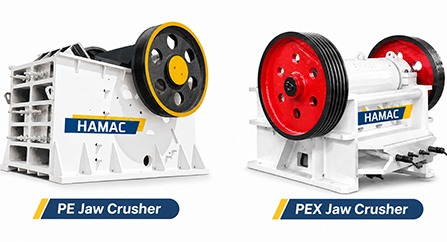
For conventional primary crushing applications, you can also explore HAMAC's PE and European-type jaw crushers.