





How Does a Jaw Crusher Work? Working Principle Explained with Diagrams | HAMAC
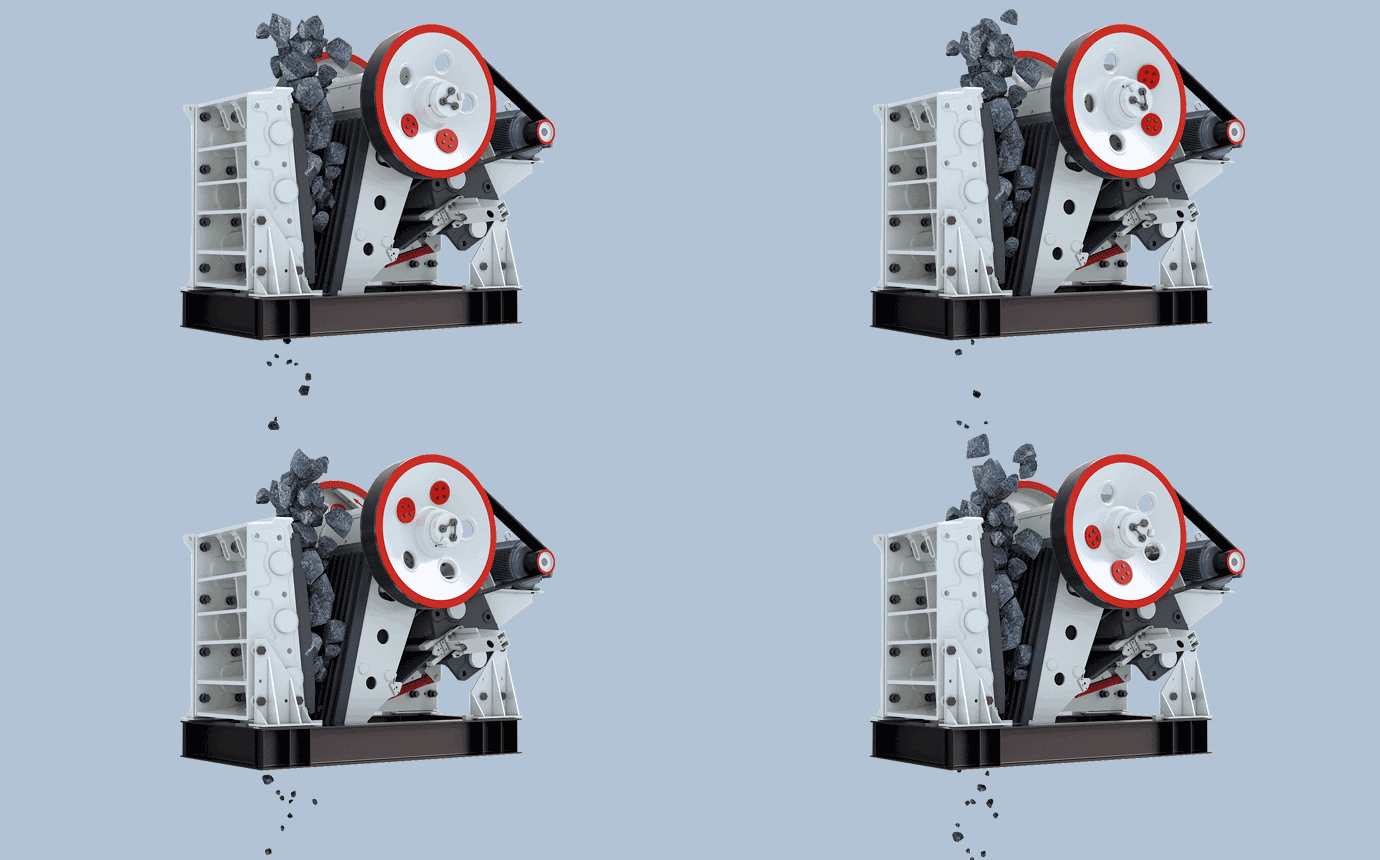
A jaw crusher breaks rock by compression. An eccentric shaft drives a moving jaw toward a fixed jaw, squeezing material inside a V-shaped crushing chamber. Broken pieces move down into the narrower part of the chamber with each stroke, and leave through the bottom opening once they are smaller than the discharge setting.
Because the jaw crusher accepts large feed and is mechanically simple, it is widely used for primary crushing in quarries, mines, aggregate plants and construction-waste recycling. The sections below explain the parts, the crushing cycle, the jaw motion, and how these principles appear in real HAMAC specification tables.
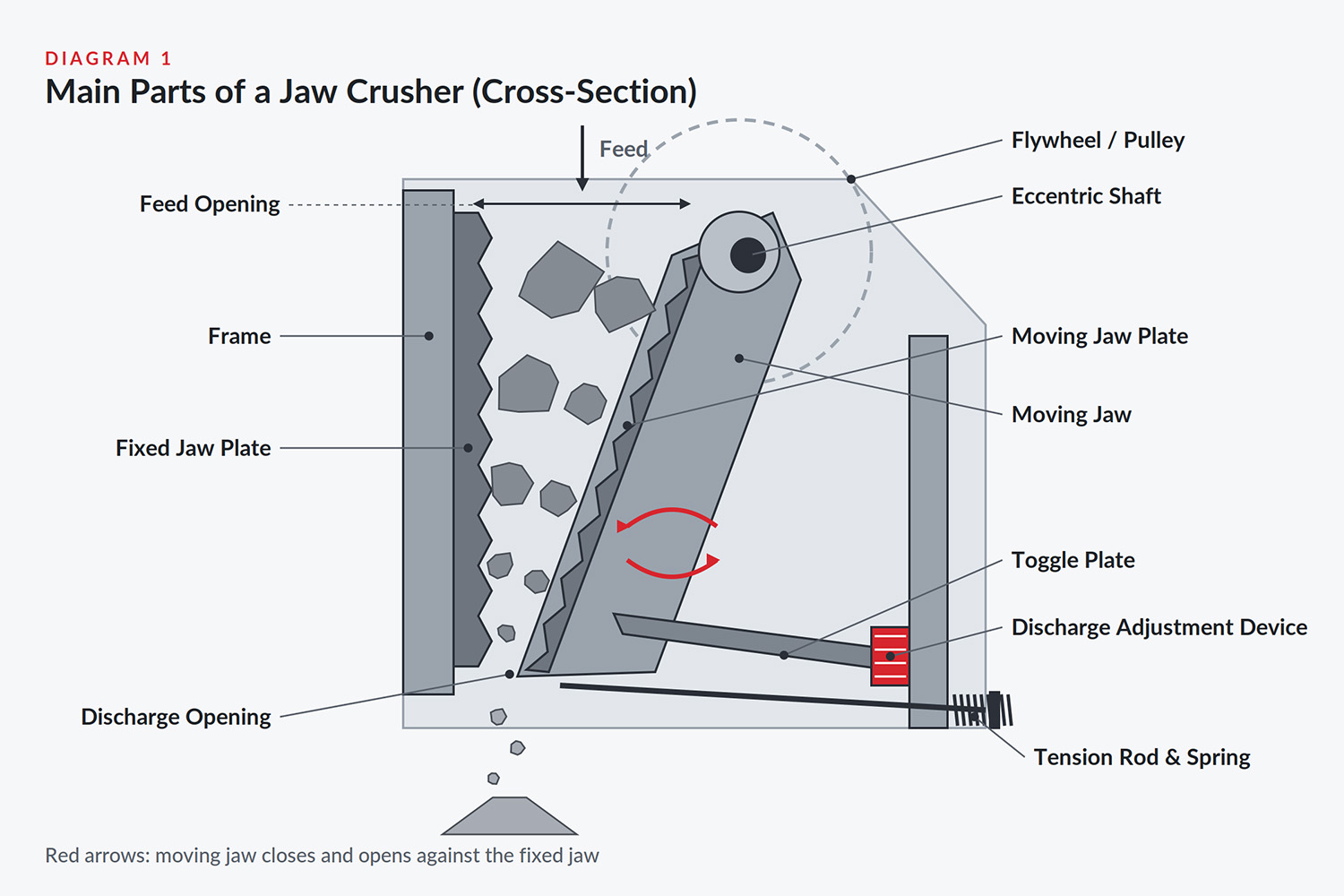
1. Main Parts of a Jaw Crusher and What They Do
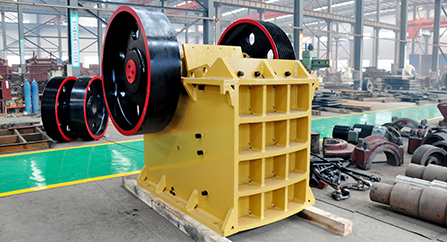
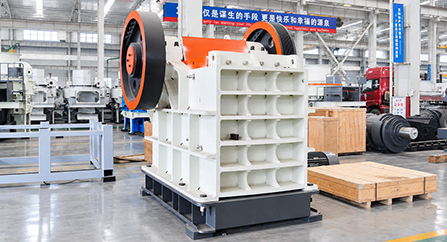
HAMAC lists the main structure of its PE Series Jaw Crusher as the frame, eccentric shaft rotating part, mobile jaw plate, stationary jaw plate, safety device and discharge opening adjustment device.
2. How a Jaw Crusher Works Step by Step
The motor drives the flywheel through V-belts. The eccentric shaft turns, and the moving jaw repeats a cycle of closing and opening against the fixed jaw. Each shaft revolution is one crushing cycle.
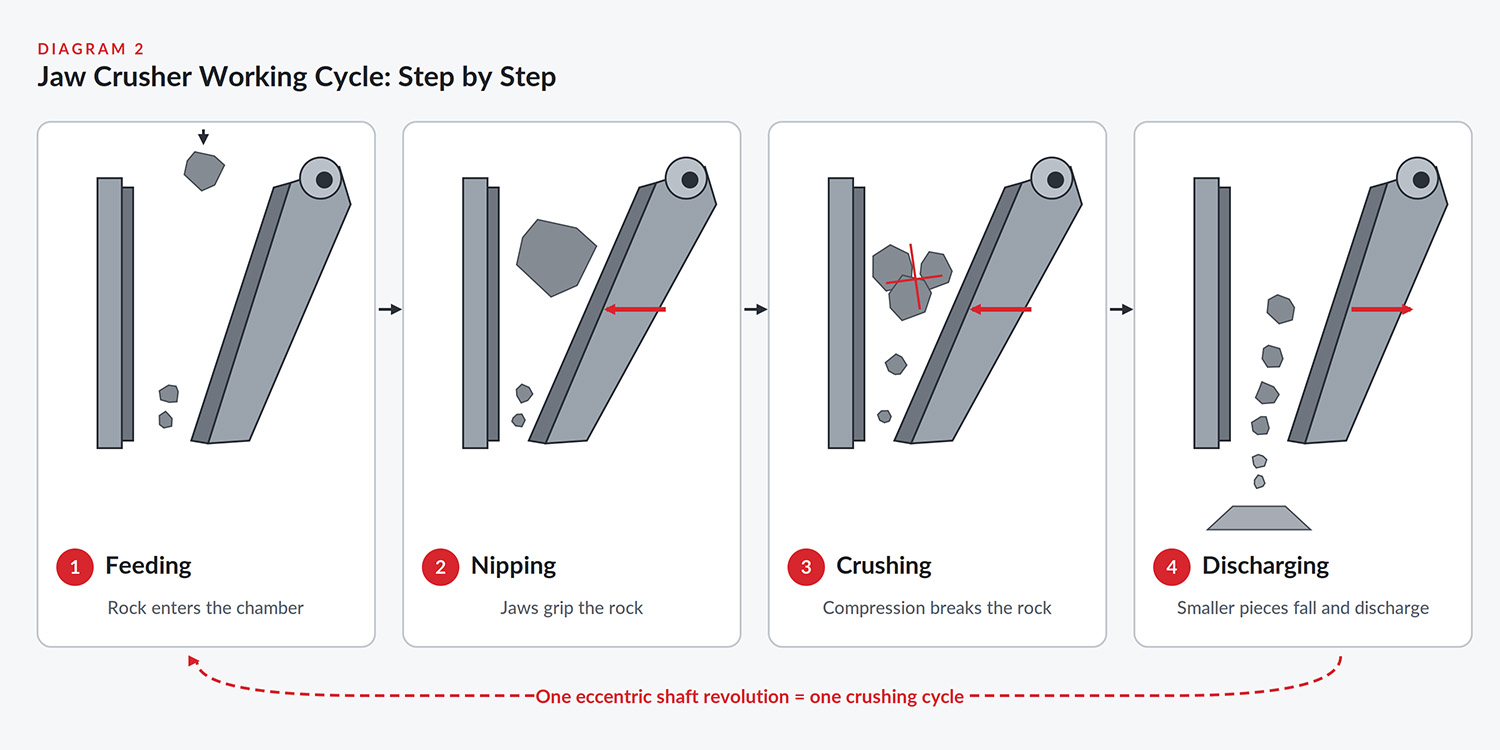
| Step | What Happens in the Chamber |
|---|---|
| 1. Feeding | A feeder delivers rock evenly into the top of the V-shaped chamber, where the gap is widest. |
| 2. Nipping | The moving jaw approaches the fixed jaw and grips the rock between the two plates instead of pushing it upward. |
| 3. Crushing | Compressive force rises until it exceeds the rock's strength. The rock cracks and breaks into smaller pieces. |
| 4. Discharging | On the return stroke, the jaw opens. Broken material falls by gravity to a lower, narrower position, and pieces smaller than the bottom gap leave the crusher. |
A single rock is usually not reduced to its final size in one stroke. It is crushed repeatedly as it moves down the chamber, with each stroke reducing it further, until it can pass the discharge opening.
HAMAC describes this as a curved extrusion crushing method: the motor drives the belt and pulley, the eccentric shaft swings the moving jaw, material is crushed as the moving jaw approaches the fixed jaw, and the crushed material is discharged as the jaw retreats under the action of the eccentric shaft and spring.
The rotation speed sets how often this cycle repeats. HAMAC's European Tech. jaw crusher table lists eccentric speeds from 350 rpm on the 6CX80 to 220 rpm on the larger 6CX125–6CX160 models, which corresponds to roughly 220–350 crushing cycles per minute.
3. Jaw Motion: Single Toggle vs. Double Toggle
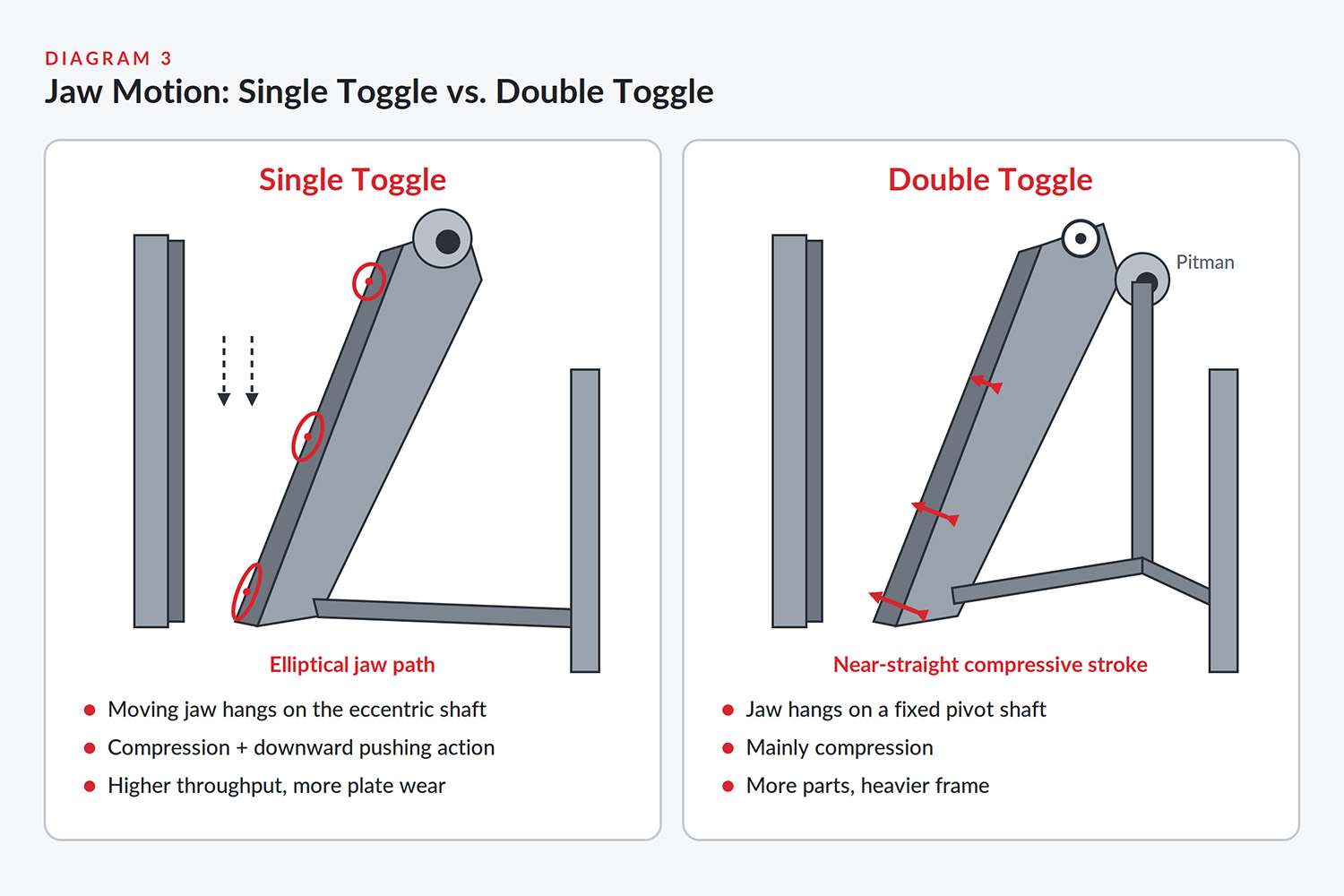
| Feature | Single Toggle Jaw Crusher | Double Toggle Jaw Crusher |
|---|---|---|
| Shaft arrangement | Moving jaw hangs directly on the eccentric shaft at the top | Jaw hangs on a fixed pivot shaft; a separate eccentric drives two toggle plates |
| Jaw motion | Elliptical path: the jaw moves toward the fixed jaw and also up and down | Mainly a back-and-forth stroke perpendicular to the jaw face |
| Forces on material | Compression plus a rubbing, downward-pushing action | Mainly compression |
| Throughput | The pushing action helps move material down, increasing capacity | Lower capacity than a single toggle machine of similar size |
| Jaw plate wear | Rubbing action tends to increase wear on the jaw surfaces | Less rubbing on the plates |
| Structure | Fewer shafts and bearings; lighter and more compact | More moving parts; heavier and larger |
Metso explains that the single toggle's chewing motion compresses material at both the intake and discharge, which gives it better capacity than a double toggle jaw of similar size. See Metso Crushing 101. Research on single toggle force transmission also notes that this rolling elliptical motion improves throughput but tends to accelerate jaw-plate wear: Analysis of the Single Toggle Jaw Crusher Force Transmission Characteristics.
For a more detailed mechanical comparison, read 911Metallurgist: Difference Between Single and Double Toggle Jaw Crushers.
HAMAC's PE and European Tech. jaw crushers use an eccentric-shaft-driven swinging jaw. On the European Tech. model, HAMAC states that the moving jaw moves forward, backward, up and down through the eccentric shaft, which is the combined motion described above.
4. Key Terms: Feed Opening, CSS, OSS, Stroke and Nip Angle
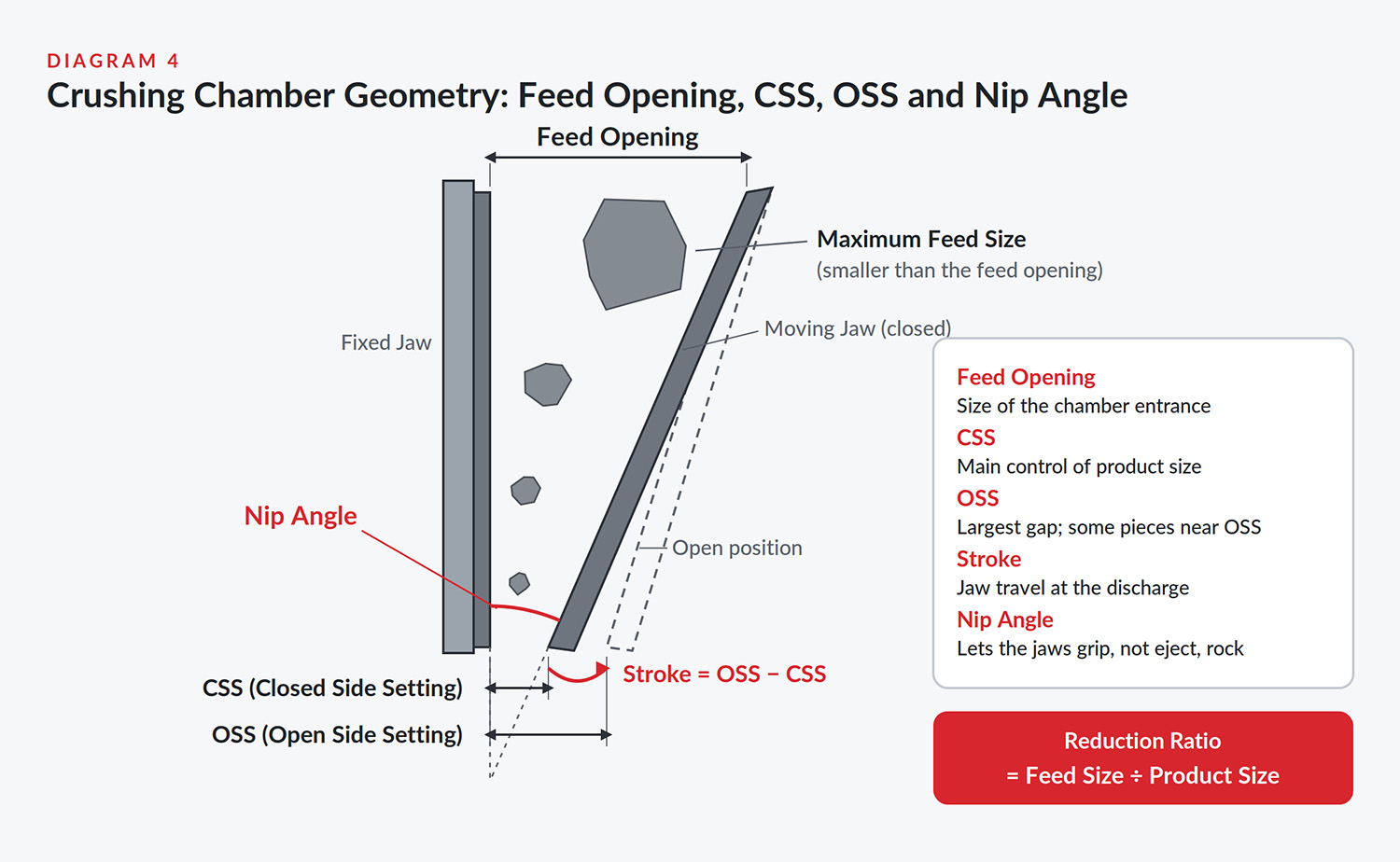
| Term | Meaning | What It Affects |
|---|---|---|
| Feed opening | Width × length of the chamber entrance, such as 600 × 900 mm | The largest rock the chamber can physically receive |
| Maximum feed size | Largest recommended rock size, always smaller than the feed opening | Reliable nipping and blockage prevention |
| Closed side setting (CSS) | Smallest gap at the bottom when the jaw is fully closed | Top size of most of the product; main control of output size |
| Open side setting (OSS) | Largest gap at the bottom when the jaw is fully open | Some product pieces can be larger than CSS, up to near OSS |
| Stroke | Difference between OSS and CSS | Crushing action and throughput |
| Nip angle | Angle between the fixed and moving jaw plates | Whether rock is gripped and crushed or pushed back upward |
Reduction ratio is a simple way to describe how much work one crushing stage does:
Reduction Ratio = Feed Size ÷ Product Size
For example, reducing 500 mm feed to a 100 mm product is a ratio of 5:1. This is an illustration only; the actual product grading depends on rock type, CSS and feed conditions, and a product sample should be checked by sieve analysis.
5. How the Working Principle Shows Up in a Jaw Crusher Specification Table
The following HAMAC PE jaw crusher data shows how feed opening, maximum feed size, discharge range and capacity relate to each other.
| Model | Feed Opening | Maximum Feed Size | Discharge Range | Capacity | Motor Power | Weight |
|---|---|---|---|---|---|---|
| PE500×750 | 500 × 750 mm | 425 mm | 50–100 mm | 40–110 t/h | 55 kW | 11.7 t |
| PE600×900 | 600 × 900 mm | 500 mm | 65–180 mm | 80–180 t/h | 55–75 kW | 16.1 t |
| PE750×1060 | 750 × 1060 mm | 630 mm | 80–180 mm | 110–320 t/h | 90–110 kW | 30.1 t |
| PE900×1200 | 900 × 1200 mm | 780 mm | 95–225 mm | 220–450 t/h | 110–132 kW | 49.0 t |
| PE1200×1500 | 1200 × 1500 mm | 1020 mm | 150–300 mm | 400–800 t/h | 160–220 kW | 100.9 t |
Source: HAMAC PE Series Jaw Crusher technical data.
Three practical points follow from the working principle:
1. The feed opening is not the maximum feed size. On the PE600×900, a 600 mm wide opening corresponds to a 500 mm maximum feed size, because rock must be gripped below the top of the chamber. A 550 mm boulder should not be planned for this model.
2. Capacity is a range because it depends on the discharge setting. A smaller setting produces a finer product but lowers throughput, because material stays in the chamber longer. The upper capacity normally corresponds to a larger setting and suitable feed.
3. Published capacity is a reference, not a guarantee. Rock hardness, abrasiveness, moisture, clay content, feed grading and feeding consistency all change the real output.
HAMAC's PEX series (for example PEX250×1200, 25–60 mm discharge, 20–61 t/h) uses the same principle with a narrow, long chamber for finer secondary jaw crushing.
The HAMAC European Tech. Jaw Crusher applies the same crushing principle with a symmetrical V-shaped chamber, double-wedge discharge adjustment and high-manganese steel jaw plates. Its published capacity is up to 650 t/h with 55–450 kW motor power.
| Model | Feed Opening | Motor Power | Rotation Speed | Jaw Plate Length | Total Weight |
|---|---|---|---|---|---|
| 6CX80 | 800 × 510 mm | 75 kW | 350 rpm | 1100 mm | 7,520 kg |
| 6CX96 | 930 × 580 mm | 75 (90) kW | 300 rpm | 1380 mm | 12,000 kg |
| 6CX106 | 1060 × 700 mm | 110 kW | 280 rpm | 1450 mm | 19,000 kg |
| 6CX125 | 1250 × 950 mm | 160 (132) kW | 220 rpm | 2000 mm | 36,700 kg |
A longer jaw plate gives material more crushing strokes before discharge. Larger machines also run at lower speed, which matches the longer stroke and heavier moving mass.
Frequently Asked Questions
What is the working principle of a jaw crusher?
A jaw crusher crushes rock by compression between a fixed jaw and a moving jaw. An eccentric shaft drives the moving jaw toward and away from the fixed jaw. Rock is crushed on the closing stroke and moves down on the opening stroke until it passes the discharge opening.
What determines the output size of a jaw crusher?
Mainly the closed side setting (CSS), the smallest gap at the bottom of the chamber. Some pieces can approach the open side setting, and rock type, jaw-plate wear and feed conditions also affect the product grading.
What is the difference between single toggle and double toggle jaw crushers?
In a single toggle crusher, the moving jaw hangs on the eccentric shaft and follows an elliptical path, adding a pushing action that increases throughput but can increase plate wear. A double toggle crusher uses a separate pivot shaft and two toggle plates, producing mainly compressive motion with more parts and weight.
Why can't a jaw crusher accept rock as large as its feed opening?
Rock must be gripped below the top of the chamber. If it is too large, it can bounce or bridge instead of being nipped. That is why HAMAC lists a maximum feed size of 500 mm for the PE600×900, below its 600 mm opening width.
Why do jaw plates wear unevenly?
Most crushing and rubbing occurs in the lower part of the chamber, where pieces are smaller and forces concentrate. Uneven feeding across the jaw width also causes localized wear. Regular inspection, even feeding and turning reversible plates help extend service life.
Request a Jaw Crusher Recommendation
Send HAMAC the information below to receive a jaw crusher or primary crushing plant recommendation matched to your material.
| Information to Send | Details |
|---|---|
| Material | Rock type, photos, hardness or abrasiveness, moisture and clay |
| Maximum feed size | Largest rock size in mm |
| Target capacity | Required t/h and working hours per day |
| Product requirement | Required output size or the feed size of the next crushing stage |
| Plant type | Stationary, wheeled, tracked or modular |
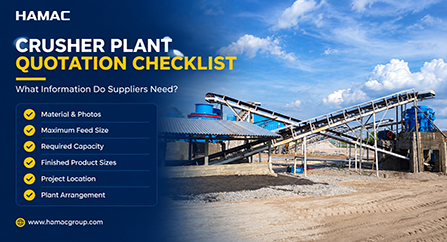
For a complete inquiry list, read the Crusher Plant Quotation Checklist.