



Tracked Mobile Crusher vs. Tyre-Type Mobile Crusher: How to Choose | HAMAC
What Environment Suits a Tracked Mobile Crusher?
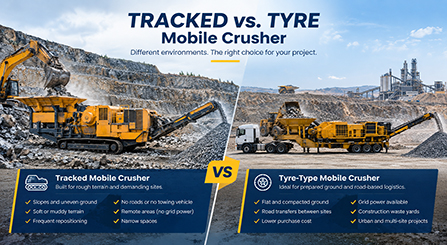
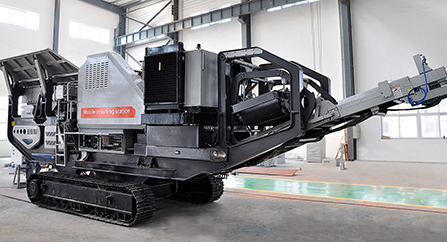
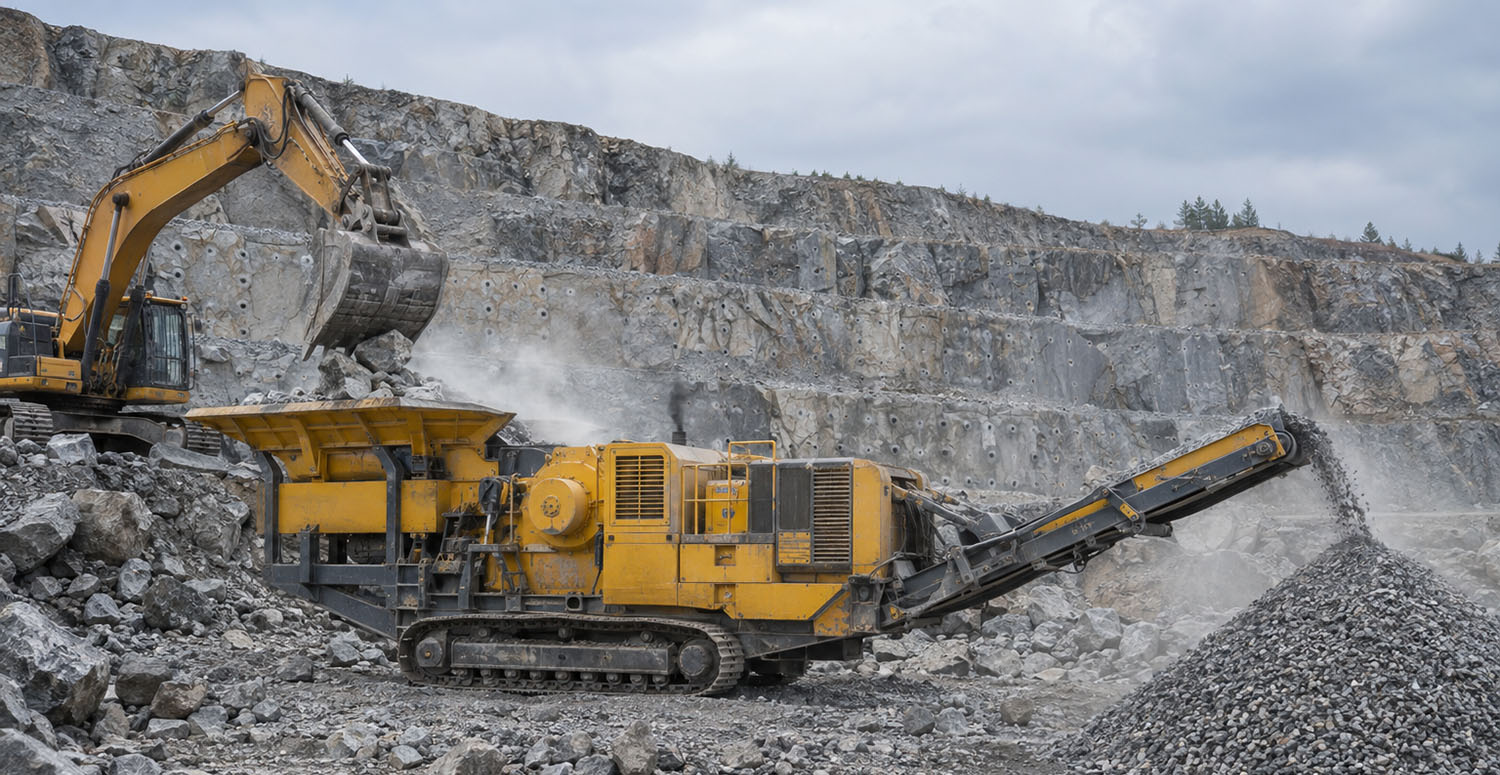
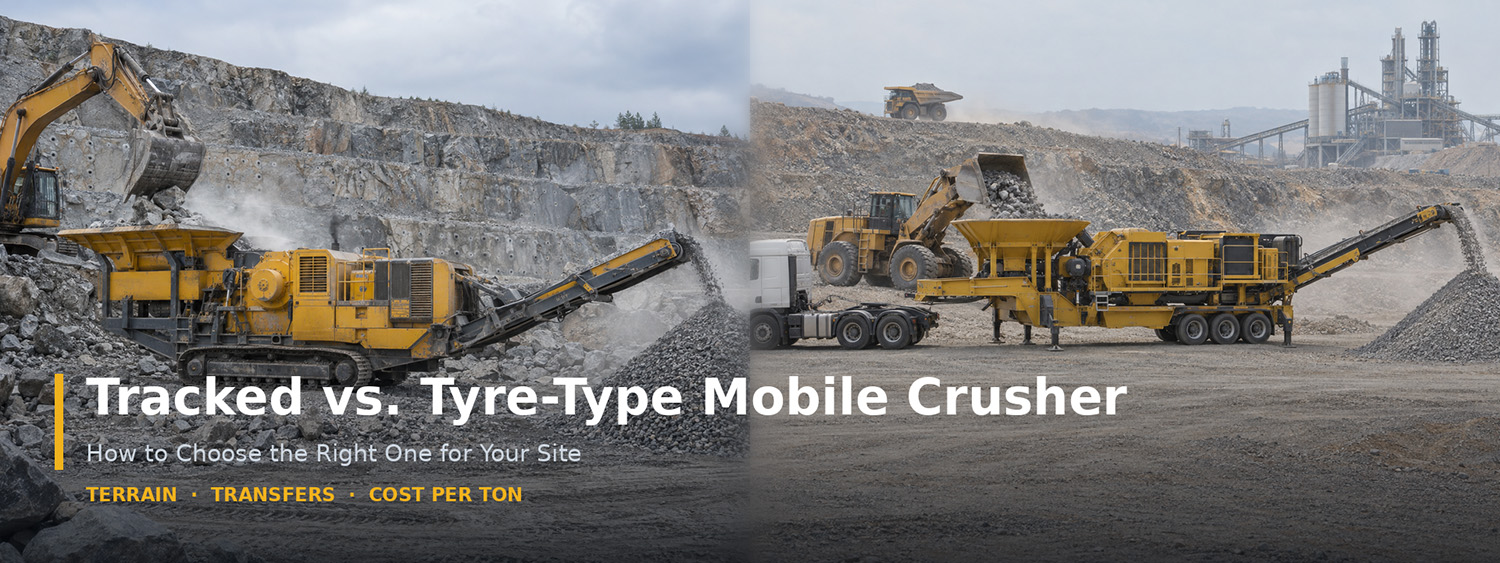
Choosing between a tracked mobile crusher and a tyre-type mobile crusher is really a question about your working environment, not about which machine is "better." A tracked mobile crusher (crawler type) is built for rough ground: it walks on steel crawler tracks under its own hydraulic power, so it goes where towed equipment cannot. Choose a tracked plant when your site looks like this:
| Site Condition | Tracked Crusher Fit |
|---|---|
| Slopes up to 15–25 degrees (quarry faces, mountain roads) | Excellent — crawls and climbs under its own power |
| Soft, muddy or uneven ground | Excellent — low ground pressure (typically 0.05–0.1 MPa) prevents sinking |
| Frequent repositioning inside one site | Excellent — self-propelled, can pivot turn, no tractor needed |
| No prepared roads or no towing vehicle available | Excellent — moves 0.5–2 km/h on its own tracks |
| No grid power | Good — diesel or diesel-electric drive, works remotely |
| Narrow spaces (demolition sites, tunnels) | Good — compact, in-place turning |
Typical homes for a tracked plant: mines, quarry faces, mountainous projects and demolition sites where the crusher follows the material. In our tracked jaw crusher plant line, on-site travel speed is 0.6–1 km/h — slow on purpose, because the point is positioning precision, not road speed.
 What Environment Suits a Tyre-Type Mobile Crusher?
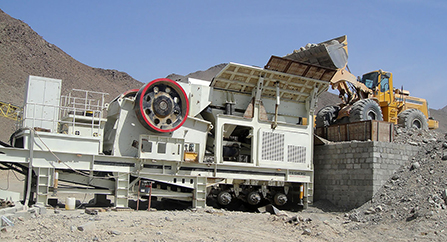
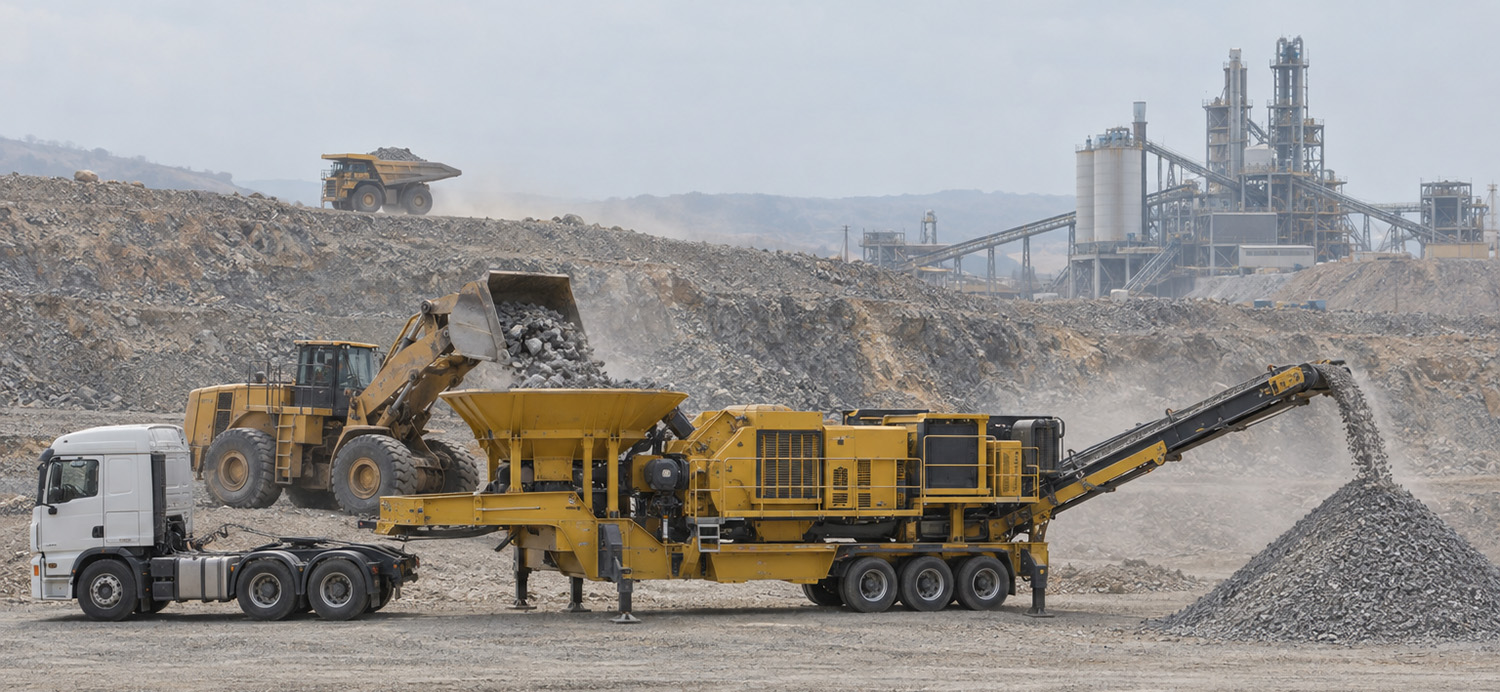
A tyre-type mobile crusher (wheel-mounted, towable) is built for prepared ground and road-based logistics. It rides on a semi-trailer chassis with two or three axles, and a standard truck tractor tows it between sites — including on public roads. Choose a tyre plant when your site looks like this:
| Site Condition | Tyre Crusher Fit |
|---|---|
| Flat, compacted or hardened ground (yards, plants, urban sites) | Excellent — designed for it |
| Frequent transfers between different sites by road | Excellent — towed directly, no low-bed trailer or oversize permit |
| Budget-sensitive projects | Excellent — typically 20–40% lower purchase cost than a comparable tracked unit |
| Grid power available on site | Excellent — can run on external power, cutting energy cost per ton |
| Soft, muddy or steep terrain | Poor — needs site preparation and can lose traction |
| Moving inside a large rough site without roads | Poor — depends on a tractor or loader for every reposition |
Typical homes for a tyre plant: construction waste recycling yards, urban infrastructure projects, road works and multi-site contractors. Our tyre-type mobile jaw crusher plant ships with a magnetic separator and double or triple axles as standard — ready for truck towing between sites.
 How to Choose: A 3-Step Decision Framework
Answer these three questions in order and the choice usually makes itself:
Step 1 — Look at the ground. Slopes over roughly 10 degrees, mud or unpaved surfaces push the decision to a crawler mobile crusher. Flat, hardened sites keep the wheel-mounted mobile crusher option open.
Step 2 — Look at your transfers. If the machine mostly moves inside one site (following the face or the demolition zone), choose tracked. If it mostly moves between sites on roads, choose tyre.
Step 3 — Do the money math. Compare the purchase price gap against the cost of every road move: a tracked unit needs a low-bed trailer and permits for long-distance transport; a tyre unit is towed by an ordinary tractor. Then add operating cost — a tyre plant on grid power usually wins on cost per ton, while a tracked plant saves haul-truck hours by crushing at the source.
| If your project is... | Choose |
|---|---|
| Quarry or mine with rough terrain, moving with the face | Tracked |
| Demolition site with tight access, no roads | Tracked |
| Construction waste yard, flat and road-accessible | Tyre |
| Multiple urban sites, transfers several times a year | Tyre |
| Remote site, no grid power, no towing vehicle | Tracked |
| Budget-first project on prepared ground | Tyre |
Tracked vs. Tyre Mobile Crusher: Full Comparison
| Item | Tracked Mobile Crusher | Tyre-Type Mobile Crusher |
|---|---|---|
| Chassis | All-steel crawler chassis, hydraulic self-propelled | Semi-trailer chassis, truck-towed |
| On-site mobility | Self-propelled, pivot turns, remote control | Needs tractor/loader for every move |
| Long-distance transport | Low-bed trailer + oversize permits | Towed on public roads by standard tractor |
| Travel speed | 0.5–2 km/h on tracks | Road speed of the towing truck |
| Terrain | Soft, muddy, steep (up to ~25°) | Flat, compacted surfaces |
| Setup time | Typically 15–60 minutes, no foundation | Typically 1–2 hours leveling; more if pads are needed |
| Ground pressure | Low (approx. 0.05–0.1 MPa) | Higher, concentrated on axles |
| Initial investment | Higher | Lower — typically 20–40% less |
| Operating cost | Higher fuel use; track wear parts | Lower, especially on grid power |
| Power | Diesel or diesel-electric | Diesel or external electric supply |
| Best for | Mines, quarries, rough and remote sites | Construction waste, urban and multi-site projects |
For background on how these machines fit the wider family of crushing equipment, see this overview of crusher types and principles.
Real Specifications: HAMAC Tracked vs. Tyre Jaw Crusher Plants
Numbers make the comparison concrete. Below are actual specifications from the HAMAC tracked jaw crusher plant line (HMC Series):
| Tracked Model | Jaw Feed Opening (mm) | Capacity (t/h) | Max Feed (mm) | Total Power (kW) | Track Speed (km/h) | Weight (t) |
|---|---|---|---|---|---|---|
| MJ150SE | 800 × 510 | 55–335 | 430 | 94.2 | 0.6–1 | 34 |
| MJ260E | 1060 × 700 | 150–500 | 560 | 146.8 | 0.6–1 | 50 |
| MJ-350E | 1130 × 750 | 160–570 | 630 | 146.8 | 0.6–1 | 54 |
| MJ-450SE | 1200 × 870 | 175–610 | 720 | 185.4 | 0.6–1 | 58 |
And from the HAMAC tyre-type mobile jaw crusher plant line:
| Tyre Model | Jaw Crusher | Capacity (m³/h) | Max Feed (mm) | Axles | Length × Width (mm) |
|---|---|---|---|---|---|
| MJ69 | PE600×900 | 30–85 | 480 | Double | 11097 × 3759 |
| MJC96 | 6CX96 | 60–200 | 500 | Double | 11097 × 3759 |
| MJ750 | PE750×1060 | 72–150 | 630 | Triple | 13300 × 2900 |
| MJC106 | 6CX106 | 100–300 | 650 | Triple | 13300 × 2900 |
Read the two tables together and one thing becomes clear: the tracked chassis does not limit capacity. The top tracked model (610 t/h) out-crushes the top tyre model — what you pay for with tracks is the undercarriage and self-propulsion, not a capacity penalty.
The Cost Calculation: Purchase Gap vs. Transfer Costs
Here is a simple worked example (illustrative numbers — use your own quotes and local rates). Suppose the tracked unit costs USD 100,000 more than an equivalent tyre plant. Your site-to-site transfer costs break down like this:
| Cost Item | Tracked | Tyre |
|---|---|---|
| Long-distance move (each) | Low-bed trailer + permits, e.g. USD 2,000–4,000 | Standard tractor towing, e.g. USD 500–1,500 |
| On-site repositioning | Included — self-propelled | Tractor or loader hours, every move |
| Setup at each new site | 15–60 minutes | 1–2 hours or more |
At 10 road moves per year, the tyre unit might save roughly USD 15,000–25,000 per year in transfer costs — recovering a USD 100,000 purchase gap in 4–7 years. But if your sites are rough, the tyre unit may not work at all, and if your material moves to the crusher (instead of the crusher moving to roads), the tracked unit saves haul-truck hours that dwarf trailer fees. Cost per ton, not purchase price, is the number that decides profitability. For the full price picture, see our guide on how much a mobile crusher costs.
Matching the Crusher to Your Project Type
| Project Type | Recommended | Why |
|---|---|---|
| Quarry / aggregate production | Either — by terrain | Face mining favors tracked; yard-based favors tyre |
| Construction & demolition waste recycling | Tyre (usually) | Flat urban yards, road transfers, grid power |
| Mining and mountainous sites | Tracked | Slopes, soft ground, no roads |
| Road construction projects | Tyre | Long linear sites with road access |
| Equipment rental fleet | Both | Tracked for versatility, tyre for price and resale |
For deeper reading by scenario, see our guides on choosing a mobile crusher for a stone quarry and mobile crushers in construction and demolition recycling.
Common Mistakes When Choosing a Mobile Crusher
Buying by budget instead of by site. The cheapest machine that cannot climb your haul road is the most expensive one you can buy.
Ignoring transport costs. Ten low-bed trailer moves per year can erase the purchase savings of a cheaper tracked unit — or justify the tyre premium.
Overestimating on-site mobility needs. If your plant sits in one yard for two years, you are paying for tracks you never use.
Forgetting ground bearing capacity. A loaded tyre plant concentrates weight on its axles; soft ground that seems "flat enough" can still fail.
Comparing tracked and tyre plants with different crushers. Compare the same host crusher (jaw, impact or cone) on both chassis — see our cone crusher vs. jaw crusher and jaw vs. impact crusher comparisons first.
HAMAC Tracked and Tyre Crusher Lines
Both product lines are available so the choice can follow your project, not our inventory. Tracked: tracked jaw, tracked impact, tracked cone and tracked screening plants — browse all tracked crushing plants. Tyre: mobile jaw, mobile impact, mobile cone and the 4-in-1 crushing and screening plant — browse all wheel-type mobile crushers. Reference installations include a 250 TPH mobile jaw crusher in Oman and a 100–120 TPH mobile crushing and screening plant in Algeria.
Frequently Asked Questions
Which is cheaper, a tracked or a tyre mobile crusher?
Tyre-type plants typically cost 20–40% less to purchase for comparable crushing capacity. Tracked plants repay the difference through on-site flexibility and haul-truck savings in rough-terrain projects.
Can a tracked mobile crusher travel on public roads?
No — it moves at 0.5–2 km/h on its own tracks. Long-distance moves require a low-bed trailer and oversize-load permits.
Can a tyre-type mobile crusher work on soft or muddy ground?
Generally no — it needs flat, compacted surfaces and loses traction on soft ground. Site preparation is possible but usually uneconomical.
Which one is faster to set up?
Tracked plants are typically crushing within 15–60 minutes of arrival with no foundation. Tyre plants usually need 1–2 hours of jacking and leveling, more if pads or ramps are required.
Which type is better for construction waste recycling?
Usually tyre-type: recycling yards are flat, road-accessible and often have grid power. Tracked plants fit demolition sites with rough ground and tight access.
Do tracked crushers produce less capacity than tyre crushers?
No. Capacity depends on the host crusher, not the chassis — HAMAC's largest tracked jaw plant reaches 610 t/h, above the largest tyre model.
Get Help Choosing Your Mobile Crusher
Tell HAMAC your material, site conditions, transfer frequency and target capacity, and our engineers will recommend the right chassis — tracked or tyre — with a configuration and quotation to match. Send your project details through our contact page for a free selection review.