



300 TPH Stone Crushing Plant: Equipment Configuration, Layout and Expansion Guide | HAMAC
Planning a 300 TPH stone crushing plant for a medium-to-large quarry, EPC project, mine-support operation or long-term aggregate supply contract? The right configuration requires more than a crusher with a 300 TPH rating. It must coordinate raw-material supply, crushing, screening, conveyors, product storage, maintenance and future expansion.
This guide explains reference process routes, HAMAC equipment parameters, closed-circuit load, plant layout and expansion planning. The configurations are preliminary engineering references, not fixed equipment packages or production guarantees.
For the broader project-design checklist, read How to Design a Stone Crushing Plant by Capacity: 100 TPH, 200 TPH and 300 TPH.
1. Define the 300 TPH Production Target
First confirm whether 300 TPH means fresh material entering the plant or qualified finished aggregate leaving the plant. Fresh feed, internal circuit flow and saleable production are different quantities. Rejected material, bypass streams, fines and returned oversize must be included in the process balance.
| Design Input | Information to Confirm | Why It Matters |
|---|---|---|
| Material | Limestone, granite, basalt, river stone or another material; hardness, abrasiveness, clay and moisture | Determines the crushing route, wear requirements and screening conditions |
| Feed size | Maximum rock size and typical feed-size distribution | Determines the feeder, primary crusher and need for oversize handling |
| Capacity definition | 300 tonnes per hour of fresh feed or finished saleable products | Determines the mass balance and equipment throughput at each process stage |
| Products | Required sizes, target proportions, end use and local quality standards | Determines crushing stages, screening, shaping and product handling |
| Operating plan | Effective production hours, maintenance periods and expected material variation | Connects hourly output with daily production and delivery commitments |
For example, 300 tonnes per hour of finished aggregate over 8 effective production hours equals 2,400 tonnes per day. This is a planning calculation, not a guaranteed daily output. Scheduled shift hours should not automatically be treated as effective production hours.
2. Reference Process Routes for Limestone and Hard Rock
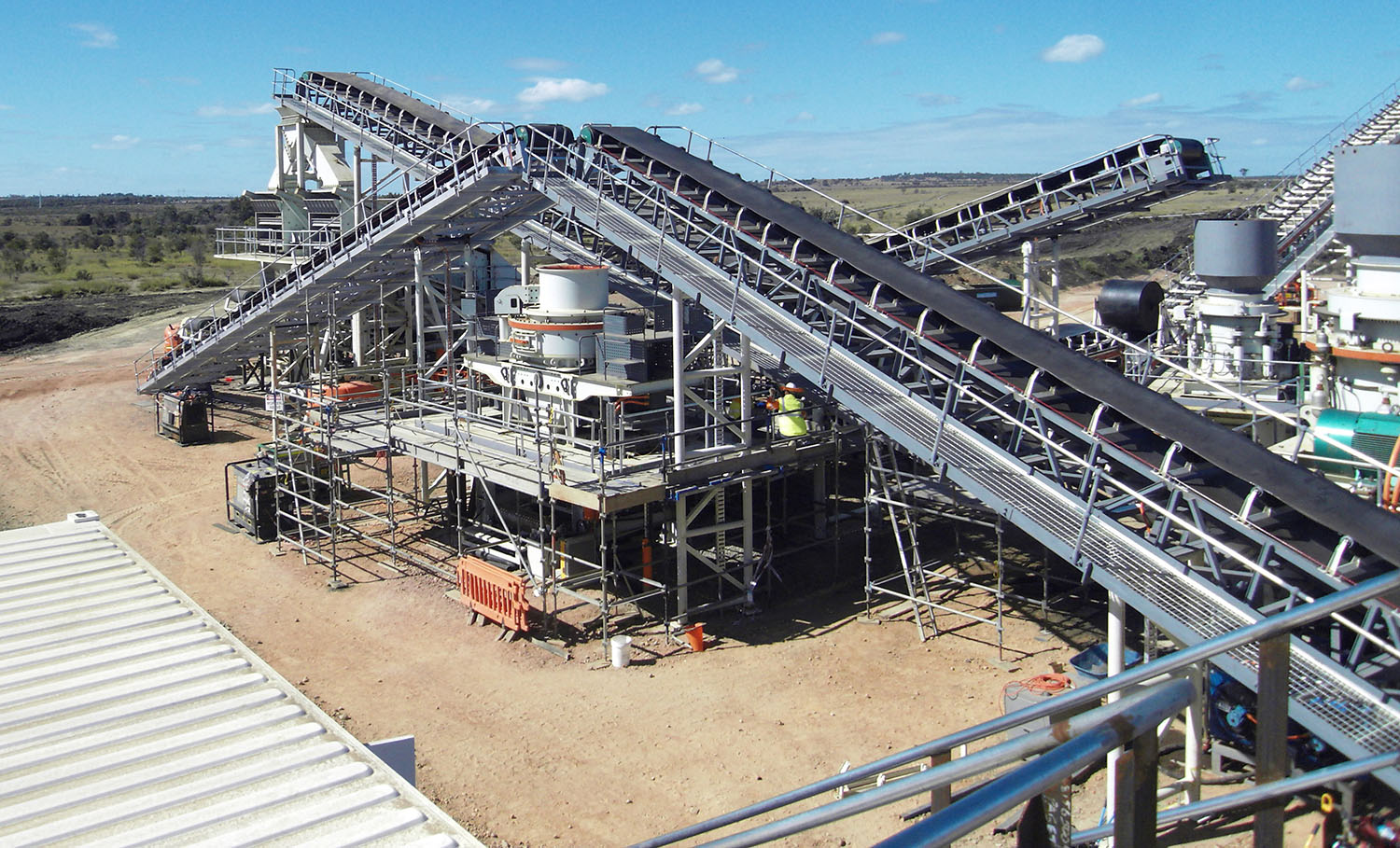
Choose the crushing process around the material and products, not capacity alone. Medium-to-low abrasiveness limestone projects can evaluate an impact-crusher route, while granite, basalt and abrasive hard-rock projects commonly evaluate cone crushing after the primary jaw crusher.
| Project Type | Reference Process | Main Engineering Focus |
|---|---|---|
| 300 TPH limestone crushing plant | Hopper → Feeder / Pre-screen → Jaw Crusher → Impact Crusher → Screen → Product Conveyors | Material abrasiveness, aggregate shape, fines production, moisture and secondary-crusher wear |
| 300 TPH granite or basalt crushing plant | Hopper → Feeder / Pre-screen → Jaw Crusher → Cone Crusher → Screen → Product Conveyors | Primary discharge, cone chamber, discharge setting, liner wear and circuit load |
| Fine aggregate or manufactured-sand extension | Selected Material → Additional Crushing or VSI Shaping → Fine Screening → Optional Washing | Required sand proportion, grading, particle shape, fines and water-management requirements |
Oversized material can return from the screen to the secondary crushing stage. A third crushing stage is not mandatory simply because the plant target is 300 TPH. Add another stage when feed reduction, product shape, sand demand or circuit balance requires it.
Pre-screened material also needs a defined destination. Depending on its size and cleanliness, it may bypass primary crushing, enter another processing stage or be rejected. Do not automatically mix clay-rich pre-screened material into finished aggregate.
3. Reference Equipment Table for a 300 TPH Hard-Rock Plant
The following table is a preliminary configuration for granite, basalt or similar hard rock. It assumes approximately 300 TPH of fresh feed and a maximum feed size not exceeding 650 mm. Example products are 0–5 mm, 5–10 mm, 10–20 mm and 20–31.5 mm, subject to local market requirements.
If the target is 300 TPH of qualified finished products, the feed requirement and equipment selection must be recalculated. Published catalogue ranges do not confirm output at a particular crusher setting or with a particular rock.
| Process Stage | Candidate Equipment | Quantity Basis | Published Reference Data | Engineering Check |
|---|---|---|---|---|
| Raw-material receiving | Hopper or receiving bin | One receiving system, subject to layout | Volume and structure to be designed | Truck payload, unloading cycle, loader operation and required buffer |
| Feeding and pre-screening | ZSW4911 Vibrating Feeder | One candidate unit | 1100 × 4900 mm; maximum feed 650 mm; capacity 250–480 t/h; power 22 kW | Controlled feed rate, material grading, pre-screen separation and crusher compatibility |
| Alternative feeding assessment | ZSW4913 Vibrating Feeder | Alternative, not an additional mandatory unit | 1300 × 4900 mm; maximum feed 750 mm; capacity 340–600 t/h; power 22 kW | Assess for different feed conditions; suitability at the required controlled rate must be confirmed |
| Primary crushing | PE900×1200 Jaw Crusher | One candidate unit | Feed opening 900 × 1200 mm; maximum feed 780 mm; listed output range 95–225 mm; capacity 220–450 t/h; power 110–132 kW | Hard-rock capacity at the selected discharge setting and compatibility with the secondary crusher |
| Interstage buffer | Surge bin and controlled feeding equipment | Evaluate according to circuit arrangement | Size and equipment to be designed | Stabilize secondary feed where needed without creating restricted flow or maintenance problems |
| Secondary / fine crushing | Cone crusher; model and chamber to be confirmed | One or multiple units after circuit calculation | No fixed model or power assigned at this stage | Primary discharge, product target, abrasiveness, chamber selection and combined new-feed / return load |
| Product screening | 4YK2160 or 4YK2460 Vibrating Screen | Start with an assessment; final number depends on screening calculation | 4YK2160: 4 decks, listed area 12.6 m², 85–700 m³/h, 37 kW. 4YK2460: 4 decks, listed area 14.4 m², 100–800 m³/h, 37 kW | Screen openings, actual incoming volume, moisture, near-size material and required separation efficiency |
| Oversize return | Return conveyor and transfer chutes | According to the closed circuit | Width, speed, length and power to be designed | Expected and peak return flow, chute loading and maintenance access |
| Finished-product handling | Separate product conveyors and stockpiles | According to product streams | Conveyor and storage requirements to be designed | Individual product flow, stockpile capacity, segregation and loading routes |
| Controls and environmental systems | Electrical controls, dust-control measures and utilities | Project-specific system | Scope and power to be confirmed | Equipment sequencing, interlocks, dust sources, drainage and local requirements |
Review the original HAMAC specifications for the ZSW vibrating feeder, PE Series Jaw Crusher and YK vibrating screen.
Feed limits must be checked across the complete front end. For example, the PE900×1200 has a published maximum feed size of 780 mm, but a ZSW4911 feeder limits this reference arrangement to 650 mm unless the feeding equipment is changed and the revised system is approved.
The jaw crusher's listed output range must not be treated as a complete discharge particle-size distribution. Secondary crusher selection requires the expected top size, grading and flow at the chosen operating setting.
4. Balance Screening, Return Load and Product Storage
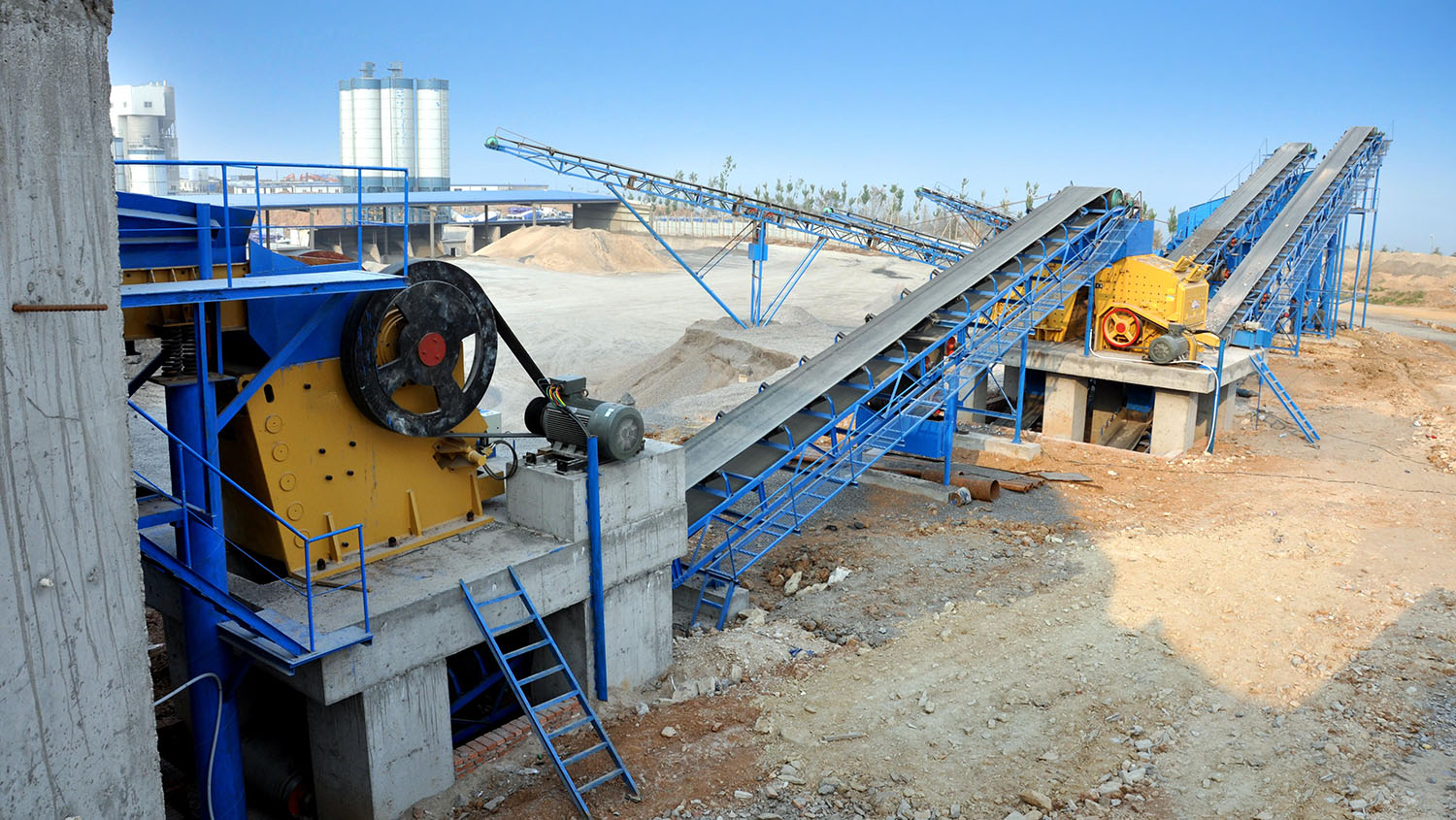
A closed-circuit plant may process more material internally than its fresh-feed capacity. If a secondary circuit receives 300 TPH of new material and 90 TPH of returning oversize, equipment receiving both streams must be assessed for approximately 390 TPH.
Circuit Load = New Material Entering the Circuit + Returning Oversize
The 90 TPH return stream is an illustrative assumption, not a standard return rate. Actual values require a mass balance that includes pre-screen bypasses, product separation and rejected material.
Also distinguish mass capacity from volumetric capacity. HAMAC screen capacities are published in m³/h, not t/h:
Mass Flow (t/h) = Volume Flow (m³/h) × Bulk Density (t/m³)
This conversion does not establish screening performance. Screen selection still requires the target openings, particle-size distribution, near-size fraction, moisture and separation requirements. HAMAC describes the YK screen application as suitable for material moisture below 5%; wetter or sticky feeds require a specific suitability review rather than assuming the same performance.
For conveyors, HAMAC lists belt widths of 500, 650, 800, 1000, 1200 and 1400 mm. Width alone is not a capacity specification: belt speed, loading cross-section, bulk density, incline, lump size and transfer design must be checked for each stream. See HAMAC belt conveyor information.
Specify the target proportion of each finished product. A circuit supplying mostly coarse aggregate can differ from one targeting a high fine-aggregate or manufactured-sand proportion. Screened 0–5 mm material should not automatically be called compliant manufactured sand without checking the applicable grading, shape and fines requirements.
Plan separate stockpiles and loading routes around product demand, inventory strategy and dispatch capacity. Storage should support the supply contract without causing product mixing or excessive rehandling.
5. Design the Layout for Operation and Maintenance
A practical 300 TPH crusher plant layout must support material flow, equipment servicing and safe vehicle movement. Do not minimize the footprint at the expense of inspection, lifting access or product handling.
| Layout Zone | Planning Requirement |
|---|---|
| Raw-material receiving | Provide truck or loader access, controlled unloading, suitable hopper placement and oversize-handling arrangements |
| Crushing and buffer areas | Allow inspection, wear-part replacement, lifting access and safe access to feeders, crushers and bins |
| Screening and return circuit | Provide screen-media replacement access, manageable transfer heights and access to return chutes and conveyors |
| Product storage and dispatch | Separate grades, plan stockpile capacity and avoid conflicts between loading vehicles and process equipment |
| Utilities and environmental systems | Plan power distribution, controls, water supply, drainage and dust-control interfaces |
| Expansion areas | Reserve practical equipment positions, conveyor connections and maintenance routes for future stages |
Dust-control planning should cover receiving areas, crusher feed and discharge, screens, conveyor transfers and stockpile discharge points. Select suppression, enclosure or extraction measures according to the material, product-moisture limits and local requirements.
There is no universal land-area or total-power figure for a 300 TPH aggregate plant. Calculate these from the confirmed equipment arrangement, conveyor distances, storage strategy, foundations, terrain and optional process stages.
For an external industry perspective on bottlenecks, maintenance access and future flexibility, read Mellott's crushing plant design considerations.
6. Plan Capacity and Product Expansion Separately
Expansion can mean processing more fresh feed, producing more fine aggregate, adding a new product grade or improving product quality. These goals do not necessarily require the same equipment changes.
| Expansion Goal | Systems to Review |
|---|---|
| Increase fresh-feed throughput | Quarry supply, receiving capacity, feeder, primary crusher, downstream circuits and conveyors |
| Increase fine aggregate or sand production | Additional crushing or shaping, fine screening, fines control and optional washing |
| Add another product grade | Screening arrangement, chutes, product conveyors, stockpile space and dispatch |
| Improve continuity during maintenance | Buffer strategy, spare parts, maintenance scheduling and any justified alternative processing route |
| Upgrade automation | Instrumentation, electrical interfaces, control logic and equipment communication |
Before approving an expansion, identify the next bottleneck and confirm which existing assets can be retained. Reserve space, power and conveyor interfaces, but do not claim that a 300 TPH configuration can reach a higher fixed capacity without further engineering checks.
For EPC projects, document the current scope and future interfaces separately. State who supplies foundations, structural supports, electrical installation, utilities, dust control, commissioning and performance testing.
7. Request a Project-Based 300 TPH Plant Proposal
To obtain a useful 300 TPH stone crusher plant quotation, provide a consistent design basis and compare the complete supply scope rather than only the crusher price.
| Information to Send | Details |
|---|---|
| Material information | Rock type, photos, test results where available, hardness, abrasiveness, moisture and clay |
| Feed conditions | Maximum size, typical grading, unloading method and expected supply variation |
| Production target | Fresh feed or saleable output; effective hours and daily delivery target |
| Products | Sizes, target proportions, end uses and required quality standards |
| Site information | Country, site plan, terrain, power, water, drainage and environmental requirements |
| Project scope | Equipment, structures, controls, installation, commissioning, training and initial spare parts |
| Expansion plan | Future capacity, additional products, planned sand production and construction phases |
Planning a 300 TPH hard-rock quarry, EPC package or long-term aggregate production project? Send HAMAC your material information, maximum feed size, product specifications and site plan for an equipment configuration, layout and expansion review.
Request a HAMAC 300 TPH Stone Crushing Plant Configuration and Quotation