





Dust Control for Stone Crusher Plants: Engineering Solutions and Compliance Guide | HAMAC
When a stone crusher plant creates visible dust at the hopper, crusher, screen, conveyor transfer point or stockpile, the problem is more than housekeeping. Dust can affect worker health, plant reliability, aggregate quality, nearby communities and compliance with local environmental requirements.
A practical dust-control system should be designed as part of the crushing and screening process. It should control dust at the source while allowing the plant to maintain stable capacity, screening efficiency and saleable aggregate quality.
HAMAC provides stationary crushing plants, mobile crushing plants, jaw crushers, impact crushers, cone crushers, vibrating screens, vibrating feeders and belt conveyors. These systems can be configured with dust-control measures based on the raw material, capacity, site layout and local project requirements.
Where Does Dust Come From in a Stone Crusher Plant?
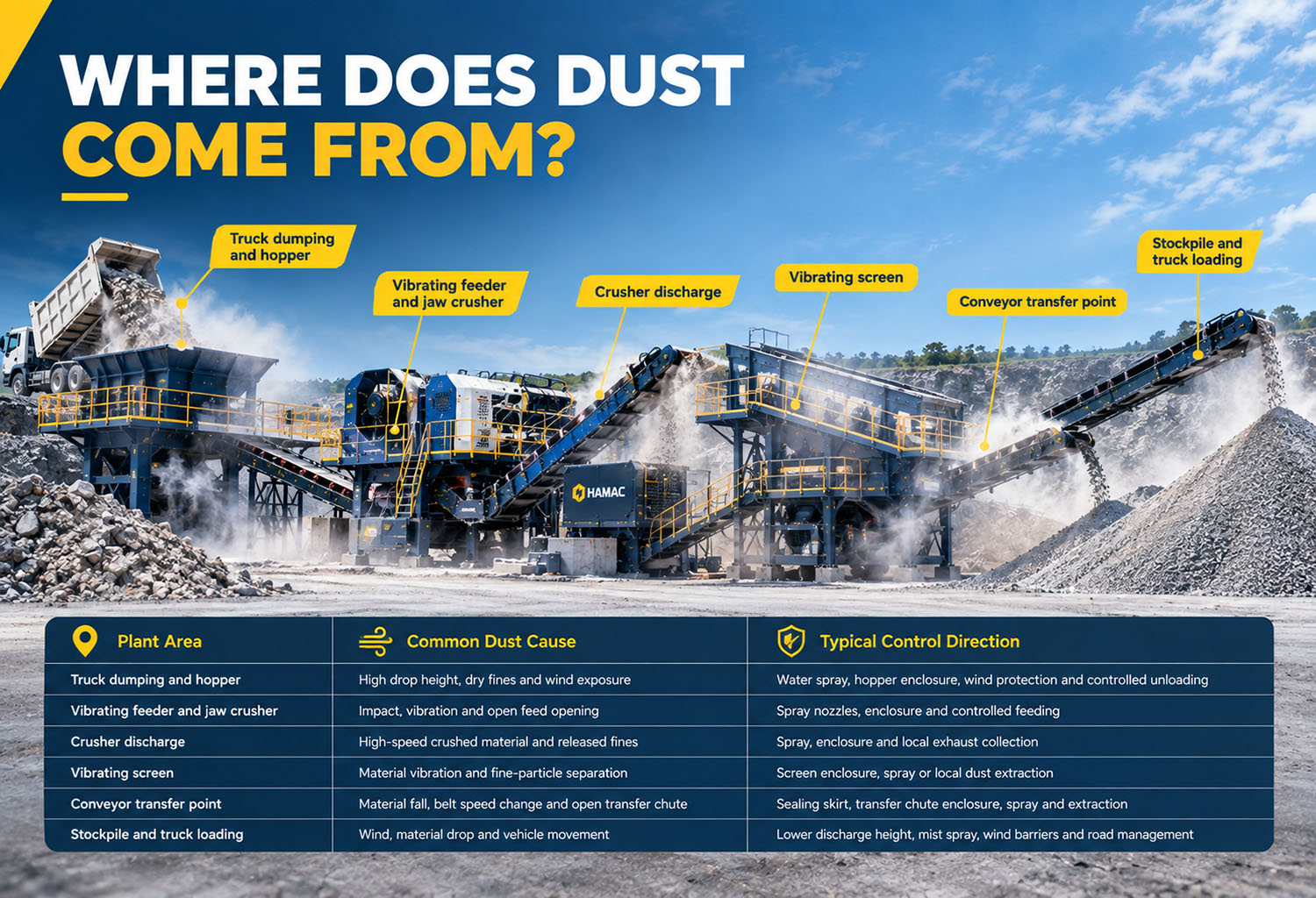
Dust is generated when dry material falls, impacts, vibrates, is crushed, screened or transferred. The main dust sources are often not only the crusher itself. Conveyor transfer points, vibrating screens, stockpile discharge points and truck loading areas can create significant visible dust when they are not properly controlled.
| Plant Area | Common Dust Cause | Typical Control Direction |
|---|---|---|
| Truck dumping and hopper | High drop height, dry fines and wind exposure | Water spray, hopper enclosure, wind protection and controlled unloading |
| Vibrating feeder and jaw crusher | Impact, vibration and open feed opening | Spray nozzles, enclosure and controlled feeding |
| Crusher discharge | High-speed crushed material and released fines | Spray, enclosure and local exhaust collection |
| Vibrating screen | Material vibration and fine-particle separation | Screen enclosure, spray or local dust extraction |
| Conveyor transfer point | Material fall, belt speed change and open transfer chute | Sealing skirt, transfer chute enclosure, spray and extraction |
| Stockpile and truck loading | Wind, material drop and vehicle movement | Lower discharge height, mist spray, wind barriers and road management |
For crusher operations, the U.S. Occupational Safety and Health Administration identifies hoppers, conveyors, sieve or vibrating components, and discharge points as key locations where water spray or mist can be applied to control dust at the generation point. Read the OSHA crushing-machine dust-control fact sheet.
Start With a Dust-Control Plan
Do not select a water spray system or baghouse only because it is the lowest-cost item in a quotation. First identify where dust is generated, which workers are exposed, whether water is available, whether the plant is stationary or mobile, and whether finished aggregate must remain relatively dry.
A complete crusher plant dust-control plan normally includes four steps:
1. Identify dust points: hopper, feeder, primary crusher, secondary crusher, screen, conveyor transfer points, stockpile and loading areas.
2. Check material conditions: rock type, moisture, clay content, fines content, feed size, abrasiveness and required final product sizes.
3. Select engineering controls: water spray, dry fog, enclosure, conveyor sealing, local exhaust, baghouse filtration or a combined system.
4. Define operating and maintenance actions: nozzle inspection, water pressure check, filter cleaning, fan inspection, chute sealing, housekeeping and operator training.
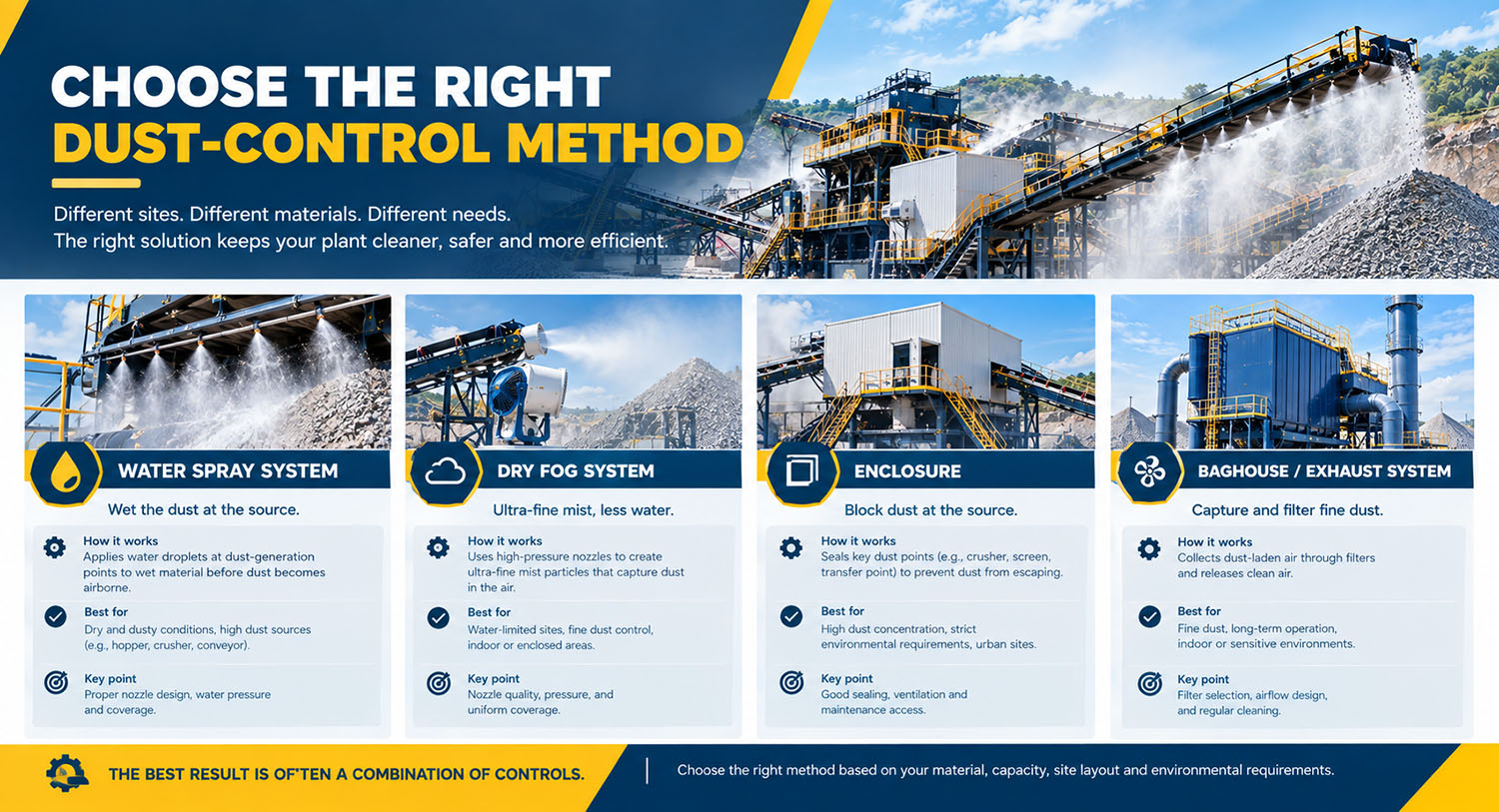
The best solution is usually a combination of controls. For example, a crusher discharge point may use water spray to suppress dust at the source, enclosure to prevent dust escape, and local exhaust collection where dry conditions or strict site requirements make additional capture necessary.
Wet Dust Suppression vs. Dry Dust Collection
| Solution | How It Works | Suitable Conditions | Key Engineering Point |
|---|---|---|---|
| Water spray system | Applies water droplets at dust-generation points to wet material before dust becomes airborne | Common aggregate plants with available water supply | Control water volume to avoid wet product and screen blinding |
| Fine mist or dry fog | Uses fine droplets to capture airborne dust with less added water | Plants that need lower water addition or have fine dust at transfer points | Correct nozzle position, droplet size and wind protection are important |
| Enclosure and sealing | Contains dust inside hoppers, chutes, screens and transfer points | High-dust areas, windy locations and enclosed process zones | Allow access for inspection, maintenance and blockage removal |
| Local exhaust and baghouse | Captures dust through hoods, ducts, fans and filters before clean air is discharged | Dry plants, enclosed buildings and projects with higher dust-control requirements | Airflow, hood design, duct layout, filter area and maintenance must match plant capacity |
| Combined dust-control system | Combines spray, enclosure, sealing and dry collection | Large crushing and screening plants or sites with strict environmental requirements | Use control interlocks with crusher, feeder, screen and conveyor operation |
Water spray or mist is often the first engineering control at open dust-generation points. OSHA recommends locating nozzles upstream of the dust-generation point, positioning them to thoroughly wet material, and ensuring that droplets provide full coverage without being carried away by wind.
OSHA identifies an optimal water-droplet range of approximately 10 to 150 μm for crusher dust suppression. Actual nozzle selection, water pressure and water flow must be determined according to material condition, plant layout, wind, crusher capacity and product moisture requirements. See OSHA guidance on wet methods for crushing machines.
Dust Control by Process Area
Hopper and feeder: Install spray nozzles where material enters the hopper or feeder. Reduce unnecessary fall height where possible. For dry fines or windy areas, use side panels, hopper covers or wind barriers to reduce dust escape.
Primary crusher: Place dust-control nozzles before the jaw crusher feed opening and at the crusher discharge point. The spray should wet the material, not flood it. Excess water can increase moisture in the final product and may affect downstream screening.
Secondary crusher and vibrating screen: Impact crushers, cone crushers and screens can generate fine dust at discharge and classification points. Consider screen covers, enclosed chutes, spray nozzles and local extraction where material is dry or fine.
Conveyor transfer points: Use properly designed transfer chutes, rubber sealing skirts and enclosed covers to reduce air movement and material leakage. Apply spray at the point where material changes direction or falls onto the receiving belt.
Stockpiles and loading areas: Keep discharge height as low as practical, manage vehicle speed on unpaved roads, and use mist spray or wind protection where the local site condition requires it.
For general crushing equipment selection and process planning, visit HAMAC Crushing and Screening Solutions.
Technical Parameters That Matter
A dust-control proposal should include more than the phrase “water spray system” or “dust collector.” Buyers should request technical details that show whether the system matches the crushing plant capacity and dust-generation points.
| Technical Item | What to Confirm | Why It Matters |
|---|---|---|
| Plant capacity | Target output in TPH, such as 100 TPH, 200 TPH or 300 TPH | Dust-control coverage must match actual material throughput |
| Number of dust points | Hopper, crusher feed, crusher discharge, screens, conveyors and stockpiles | Prevents important emission points from being omitted |
| Water droplet range | Spray system droplet size and nozzle type | Fine droplets can improve dust capture, but the system must still wet material effectively |
| Water pressure and flow | Required pressure, water consumption and pump capacity | Ensures stable spray coverage at all operating points |
| Enclosure coverage | Which chutes, screens, conveyors and discharge points are enclosed | Reduces wind effects and helps contain dust near the source |
| Dust collector airflow | Hood design, duct diameter, airflow rate, fan and filter specification | Dry collection only works when capture velocity and airflow are correctly designed |
| Filter monitoring | Differential-pressure monitoring, cleaning system and dust discharge method | Helps maintain baghouse performance and identify blockage or filter problems |
| Automatic control | Interlock with feeder, crusher, screen and conveyor start/stop signals | Avoids running pumps or fans unnecessarily and improves operating discipline |
For enclosed operator cabs or control booths, NIOSH research reports that upgraded cab systems reduced internal dust levels by 65% to 95% compared with outside conditions. NIOSH also notes that positive cab pressure above 0.01 inches of water gauge and high-efficiency intake filtration are important design factors for reducing dust penetration. Read NIOSH best practices for dust control in crushing facilities.
Dust Control for Mobile Crusher Plants
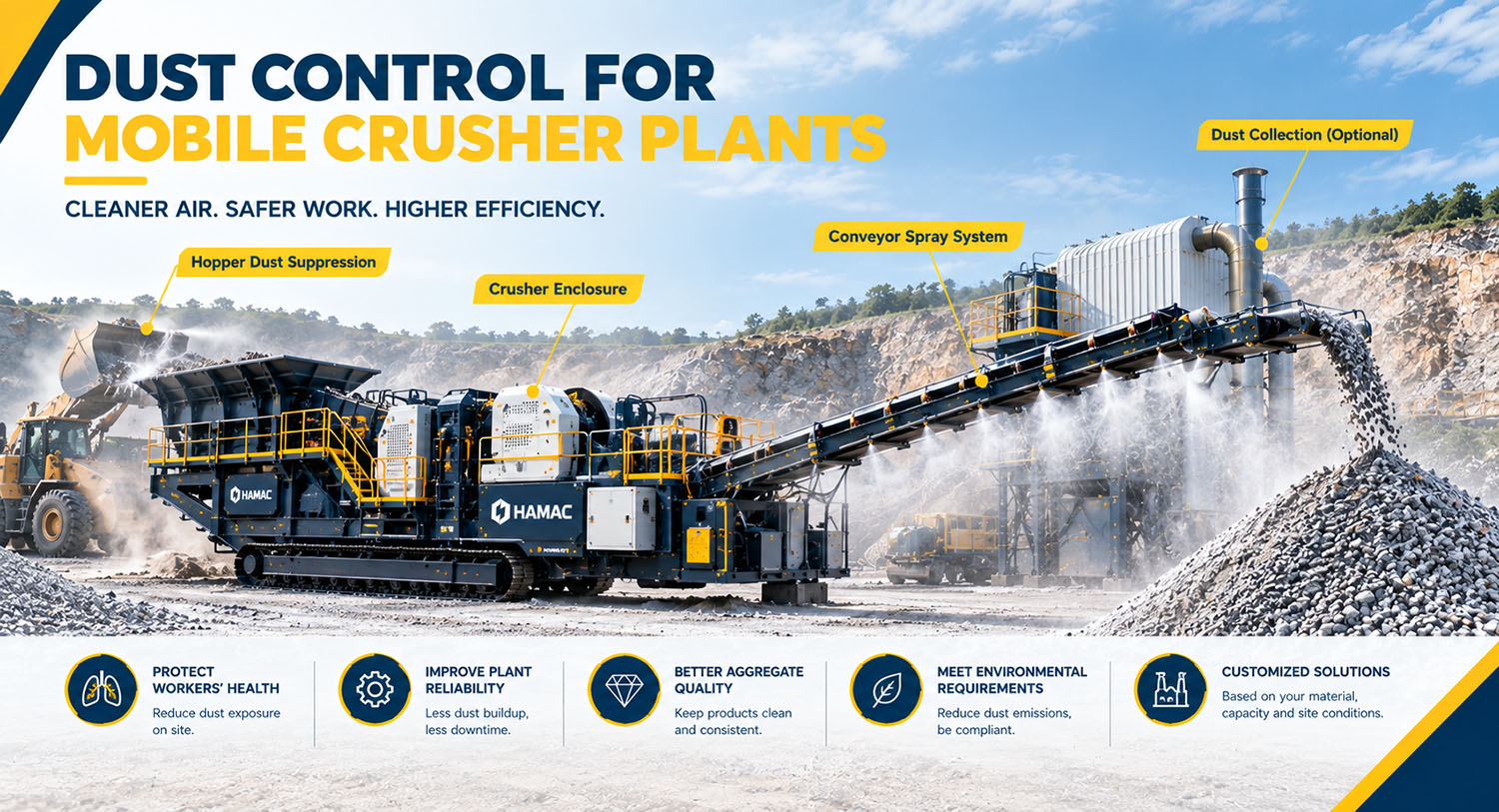
Mobile crusher plants need a flexible dust-control design because they may operate at changing quarry faces, road projects, demolition sites or concrete recycling yards. The most important points are normally the crusher feed, crusher discharge, main conveyor, screen discharge and stockpile area.
For a mobile jaw crusher plant, mobile impact crusher plant or tracked crushing and screening plant, check whether the project has a reliable water source, onboard water tank, water pump, hose connection, power supply and simple maintenance access. In cold climates, water lines and pumps may also need freeze-protection planning.
For concrete recycling, dust control should be considered together with rebar removal, contamination control, traffic management and final recycled aggregate requirements. For quarry projects, consider prevailing wind direction, operating-cab location, haul-road dust and the distance from nearby communities or sensitive areas.
HAMAC offers mobile jaw crusher plants, mobile impact crusher plants, mobile cone crusher plants and tracked vibrating screening plants for quarry, aggregate, mining and recycling applications.
Compliance and Operating Checklist
Dust-control requirements differ by country, state, province, mine permit and project type. Before finalizing a system, verify local environmental, occupational-health, mining and construction requirements. Do not use one country’s exposure limit or permit condition as a universal standard.
| Control Area | Recommended Action |
|---|---|
| Site assessment | Identify dust sources, exposed workers, wind direction, nearby receptors and existing controls |
| Engineering controls | Prioritize spray, enclosure, sealing, local exhaust, filtration and operator isolation |
| Operating procedures | Define spray startup, equipment interlocks, inspection frequency and wind-condition actions |
| Maintenance | Inspect nozzles, pumps, hoses, filters, fans, chutes, seals and water supply regularly |
| Cleaning | Use planned housekeeping and dust-removal practices to prevent accumulated dust from becoming airborne |
| Training and records | Train operators and maintenance teams; keep inspection, maintenance and monitoring records where required |
| Personal protective equipment | Use appropriate respiratory protection when required by local regulations or when engineering controls do not fully control exposure |
Respirable crystalline silica can be released during mining, crushing and milling. The U.S. Mine Safety and Health Administration states that its final silica rule took effect on June 17, 2024, with metal and nonmetal mine operator compliance required by April 8, 2026. Requirements outside the United States may differ, so each project should verify local rules before equipment selection and operation. Review MSHA silica-rule resources.
Information Needed for a Dust-Control Proposal
To recommend a suitable dust-control system for a stationary or mobile stone crusher plant, provide the following project information:
| Information Needed | Example |
|---|---|
| Raw material | Limestone, granite, basalt, river stone, concrete, asphalt or construction waste |
| Plant capacity | 100 TPH, 200 TPH, 300 TPH or higher |
| Existing process | Hopper, feeder, jaw crusher, impact crusher or cone crusher, vibrating screen and conveyors |
| Dust locations | Crusher feed, crusher discharge, screen, transfer point, stockpile or truck-loading area |
| Material condition | Maximum feed size, moisture, clay content, fines content and sticky material condition |
| Water and power supply | Available water source, pump capacity, power supply and drainage condition |
| Site condition | Stationary plant, mobile plant, wind condition, site layout and nearby communities |
| Local requirement | Mine permit, environmental requirement, occupational-health requirement or EPC specification |
A well-designed dust-control system should reduce visible dust and worker exposure without creating excessive water consumption, screen blinding, wet aggregate or unnecessary production interruptions.
Does your crusher plant need water spray suppression, enclosed transfer points, dry dust collection or a combined dust-control solution?
What is your crushing capacity: 100 TPH, 200 TPH, 300 TPH or higher?
Send your material photos, process flow, plant capacity, dust locations and site requirements to HAMAC. Our team can recommend a suitable crushing and screening configuration with practical dust-control considerations.
Contact HAMAC for a Stone Crusher Plant Dust-Control Solution