





Stone Crusher Operating Cost Per Ton: Calculation and Cost Reduction | HAMAC
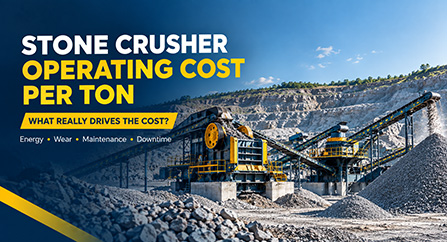
Stone crusher operating cost per ton is the total cost of running the crushing plant divided by the tonnes of saleable product produced during the same period.
The calculation should include energy, fuel, wear parts, labor, maintenance and other operating expenses. It should use saleable product tonnes—not only the raw material entering the crusher.
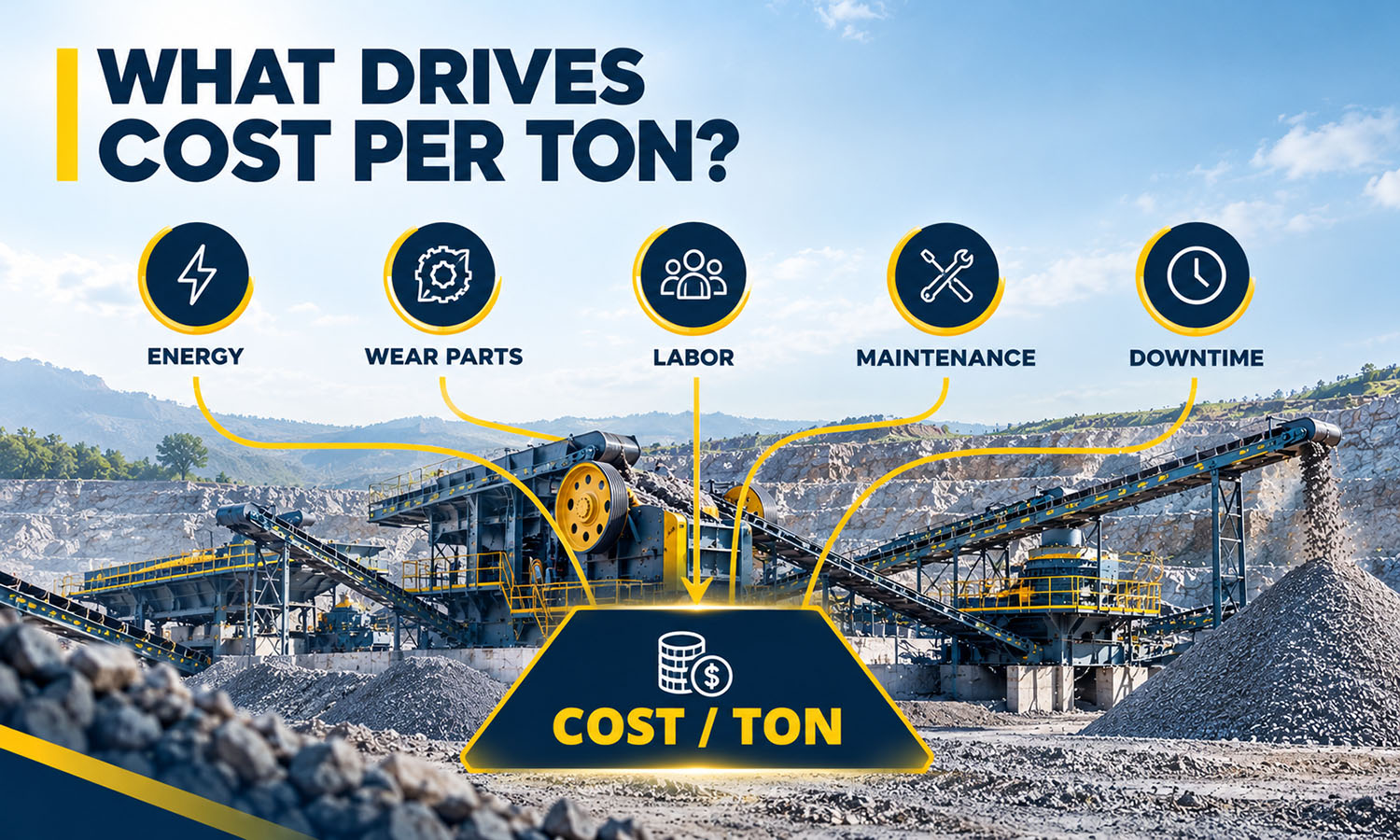
A crusher with a lower purchase price does not necessarily have the lowest operating cost. Stable production, suitable equipment, longer wear-part life and less downtime usually have a greater effect on long-term cost.
For initial equipment investment, read HAMAC’s Stone Crusher Plant Cost Guide.
Stone Crusher Cost Per Ton Formula
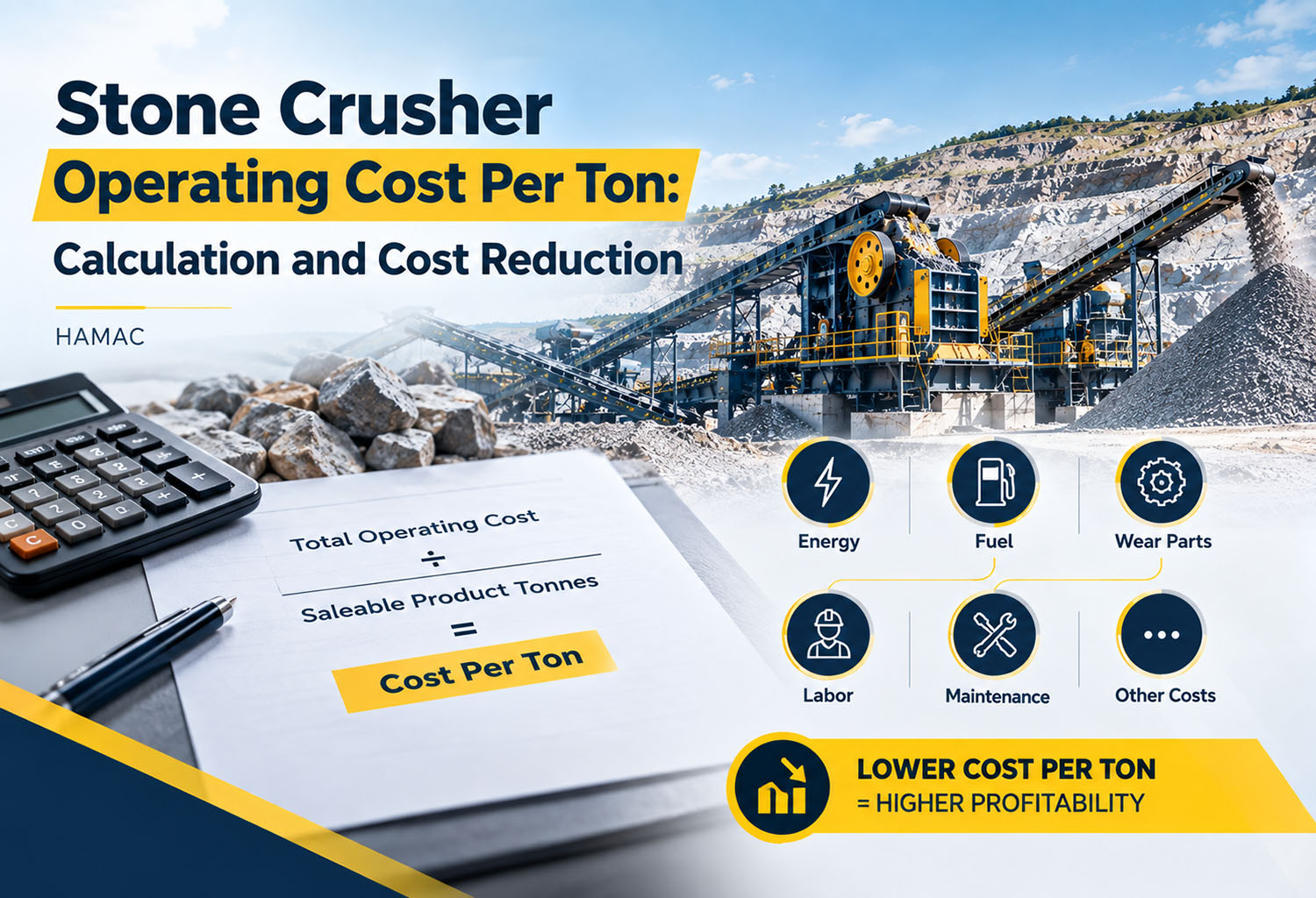
Operating Cost per Tonne = Total Operating Cost ÷ Saleable Product Tonnes
Total operating cost normally includes:
Energy or Fuel + Wear Parts + Labor + Maintenance + Lubrication + Other Operating Expenses
| Cost Item | Simple Calculation |
|---|---|
| Electricity | Electricity used × local electricity rate |
| Fuel | Fuel used × local fuel price |
| Wear parts | Wear-part purchase and replacement cost |
| Labor | Operator and maintenance labor related to production |
| Maintenance | Repair parts, lubricant and technical-service costs |
| Other expenses | Screen media, cleaning and other direct operating costs |
Important: Use the same time period for both costs and production. For example, monthly operating costs should be divided by monthly saleable product tonnes.
Raw feed and saleable product are not always equal. Some material may become unwanted fines, oversize return material or off-specification product.
Saleable Yield = Saleable Product Tonnes ÷ Total Feed Tonnes × 100%
A plant may process a large quantity of raw material but still have a high cost per saleable tonne if product yield is low. Record feed tonnes and finished-product tonnes separately.
1. Electricity Cost
For an electrically powered crushing plant, use the actual electricity consumption shown by an energy meter whenever possible.
Electricity Cost per Tonne = Actual kWh Used × Electricity Rate ÷ Saleable Tonnes
Do not calculate electricity cost only from the total motor nameplate power. The nameplate shows rated power, while actual electricity use changes with feed rate, material, CSS, operating load and idle time.
| Data to Record | Unit |
|---|---|
| Start meter reading | kWh |
| End meter reading | kWh |
| Local electricity rate | Local currency/kWh |
| Saleable production | Tonnes |
For electricity price and energy-market information, consult your local electricity provider or an official source such as the U.S. Energy Information Administration electricity data.
2. Fuel Cost
Diesel-powered mobile crushers should be evaluated using actual fuel added and actual saleable production.
Fuel Cost per Tonne = Fuel Used × Fuel Price ÷ Saleable Tonnes
High fuel cost per tonne may be caused by excessive idling, unstable feeding, low production, frequent relocation or an equipment configuration that does not match the material.
Fuel-price information should come from the local supplier or an official regional source. For general petroleum-price information, see the U.S. Energy Information Administration fuel-price data.
3. Wear Parts Cost
Wear parts are a major cost for abrasive applications. Record their cost according to the tonnes processed rather than only the number of days used.
Wear Cost per Tonne = Wear-Part Purchase and Replacement Cost ÷ Saleable Tonnes Produced
| Equipment | Main Wear Parts |
|---|---|
| Jaw crusher | Fixed jaw plate, movable jaw plate and cheek plates |
| Cone crusher | Mantle and concave |
| Impact crusher | Blow bars and impact plates |
| Vibrating screen | Screen mesh or screen panels |
| Conveyor | Belt, rollers and cleaners |
For wear-part inspection and replacement planning, read the HAMAC Jaw Plate and Cone Crusher Liner Wear Guide.
For cone crusher liner material selection, see the HAMAC Cone Crusher Liner Material Guide.
4. Labor and Maintenance Cost
Labor cost may include equipment operation, daily inspection, scheduled maintenance and repair work. Avoid counting the same employee cost in more than one category.
Labor Cost per Tonne = Production-Related Labor Cost ÷ Saleable Tonnes
Maintenance costs may include lubricants, repair parts, technical service and planned inspection. Initial equipment purchase, foundations and installation are normally treated as investment costs rather than daily operating expenses.
Use HAMAC’s Jaw Crusher Maintenance Checklist to identify small problems before they become expensive failures.
5. Downtime and Lost Production
Downtime raises cost per tonne because operating hours and saleable output decrease while some labor and equipment costs continue.
Record downtime by reason rather than entering all interruptions under “maintenance.”
| Downtime Reason | Possible Cost Effect |
|---|---|
| Crusher blockage | Lost production, clearing labor and possible component damage |
| Wear-part replacement | Parts, labor and planned or unplanned shutdown time |
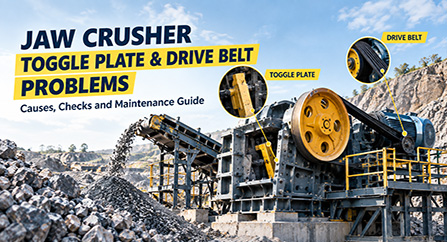
| Bearing or belt failure | Repair cost and longer unexpected downtime |
| No feed material | Labor and energy may be used without useful output |
| Screen or conveyor problem | The complete plant may stop even when the crusher is available |
| Full stockpile | Production stops because finished material cannot be discharged |
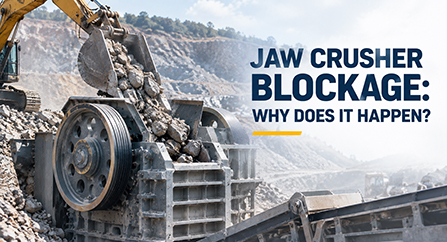
For repeated material-flow problems, read the Jaw Crusher Blockage and Choking Guide.
Factors That Change Crushing Cost
| Factor | How It Affects Cost per Tonne |
|---|---|
| Rock hardness and abrasiveness | May increase energy use and wear-part consumption. |
| Maximum feed size | Oversized feed may cause overload, bridging and downtime. |
| Average production rate | Low actual TPH spreads labor and maintenance costs over fewer tonnes. |
| Closed side setting | An unnecessarily small CSS may increase load and wear. |
| Feed stability | Empty running and sudden surges reduce efficiency. |
| Saleable product yield | More off-specification material increases cost per saleable tonne. |
| Downtime | Fewer productive hours increase the cost allocated to each tonne. |
| Plant balance | An undersized screen or conveyor can limit the complete plant. |
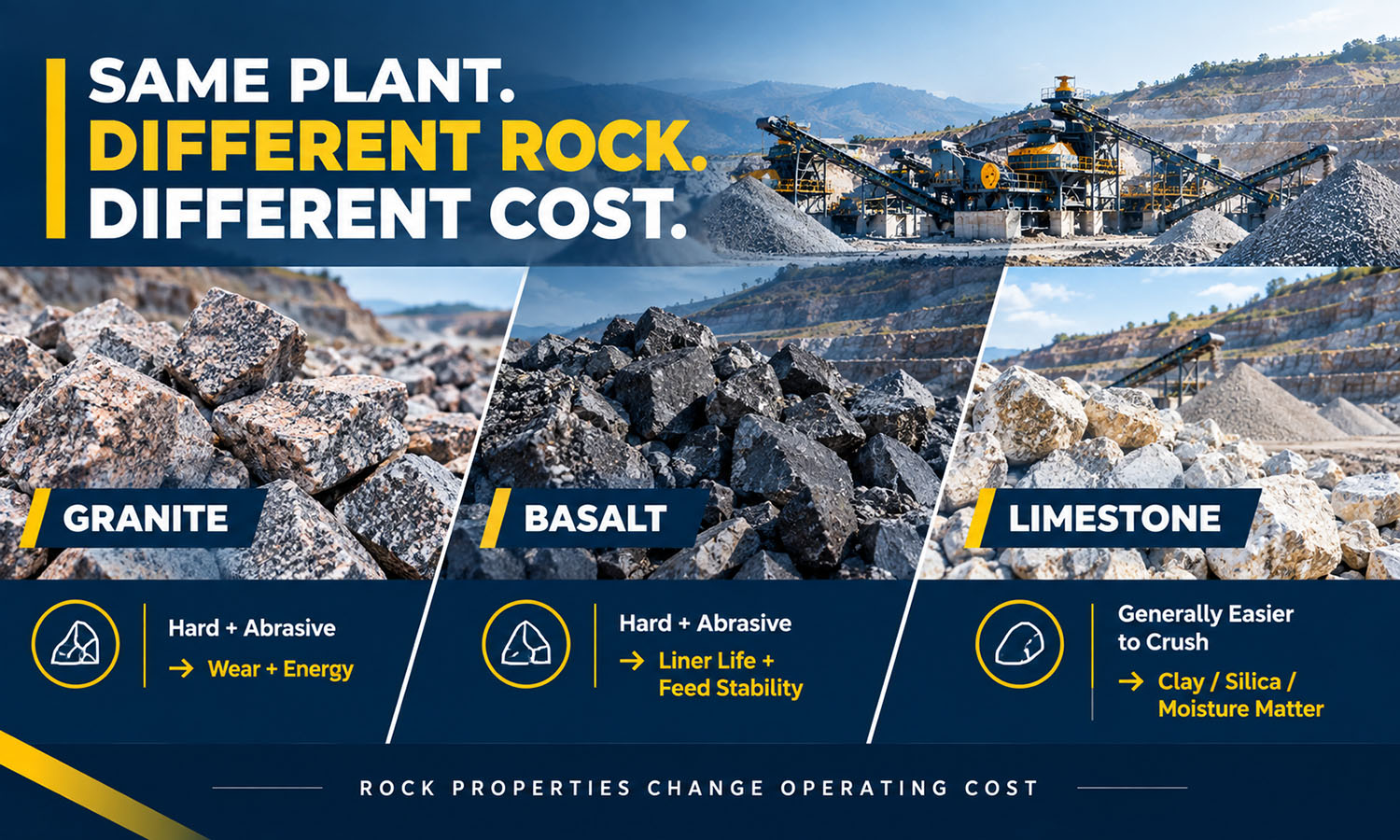
Operating Cost by Rock Type
The tables below describe general cost tendencies, not fixed cost values. Actual costs depend on local energy prices, equipment, operating conditions and product requirements.
| Material | Typical Cost Consideration | Common Equipment Direction |
|---|---|---|
| Granite | Hard and abrasive; monitor energy, jaw plates and cone liners | Jaw crusher + cone crusher |
| Basalt | Normally hard and abrasive; liner life and stable feed are important | Jaw crusher + cone crusher |
| Limestone | Generally easier to crush, but silica, clay and moisture can increase cost | Jaw crusher + impact crusher |
| Recycled concrete | Variable feed and possible steel or other foreign material | Jaw or impact crusher with sorting and metal removal |
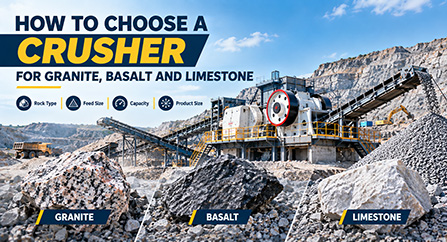
For crusher selection by material, read How to Choose a Crusher for Granite, Basalt and Limestone.
How to Reduce Crusher Cost per Tonne
1. Maintain Stable Feeding
Feed the crusher continuously and evenly. Avoid long empty-running periods and sudden feed surges. Match the feeder capacity to the crusher and downstream equipment.
For feeding-equipment options, visit the HAMAC Vibrating Feeder.
2. Select the Correct Crusher
Use a crusher suited to the material and crushing stage. Granite and basalt commonly use jaw and cone crushers, while limestone commonly uses jaw and impact crushers.
For primary crushing, see the HAMAC PE Series Jaw Crusher and the HAMAC European Tech Jaw Crusher.
3. Use a Practical CSS
Use the largest approved CSS that still meets the next crushing stage and product requirements. An unnecessarily tight setting can increase load, wear and recirculating material.
4. Reduce Unplanned Downtime
Use daily, weekly and monthly inspections to identify abnormal temperature, vibration, noise, loose parts, belt problems and wear before failure.
5. Track Wear by Tonnes
Record how many tonnes each set of jaw plates, cone liners, blow bars and screen panels processes. Compare parts by cost per tonne, not only by purchase price.
6. Balance the Complete Plant
Match the feeder, primary crusher, secondary crusher, screen and conveyors. Increasing crusher capacity will not improve final production if the screen or discharge conveyor remains the bottleneck.
For production-loss diagnosis, read Jaw Crusher Low Production: Causes and Solutions.
HAMAC Jaw Crusher Reference
The primary crusher’s size and power affect the complete process and energy demand. The following HAMAC PE Series values are reference specifications; actual output and energy use depend on material and operating conditions.
| Model | Maximum Feed Size | Reference Capacity | Installed Motor Power |
|---|---|---|---|
| PE400×600 | 340 mm | 16–60 T/H | 30 kW |
| PE600×900 | 500 mm | 80–180 T/H | 55–75 kW |
| PE750×1060 | 630 mm | 110–320 T/H | 90–110 kW |
| PE900×1200 | 780 mm | 220–450 T/H | 110–132 kW |
| PE1200×1500 | 1020 mm | 400–800 T/H | 160–220 kW |
Do not estimate actual electricity cost by multiplying motor power by operating hours without checking the real load. Use measured electricity consumption whenever possible.
For current product specifications, visit the HAMAC PE Series Jaw Crusher product page.
Fixed or Mobile Crusher Cost
| Cost Factor | Fixed Crushing Plant | Mobile Crushing Plant |
|---|---|---|
| Typical application | Long-term quarry with stable production | Short projects or frequent relocation |
| Energy | Commonly grid electricity | Diesel, electricity or hybrid options |
| Material transport | Feed must be transported to the fixed plant | Crusher can work closer to the material source |
| Installation | More foundation and site work | Normally faster relocation and setup |
| Cost advantage | Often suitable for long-term, high-volume production | May reduce hauling and relocation costs |
Neither system is automatically cheaper. Compare the project duration, relocation frequency, material-hauling distance, energy price and actual equipment utilization.
For mobile-equipment investment factors, read the HAMAC Mobile Crusher Cost Guide.
Want to estimate your stone crusher operating cost per ton?Send HAMAC your material, feed size, required capacity, product sizes, operating hours and local energy price. Our technical team can recommend a suitable crushing configuration and identify the main operating-cost factors.
Request a Stone Crusher Operating Cost Review
Frequently Asked Questions
How do you calculate stone crusher cost per ton?
Add electricity or fuel, wear parts, labor, maintenance and other direct operating expenses. Divide the total by the tonnes of saleable product produced during the same period.
What is the biggest stone crushing cost?
There is no single answer for every plant. Energy, wear parts and production losses caused by downtime are usually important items to monitor. Their actual importance depends on the material, equipment and local prices.
Does a higher-capacity crusher reduce cost per ton?
Only if the complete plant can use the capacity and produce saleable material consistently. An oversized crusher with unstable feeding or an undersized screen may still have a high operating cost.
Is a mobile crusher more expensive to operate?
Not always. A mobile crusher may consume diesel but can reduce haulage distance. Compare fuel, transport, relocation and equipment-utilization costs for the actual project.
How can I reduce stone crusher operating cost?
Maintain stable feeding, select the correct crusher, use a practical CSS, reduce unplanned downtime, track wear parts by tonnes and balance the capacity of the complete production line.
Final Recommendation
Operating Cost per Tonne = Total Operating Cost ÷ Saleable Product Tonnes.
Do not focus only on buying the cheapest crusher. A correctly selected and balanced crushing plant can reduce energy consumption, wear-part replacement and unplanned downtime while increasing saleable production.
Contact HAMAC for Stone Crusher Selection and Operating Cost Support