





Jaw Crusher Blockage and Choking: Causes, Safe Clearing and Prevention | HAMAC
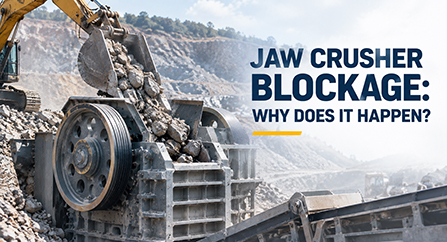
Is your jaw crusher blocked, choking or repeatedly jamming?
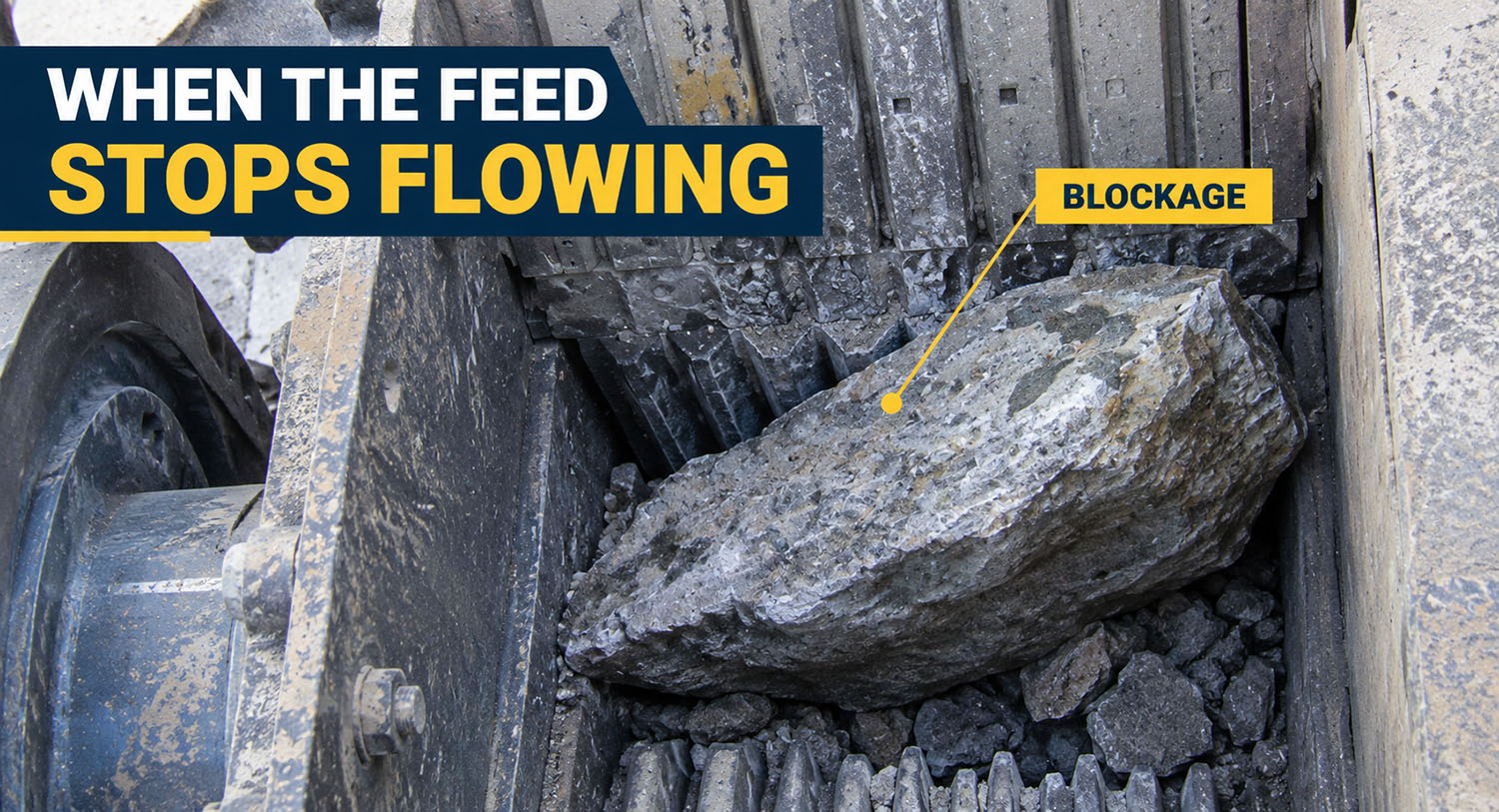
A blockage normally occurs at one of three locations: above the feed opening, inside the crushing chamber or below the discharge opening. Identifying the location makes troubleshooting faster and reduces unnecessary dismantling.
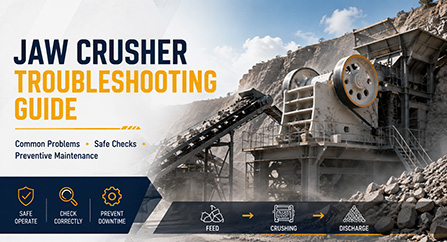
For other jaw crusher faults, read HAMAC’s Jaw Crusher Troubleshooting Guide.
7 Causes and Solutions
1. Oversized or Irregular Feed
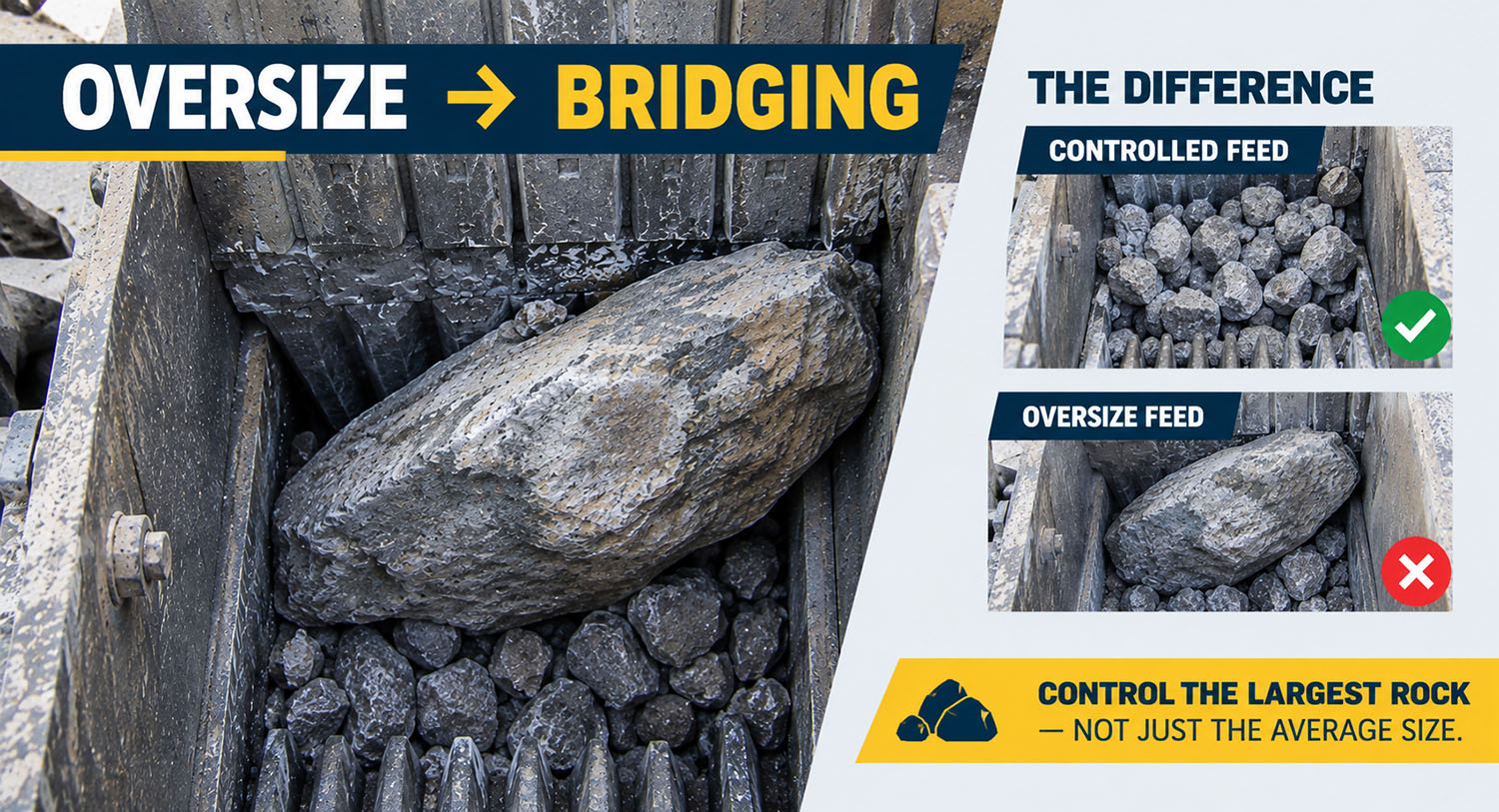
Problem: One rock larger than the effective feed opening, or several long and flat rocks crossing each other, can bridge above the crushing chamber.
Check: Measure the largest occasional rock, not only the average feed size. Compare it with the permitted maximum feed size for the actual jaw crusher model.
Solution: Improve blasting, pre-breaking or material sorting. Train loader operators to separate questionable oversize before it reaches the hopper.
A practical planning rule from McLanahan is to keep the maximum feed size at approximately 80% of the crusher feed opening. This is a general guideline rather than a replacement for the HAMAC model manual.
2. Overfeeding or Unstable Feeding
Problem: Feeding faster than the crusher can process and discharge material causes the chamber to pack. Alternating between empty running and sudden surges also creates unstable loading.
Check: Review feeder output, motor load and chamber level. Determine whether the loader sends large batches instead of maintaining a controlled feed.
Solution: Match the feeder rate to the crusher’s actual capacity and downstream discharge capacity. Use level monitoring or automatic feed control where available.
HAMAC vibrating feeders cover published capacities from approximately 90 to 900 T/H and maximum feed sizes up to 1000 mm. The selected feeder must be matched to the jaw crusher rather than operated only at its maximum possible rate.
See the HAMAC Vibrating Feeder.
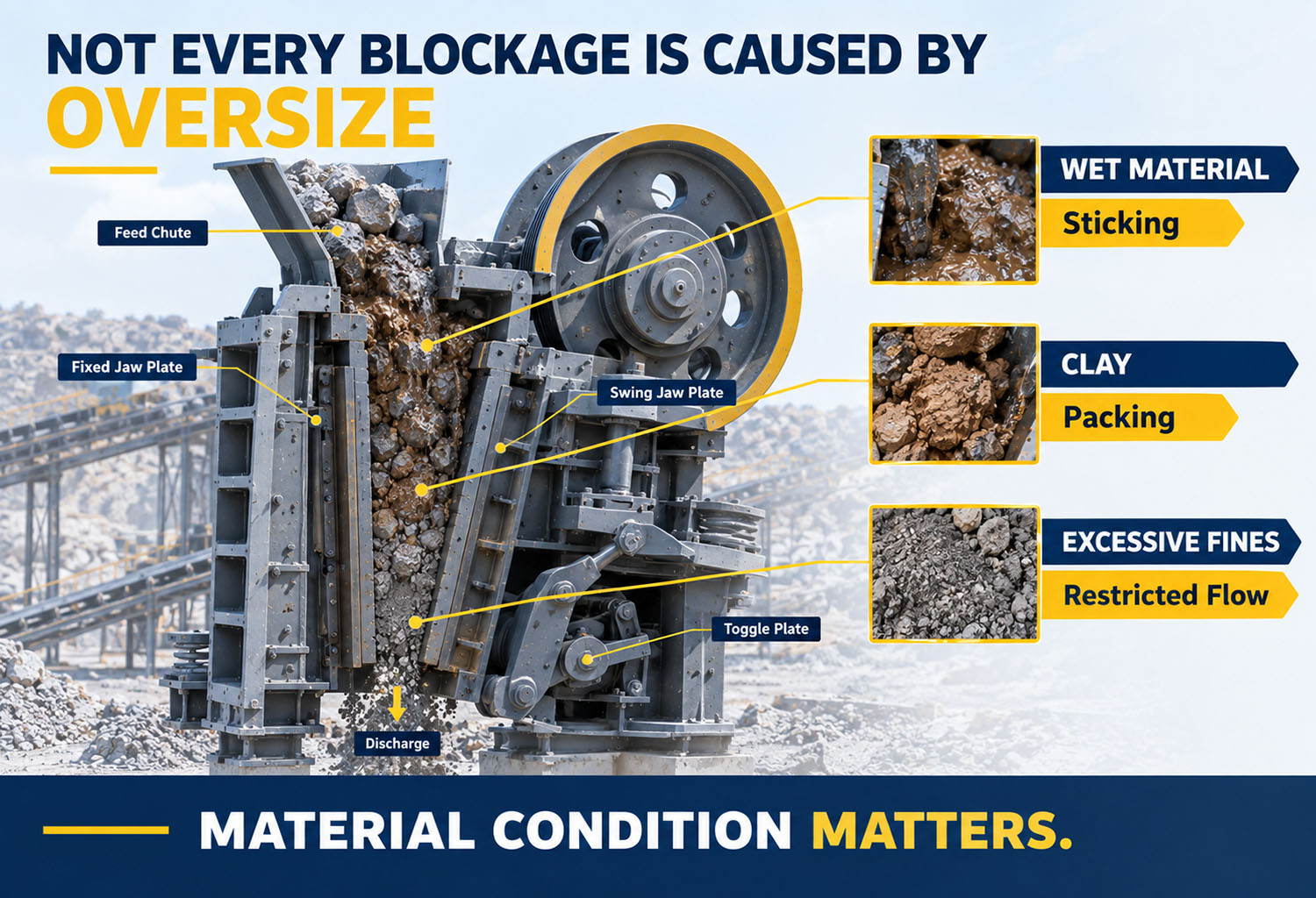
3. Wet, Sticky or Clay-Rich Material
Problem: Wet clay and fine particles can stick to jaw plates, fill spaces between larger rocks and accumulate in the discharge chute. This reduces the open area available for material flow.
Check: Determine whether the problem appears after rain, after changing the quarry bench or when processing material with more soil and clay.
Solution: Improve stockpile drainage and material preparation. Consider a grizzly feeder, scalping screen or another suitable pre-screening method to remove excessive fines before crushing.
Do not add water without evaluating the complete process. In some applications water suppresses dust, but it may make clay-rich feed more adhesive and increase chute or screen blockage.
4. Tramp Metal, Wood or Foreign Material
Problem: Bucket teeth, drill parts, reinforcing steel, wood and other uncrushable objects can obstruct the feed or damage internal components.
Check: Inspect the feed source, loader bucket, excavator attachments and upstream conveyor. Determine whether the blockage contains material that should not have entered the crusher.
Solution: Improve housekeeping and feed inspection. Use magnets or metal detection where appropriate, particularly when crushing demolition and recycling material.
Do not use the jaw crusher to process tramp metal. Remove foreign objects only after the equipment has been stopped, isolated and made safe.
5. CSS Too Small or Worn Jaw Plates
Problem: An unnecessarily small closed side setting (CSS) restricts discharge. Worn jaw plates can also change the chamber profile, reduce gripping action and slow material movement.
Check: Measure the actual CSS and compare it with the required product size and the model’s approved adjustment range. Inspect jaw plate teeth, thickness and wear pattern.
Solution: Use the largest approved CSS that still meets the downstream product requirement. Rotate or replace jaw plates only when permitted by the equipment design and HAMAC maintenance instructions.
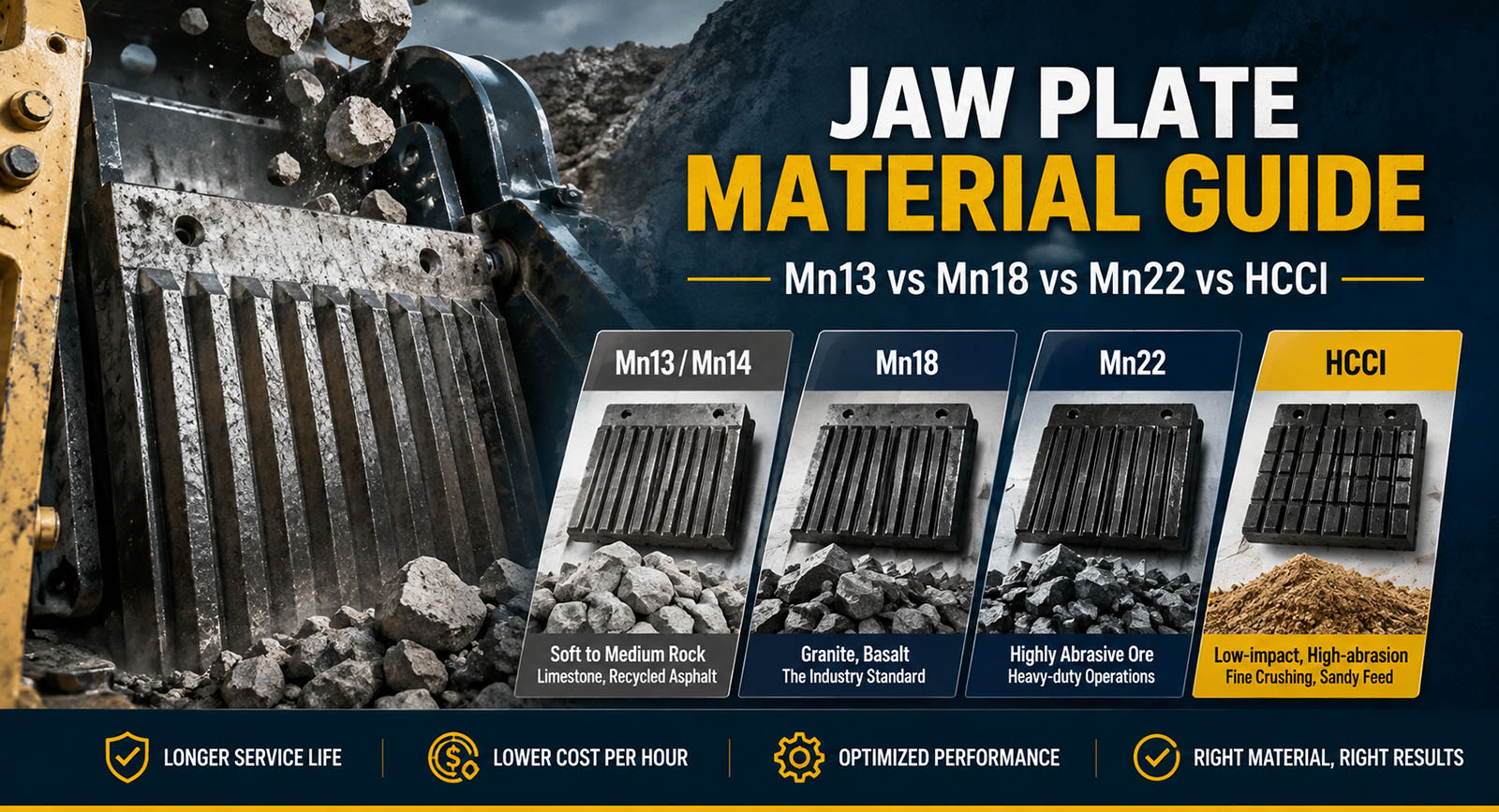
For wear-part inspection, read the HAMAC Jaw Plate and Crusher Liner Wear Guide.
6. Blocked Discharge Conveyor or Screen
Problem: The jaw crusher may be operating correctly while material is blocked below it. A stopped conveyor, packed chute, overloaded screen or full stockpile can cause material to back up into the chamber.
Check: Inspect the complete material-flow path rather than only the crusher:
Feeder → Jaw Crusher → Discharge Chute → Conveyor → Screen → Stockpile or Secondary Crusher
Solution: Match each downstream component to the required TPH. Maintain chute clearance, conveyor tracking, screen capacity and sufficient stockpile space.
| Downstream Problem | Typical Sign | Corrective Direction |
|---|---|---|
| Stopped conveyor | Material accumulates directly under the crusher | Stop the feeder and restore conveyor operation safely. |
| Blocked transfer chute | Wet fines or clay build up at the transfer point | Improve chute cleaning and material-flow design. |
| Screen overloaded | Material overflows or returns toward the crusher | Balance crusher output with screen capacity. |
| Full stockpile | Product conveyors cannot discharge | Improve stockpile and loader scheduling. |
7. Mechanical or Electrical Failure
Problem: A loose or slipping belt, motor trip, damaged bearing, broken toggle component or power problem can stop the jaw movement while material remains inside the chamber.
Check: Review alarms, motor current, belt condition, bearing temperature, noise, vibration and recent maintenance history.
Solution: Repair the mechanical or electrical fault before attempting to restart under load. Do not repeatedly reset the motor without identifying why it stopped.
For bearing-related symptoms, see the Jaw Crusher Bearing Overheating Guide.
For abnormal vibration and noise, read the Jaw Crusher Vibration and Abnormal Noise Guide.
Symptom-to-Cause Guide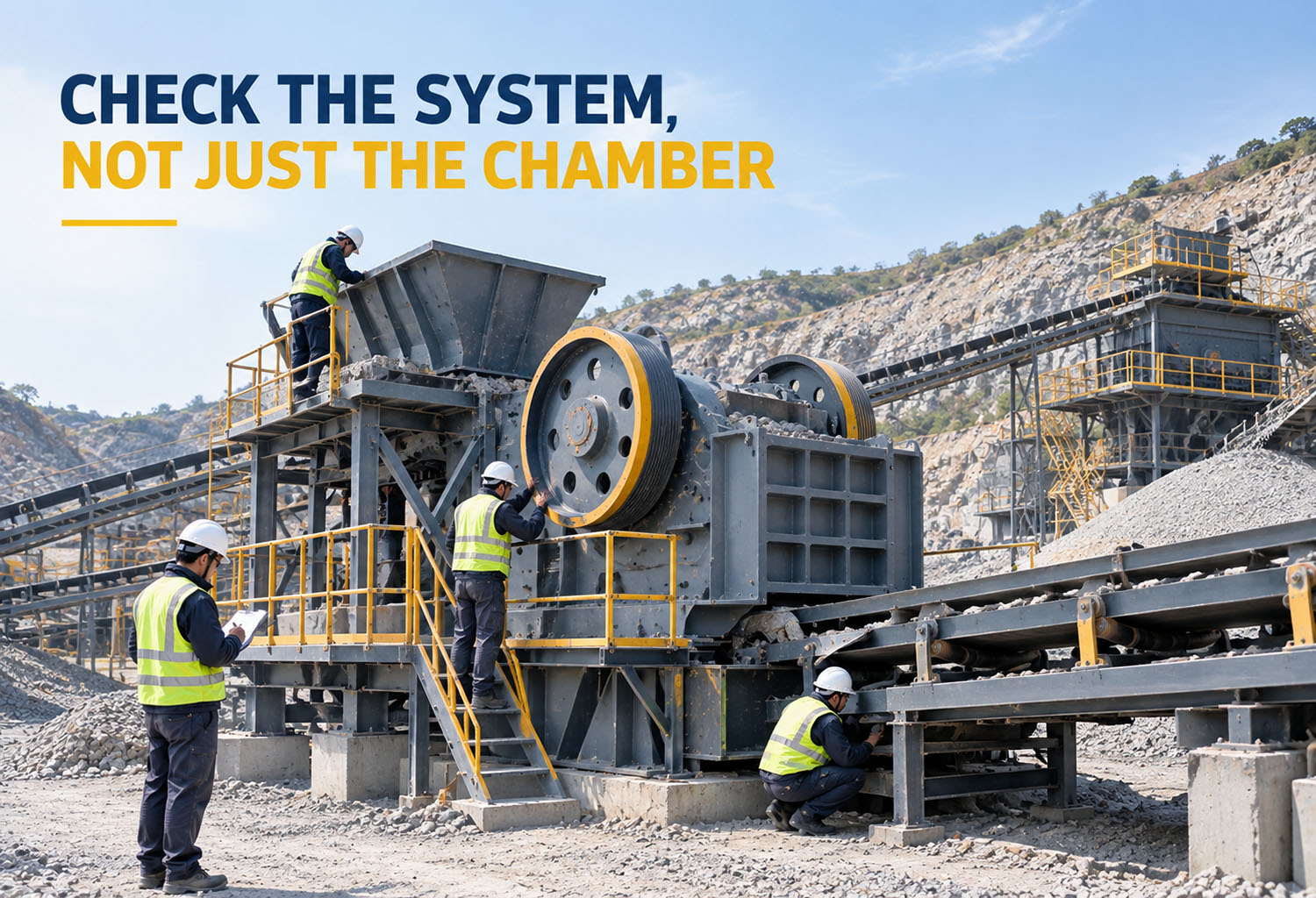
| Observed Symptom | Likely Cause | First Check |
|---|---|---|
| Large rock remains above the jaws | Oversize or bridging | Compare the rock dimensions with the feed opening. |
| Material stops moving after rain | Wet clay, sticky fines or chute buildup | Inspect moisture, clay and discharge points. |
| Motor load rises after a feed surge | Overfeeding or packed chamber | Stop the feeder and check the chamber level. |
| Crusher runs but production stops | Hopper bridging or no feed | Inspect hopper and feeder flow from a safe location. |
| Material backs up below the jaws | Discharge chute, conveyor or screen blockage | Inspect the downstream process. |
| Metallic noise occurs before stoppage | Tramp metal or mechanical damage | Stop, isolate and arrange a qualified inspection. |
| Blockage repeats at the same CSS | Restricted setting, worn profile or downstream limitation | Measure CSS and inspect jaw plates and discharge flow. |
Never reach into the chamber, climb onto the hopper or use a steel bar on a running crusher. Stored energy and unstable rocks can cause sudden movement or material ejection.
Follow the crusher manual and the site’s lockout/tagout procedure. See the HSE guidance for blocked mobile jaw crushers and the OSHA Control of Hazardous Energy Standard.
How to Restart Safely
Do not restart the crusher until the blockage cause has been identified, unstable material has been controlled and all personnel, tools and lifting equipment have been removed from the danger area.
| Before Restarting | Confirm |
|---|---|
| Crushing chamber | The obstructing material and foreign objects have been removed using the approved procedure. |
| Wear and mechanical parts | Jaw plates, toggle components, belts, bearings and guards show no unresolved damage. |
| Discharge system | The chute, conveyor, screen and product path are ready to receive material. |
| Work area | Personnel, tools and lifting equipment are clear. |
| Safety controls | Guards are installed and the responsible person authorizes startup. |
| Feed control | The feeder will restart at a controlled rate rather than immediately at full output. |
Start the downstream conveyor and related equipment in the sequence specified by the operating procedure before introducing material. Watch motor load, feed movement and discharge flow during the initial restart.
How to Prevent Repeat Blockages
| Prevention Area | Practical Action | Data to Record |
|---|---|---|
| Feed size | Remove or break oversize before the hopper | Largest occasional rock size |
| Feeder control | Maintain a stable feed matched to crusher capacity | Feeder rate and motor load |
| Feed distribution | Direct material toward the centre of the chamber | Feed pattern and jaw plate wear |
| Fines and clay | Use appropriate scalping or pre-screening | Moisture, clay and fine fraction |
| Foreign material | Inspect feed and consider magnets or metal detection | Tramp-metal events |
| CSS | Keep the setting within the approved range | Actual CSS and product size |
| Discharge path | Keep chutes, conveyors and screens clear | Blockage location and downtime |
| Operator training | Establish a written blockage-response procedure | Training and authorization records |
HAMAC Feeder Selection Reference
Stable feed control is one of the most effective ways to reduce jaw crusher jamming. HAMAC ZSW vibrating feeder models cover different feed sizes and production capacities.
| Model | Maximum Feed Size | Reference Capacity | Power |
|---|---|---|---|
| ZSW3090 | 400 mm | 90–180 T/H | 11 kW |
| ZSW3896 | 500 mm | 120–210 T/H | 15 kW |
| ZSW4211 | 650 mm | 180–400 T/H | 15 kW |
| ZSW4911 | 650 mm | 250–480 T/H | 22 kW |
| ZSW4913 | 750 mm | 340–600 T/H | 22 kW |
| ZSW6015 | 1000 mm | 400–800 T/H | 37 kW |
These are HAMAC reference specifications, not universal site-production guarantees. Select the feeder by considering the jaw crusher opening, rated capacity, maximum rock size, fines, moisture, material density and downstream capacity.
For current product information, visit the HAMAC Vibrating Feeder product page.
Does your jaw crusher repeatedly block or choke? Send HAMAC the crusher model, material, maximum feed size, CSS, target TPH, blockage location, photos and video. Our team can review the material-flow problem and recommend the next step.Request HAMAC Jaw Crusher Technical Support
Frequently Asked Questions
Why does my jaw crusher keep blocking?
Repeated blockage is commonly caused by oversized rocks, overfeeding, wet clay, excessive fines, tramp metal, a restricted CSS, worn jaw plates or a blocked downstream conveyor. Identify whether the obstruction starts above, inside or below the crushing chamber.
What is jaw crusher bridging?
Bridging occurs when one oversized rock or several interlocked rocks block the feed opening and prevent material from moving into the crushing chamber.
Can wet material block a jaw crusher?
Yes. Wet clay and fines can stick to the chamber and discharge chute, reducing the open flow area. Improve drainage, material preparation and pre-screening where appropriate.
Can too much feed cause jaw crusher choking?
Yes. When feed enters faster than the crusher and downstream equipment can process it, the chamber can pack and the motor load can rise. Match the feeder rate to the complete plant capacity.
How should a blocked jaw crusher be cleared?
Stop the feeder, shut down and isolate the plant, control unstable material and use only the approved clearing method. Never reach into, bar or work above a running crusher.
How can jaw crusher blockage be prevented?
Control the maximum feed size, maintain stable feeding, remove excess fines and tramp metal, use an approved CSS, inspect wear parts and keep the discharge conveyor and screen clear.
Should the jaw crusher be replaced if it keeps blocking?
Not necessarily. First check feed size, feeder control, clay, fines, CSS, jaw plate condition and downstream capacity. Replacement or resizing should be considered only if the correctly operated crusher remains unsuitable for the application.
Related HAMAC Resources
- Jaw Crusher Troubleshooting Guide
- Jaw Crusher Low Output Causes and Solutions
- Jaw Crusher Bearing Overheating Guide
- Jaw Crusher Vibration and Noise Troubleshooting
- HAMAC PE Series Jaw Crusher
- HAMAC European Tech Jaw Crusher
- HAMAC Vibrating Feeder
- HAMAC Crusher Parts
Final Action
If a jaw crusher blocks, stop the feed first. Locate the obstruction, isolate the equipment and use the approved clearing procedure. Before restarting, correct the underlying problem: oversize, unstable feed, wet clay, tramp metal, restricted CSS, worn parts or downstream backup.
Contact HAMAC for Jaw Crusher Blockage and Material-Flow Support