



Cone Crusher Liner Material Selection: Mantle & Concave Guide | HAMAC
Your cone crusher supplier quotes Mn18 or Mn22 liners — but never asks whether you're running a coarse, medium or fine cavity. That's a gap worth closing, because material grade and cavity type aren't independent choices; get one wrong and the other can't compensate for it. This guide breaks down manganese and chromium content, how cavity type changes the equation, CSS wear benchmarks, and when to skip manganese steel entirely in favor of high chromium cast iron.
The examples below reference HAMAC's HCS Hydraulic Cone Crusher, HP Hydraulic Cone Crusher, Compound Cone Crusher and Symons Cone Crusher ranges.
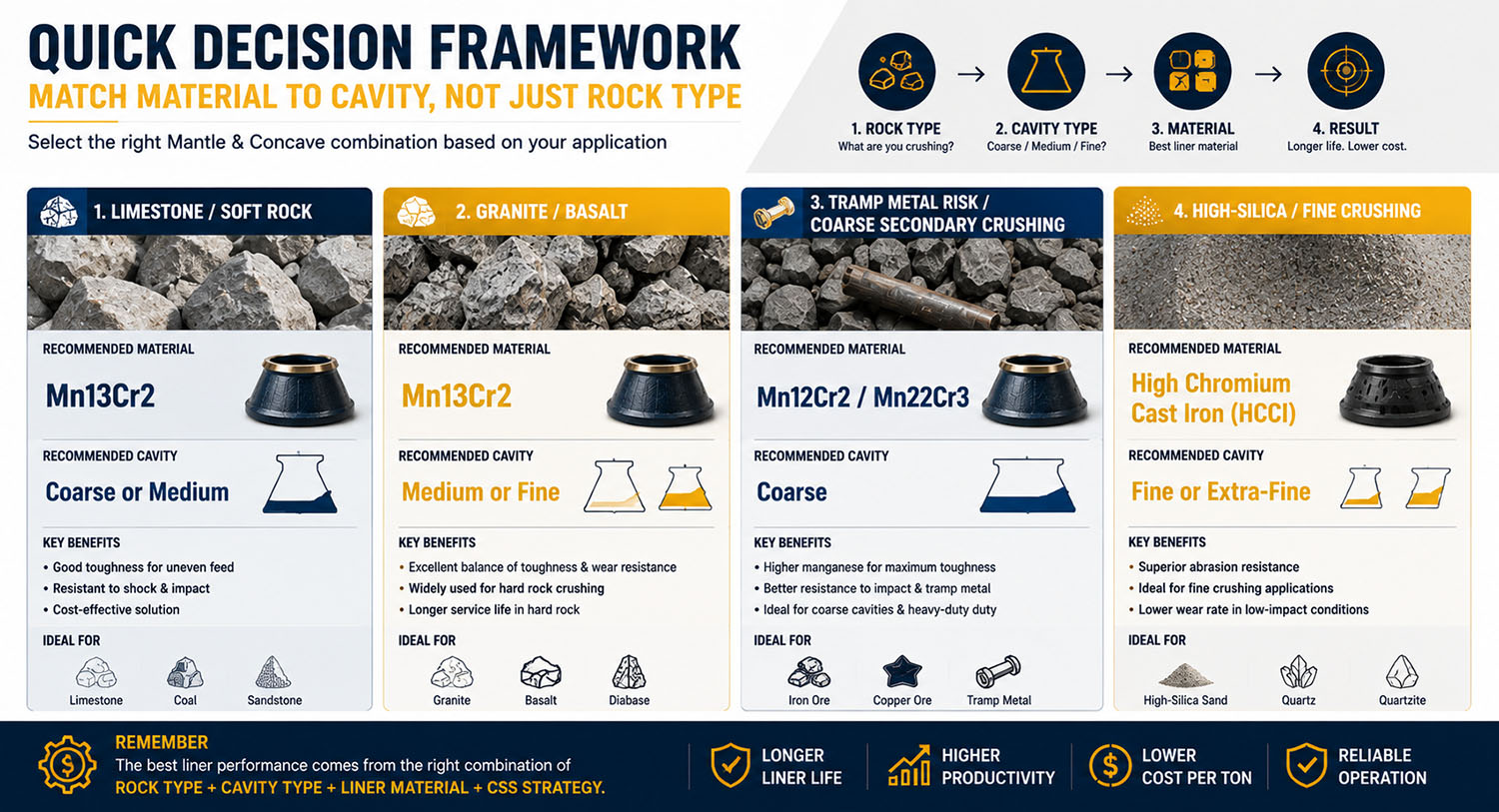
Quick Decision Framework: Match Material to Cavity, Not Just Rock Type
| Your situation | Recommended material | Cavity type |
|---|---|---|
| Limestone, soft aggregate, inconsistent feed | Mn13Cr2 | Coarse or medium |
| Granite, basalt — standard hard rock aggregate | Mn18Cr2 | Medium or fine, depending on target product |
| Ore with tramp metal risk, or coarse primary-stage secondary crushing | Mn22Cr2/Cr3 (higher toughness) | Coarse |
| High-silica sand/gravel, fine crushing, low-impact abrasive wear | High chromium cast iron (HCCI) | Fine or extra-fine |
If you only take one idea from this article: the cavity you run determines how much impact energy the liner actually receives, and that impact energy is what decides whether a given manganese grade can work-harden properly. Choosing the material without considering the cavity is choosing half the answer.
Manganese Steel Grades for Mantle and Concave: The Data
Cone crusher mantles and concaves rely on the same austenitic manganese (Hadfield) steel family used in jaw plates, but with slightly different chromium ratios optimized for continuous rotary crushing rather than reciprocating impact.
| Grade | Manganese content | Chromium content | Work-hardened hardness | Best suited for |
|---|---|---|---|---|
| Mn13Cr2 | 12–15% | 1.7–2.2% | 350–440 HB | Limestone, coal, soft-to-medium rock, unstable feed conditions |
| Mn18Cr2 | 17–19% | 1.8–2.5% | 500–550 HB | Granite, basalt — the global standard for cone crusher liners |
| Mn22Cr2 / Mn22Cr3 | 20–24% | 2–3% | 550–580 HB | Coarse cavities, ore with embedded tramp metal, high-toughness requirements |
Some premium suppliers also offer manganese liners with chromium content pushed toward the 2–3% upper range specifically to improve toughness against tramp metal impact without sacrificing too much work-hardening capacity — a balance reflected in commercial manganese liner ranges that offer 14%, 18% and 22% grades with chromium between 2–3%.
Why Cavity Type Changes Everything About Material Selection
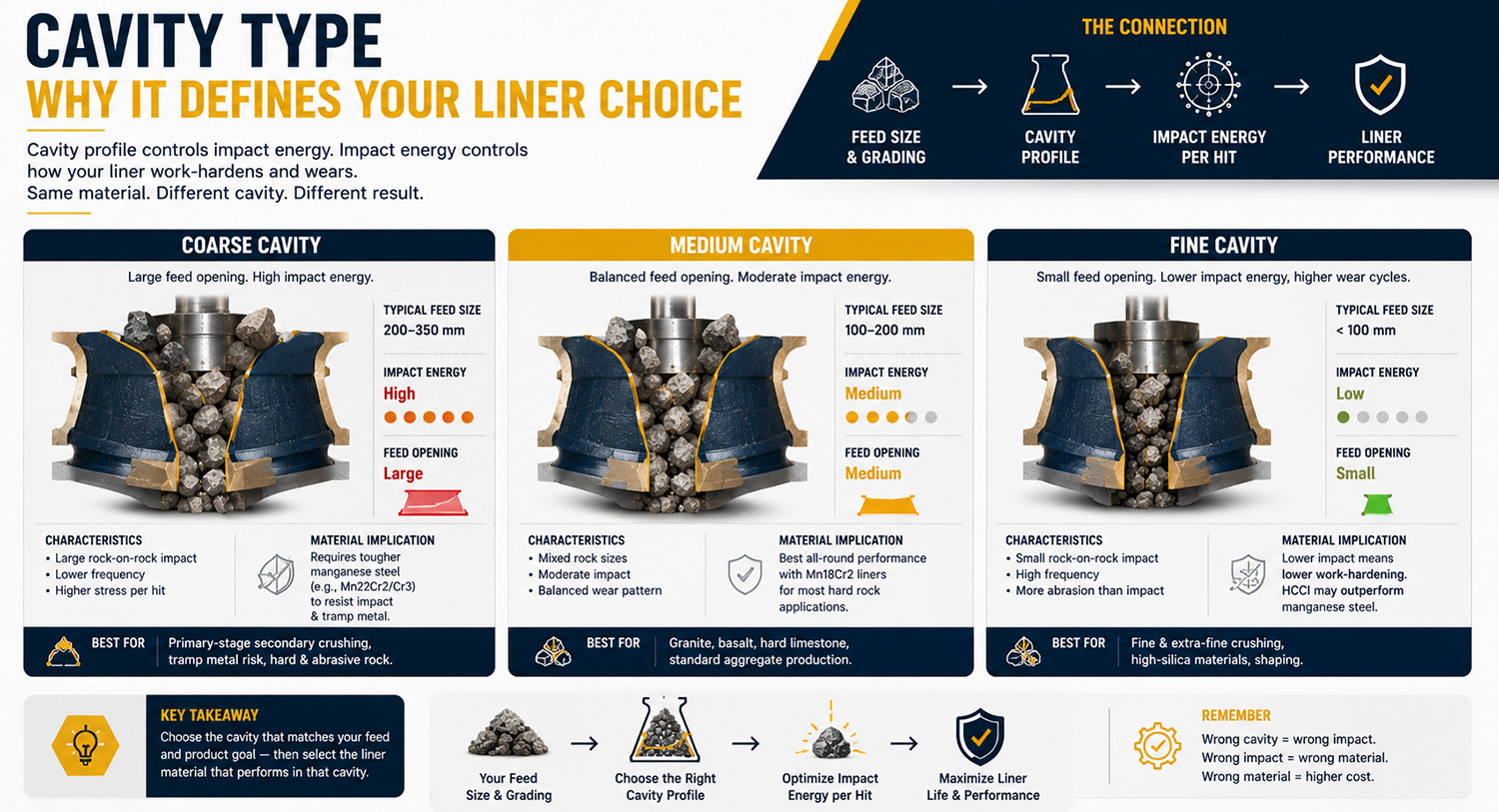
A coarse cavity produces large, high-energy impacts spaced further apart. A fine cavity produces smaller, more frequent impacts with less energy per hit. Since manganese steel's hardness gain depends entirely on impact energy, the same Mn18 liner can behave very differently depending on which cavity it's installed in.
| Cavity type | Typical feed size | Impact energy per hit | Material implication |
|---|---|---|---|
| Coarse | Larger feed, wider CSS | High | Fully activates work-hardening even at Mn18; Mn22 justified for tramp-metal-prone ore |
| Medium | Moderate feed and CSS | Moderate | Mn18 is the balanced default for most hard-rock secondary crushing |
| Fine / extra-fine | Small feed, tight CSS | Low | Manganese steel may under-perform; high chromium cast iron often outlasts it here |
This is why feed gradation and cavity selection should always be reviewed together with liner material — a detail confirmed by cone crusher liner selection guidance from equipment manufacturers, which stresses that liner performance depends heavily on matching feed size and gradation to the correct chamber profile.
When to Skip Manganese Steel Entirely: High Chromium Cast Iron
In fine and extra-fine cavities processing high-silica sand, gravel, or other low-impact but highly abrasive material, manganese liners may never receive enough impact energy to work-harden effectively. This is where high chromium cast iron (HCCI), containing 12–30% chromium, often outperforms manganese steel — its hardness (frequently HRC 60+) comes from chromium-carbide particles baked into the microstructure, not from impact-driven hardening.
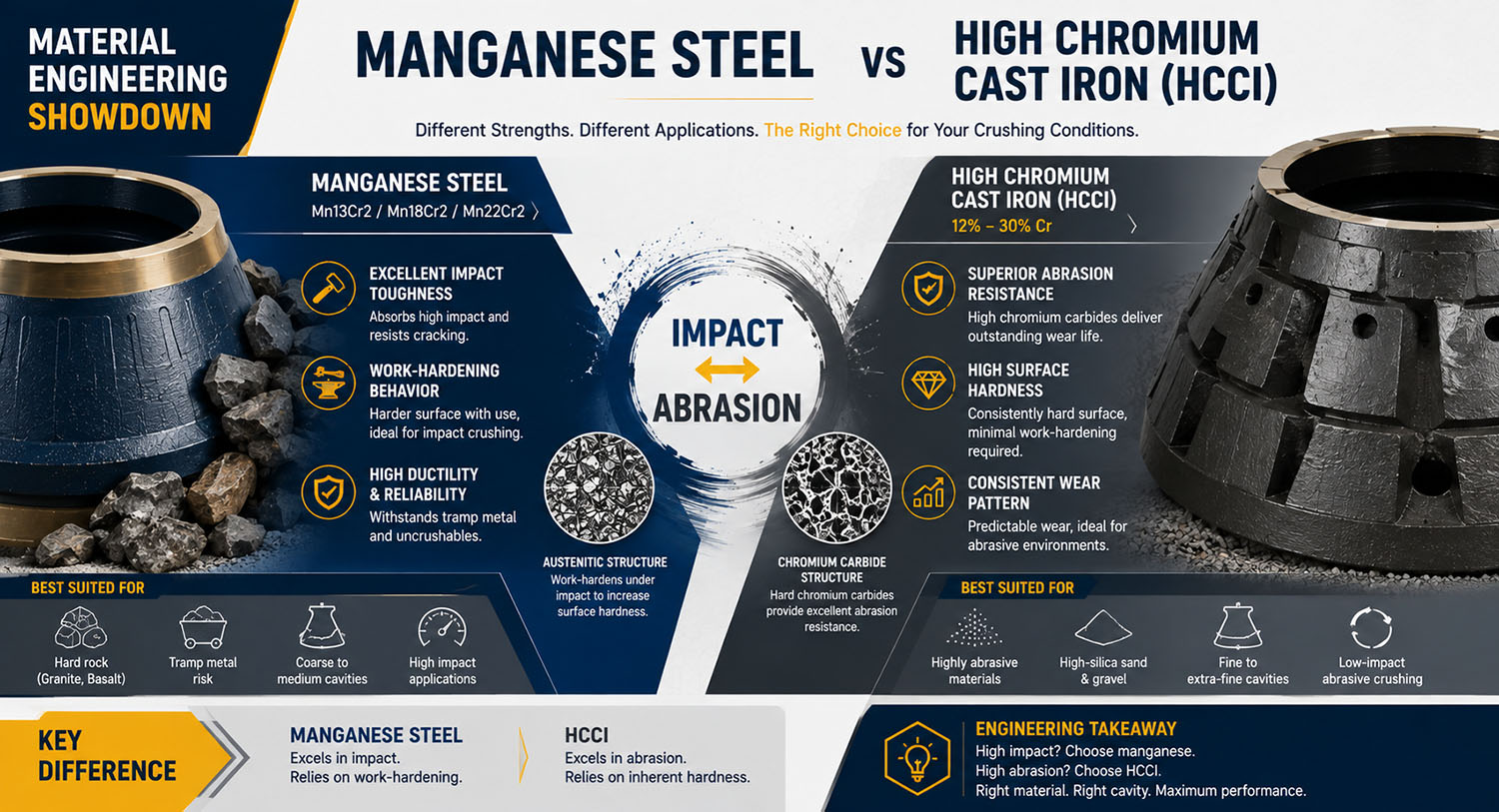
The trade-off is brittleness: HCCI liners are significantly more prone to cracking under sudden shock loading or tramp metal impact, making them a poor fit for coarse cavities or ore with contamination risk, but an excellent fit for dedicated fine-crushing duty.
Always Replace Mantle and Concave as a Matched Set
Mixing a new mantle with a worn concave (or vice versa) changes the crushing chamber geometry, which can reduce both throughput and product consistency — a point emphasized across cone crusher liner technical guides that stress matched-set replacement to preserve correct chamber profile. Even if one component appears to have wear life remaining, replacing both together protects your CSS accuracy and particle shape consistency.
CSS Wear Monitoring: A Practical Replacement Timeline
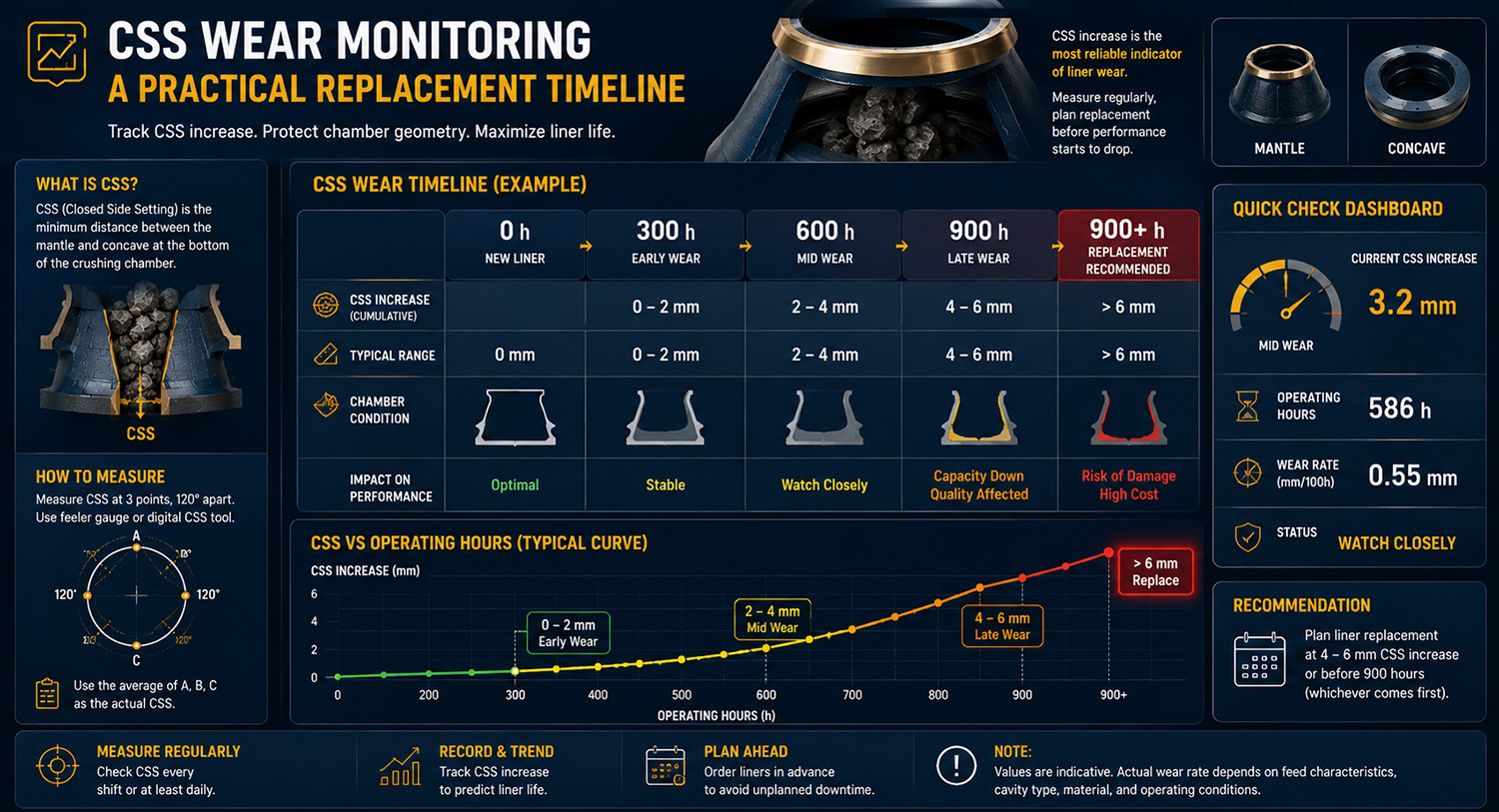
Rather than replacing liners on a fixed calendar, track closed-side setting (CSS) drift as your primary indicator:
| Operating hours | Typical CSS drift | Interpretation |
|---|---|---|
| 0–300 hours | 0–2 mm | Normal break-in wear; no action needed |
| 300–600 hours | 2–4 mm | Monitor more frequently; plan procurement of replacement liners |
| 600–900 hours | 4–6 mm | Approaching end of service life; schedule replacement |
| 900+ hours | 6 mm+ or thickness below ~19 mm in high-wear zone | High risk of cracking or chamber geometry distortion — replace promptly |
These figures are planning benchmarks — actual wear rates vary with material abrasiveness, cavity type and feed consistency, so pair CSS tracking with periodic thickness measurement for the most reliable picture.
Three Common Cone Crusher Liner Selection Mistakes
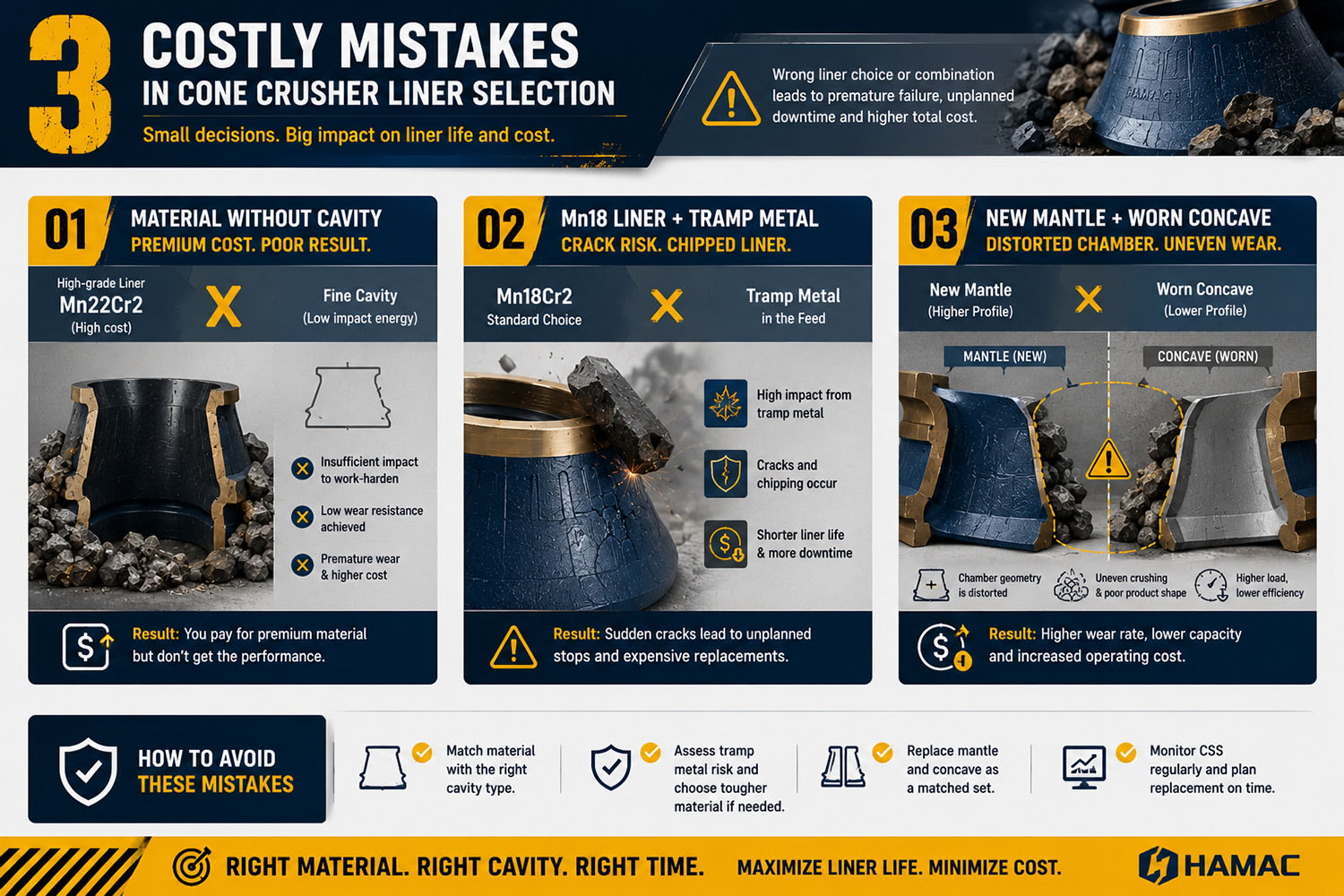
| Mistake | Why it costs you |
|---|---|
| Choosing material grade without reviewing cavity type | A high-grade Mn22 liner in a fine cavity may never work-harden properly, wasting the price premium |
| Using Mn18 on ore with known tramp metal risk to save cost | Lower toughness increases the chance of cracking on impact with embedded metal, risking unplanned downtime |
| Replacing only the mantle or only the concave | Mismatched wear stages distort chamber geometry, reducing both capacity and product consistency |
Matching HAMAC Cone Crusher Models to Liner Material and Application
| Application | Recommended material | HAMAC cone crusher |
|---|---|---|
| Limestone, secondary crushing | Mn13Cr2 | Compound Cone Crusher |
| Granite, basalt — standard hard rock | Mn18Cr2 | HCS Hydraulic Cone Crusher |
| Iron ore, ore with tramp metal risk | Mn22Cr2/Cr3 | HP Hydraulic Cone Crusher |
| Fine crushing, manufactured sand feed prep | High chromium cast iron (fine cavity) | Symons Cone Crusher (fine cavity configuration) |
For a broader view of how cone crushers fit into a complete crushing line, see our guide on primary vs secondary vs tertiary crushing equipment selection, and for jaw crusher liner selection, see jaw plate material selection: Mn13 vs Mn18 vs Mn22 vs high chrome.
Data to Prepare Before Requesting a Liner Quotation
| Data to prepare | Why it matters |
|---|---|
| Material type and abrasiveness (granite, basalt, limestone, iron ore, etc.) | Determines the appropriate manganese grade or HCCI alternative |
| Cavity type currently installed (coarse, medium, fine, extra-fine) | Determines whether the chosen material can actually reach its rated hardness |
| Known tramp metal or contamination risk | Affects toughness requirements and material brittleness tolerance |
| Current CSS and observed drift over recent operating hours | Helps estimate remaining liner life and plan replacement timing |
| Target final product size and capacity (tph) | Confirms whether the current cavity and material combination still fits the application |
With this information, HAMAC's engineering team can recommend the correct manganese grade or high chromium alternative, matched to your specific cavity type and operating conditions, rather than a generic liner quote based on rock type alone.
Frequently Asked Questions About Cone Crusher Liner Materials
Is Mn18 or Mn22 better for a cone crusher?
Mn18 is the standard choice for most granite and basalt applications in medium cavities. Mn22 is worth the added cost mainly in coarse cavities or ore with tramp metal risk, where its higher toughness reduces cracking risk.
Can I use the same liner material in any cavity type?
Not effectively. Cavity type determines the impact energy the liner receives, which directly affects whether manganese steel can work-harden to its rated hardness — the same grade can underperform in a fine cavity compared to a coarse one.
When should I use high chromium cast iron instead of manganese steel?
HCCI performs best in fine or extra-fine cavities processing high-silica, low-impact abrasive material. It is not recommended for coarse cavities or ore with tramp metal risk due to its brittleness under shock loading.
How do I know when to replace cone crusher liners?
Track CSS drift over operating hours — 4–6 mm of drift after 600–900 hours generally signals the liner is approaching end of service life — and combine this with periodic thickness checks in the highest-wear zone.
Should I replace the mantle and concave at the same time?
Yes. Replacing them as a matched set preserves correct chamber geometry, which protects both throughput and product size consistency.
Choosing the right cone crusher liner material is really two decisions made together: which manganese grade (or high chromium alternative) fits your rock's abrasiveness and toughness requirements, and which cavity type lets that material actually perform as rated. Get both right, and you avoid the two most expensive mistakes — paying for hardness the liner never activates, or running a cavity that wears out prematurely regardless of material grade. Browse HAMAC's full cone crusher range and genuine spare parts selection, or send us your material type, cavity, and target capacity for a liner recommendation matched to your project.