




How Much Does a Mobile Crusher Cost? Price Factors & Buyer’s Guide | HAMAC
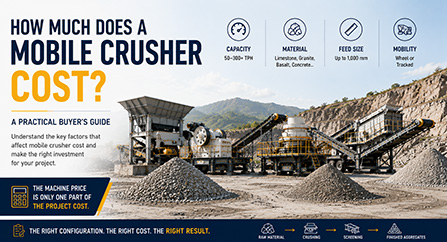
How Much Does a Mobile Crusher Cost?
A mobile crusher does not have one fixed price.
The final cost depends on the crusher type, required capacity, material characteristics, maximum feed size, mobility system, power configuration, screening requirement, optional modules and delivery scope. A compact mobile crushing unit for a small recycling project is very different from a high-capacity multi-stage mobile crushing and screening plant for a hard-rock quarry.
For this reason, buyers should not compare mobile crusher prices by one headline number alone. A useful budget starts with the material, production target, final product requirements and working conditions. The objective is not simply to find the lowest machine price, but to select a mobile crushing solution that can deliver the required output, product quality, mobility and practical cost per ton.
In this guide, you will learn what determines mobile crusher cost, what a quotation should include, how typical configurations change from 50 TPH to above 300 TPH, and what information is needed to obtain an accurate project-based quotation.
1. What Determines Mobile Crusher Cost?
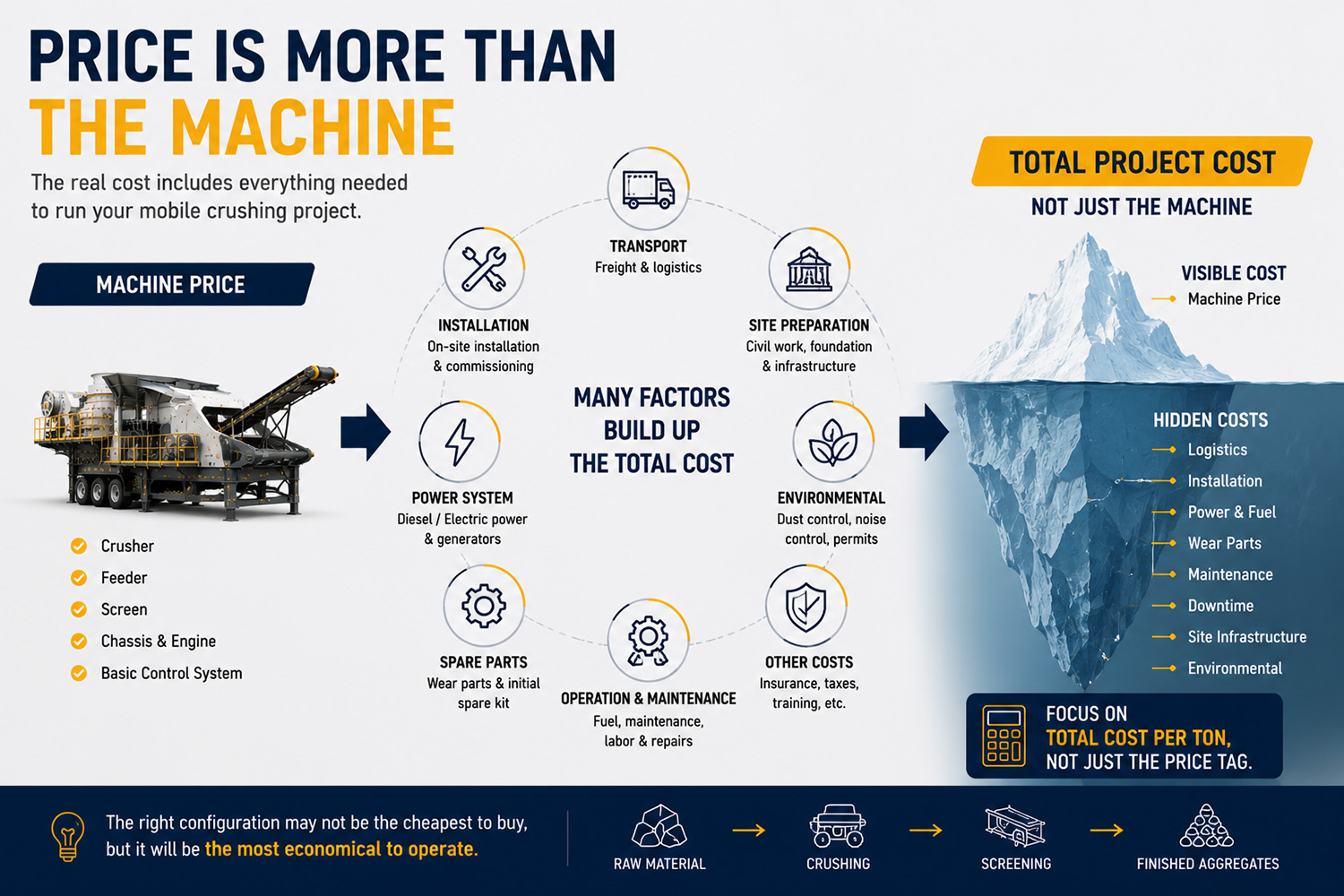
Mobile crusher price is influenced by far more than the main crushing machine. The complete cost depends on how the plant is designed to process your material, meet your hourly production target and produce the required final aggregate sizes.
1.1 Crusher Type and Crushing Stage
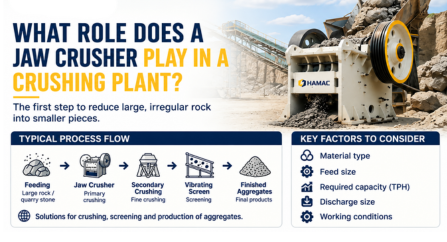
The selected crusher type is one of the main factors affecting mobile crusher cost. Different crushers perform different roles in the crushing process, and many commercial aggregate or mining projects require more than one crushing stage.
| Equipment Type | Typical Role | Typical Application Direction | Cost Consideration |
|---|---|---|---|
| Mobile Jaw Crusher | Primary crushing | Large feed material, quarry rock, road base, mining feed preparation | Depends on jaw opening, feed capacity, drive system, chassis and conveying system |
| Mobile Impact Crusher | Primary, secondary or tertiary crushing | Limestone, recycled concrete, soft-to-medium rock and applications requiring good particle shape | Depends on rotor size, chamber design, feed condition, screen configuration and wear-part requirements |
| Mobile Cone Crusher | Secondary or tertiary crushing | Hard rock, granite, basalt, river stone and multi-stage aggregate production | Depends on cone size, cavity type, automation, recirculation and screening requirements |
| Mobile Screening Plant | Material classification | Final aggregate separation, scalping, finished-product screening and closed-circuit crushing | Depends on screen size, number of decks, conveyor layout and target product sizes |
| Multi-Machine Mobile Crushing Line | Complete crushing and screening process | Commercial quarry, hard-rock aggregate production, road projects and high-capacity operations | Cost is based on the full process flow, including crushing stages, screens, conveyors and control coordination |
HAMAC provides wheel-type mobile crushing plants, as well as tracked jaw, impact, cone and screening plants. The right solution depends on the production process, not simply on the name of one crusher.
1.2 Capacity and Feed Size
Required capacity, usually expressed in tons per hour (TPH), is an important starting point for mobile crusher budget planning. However, TPH alone cannot determine the final machine size or project cost.
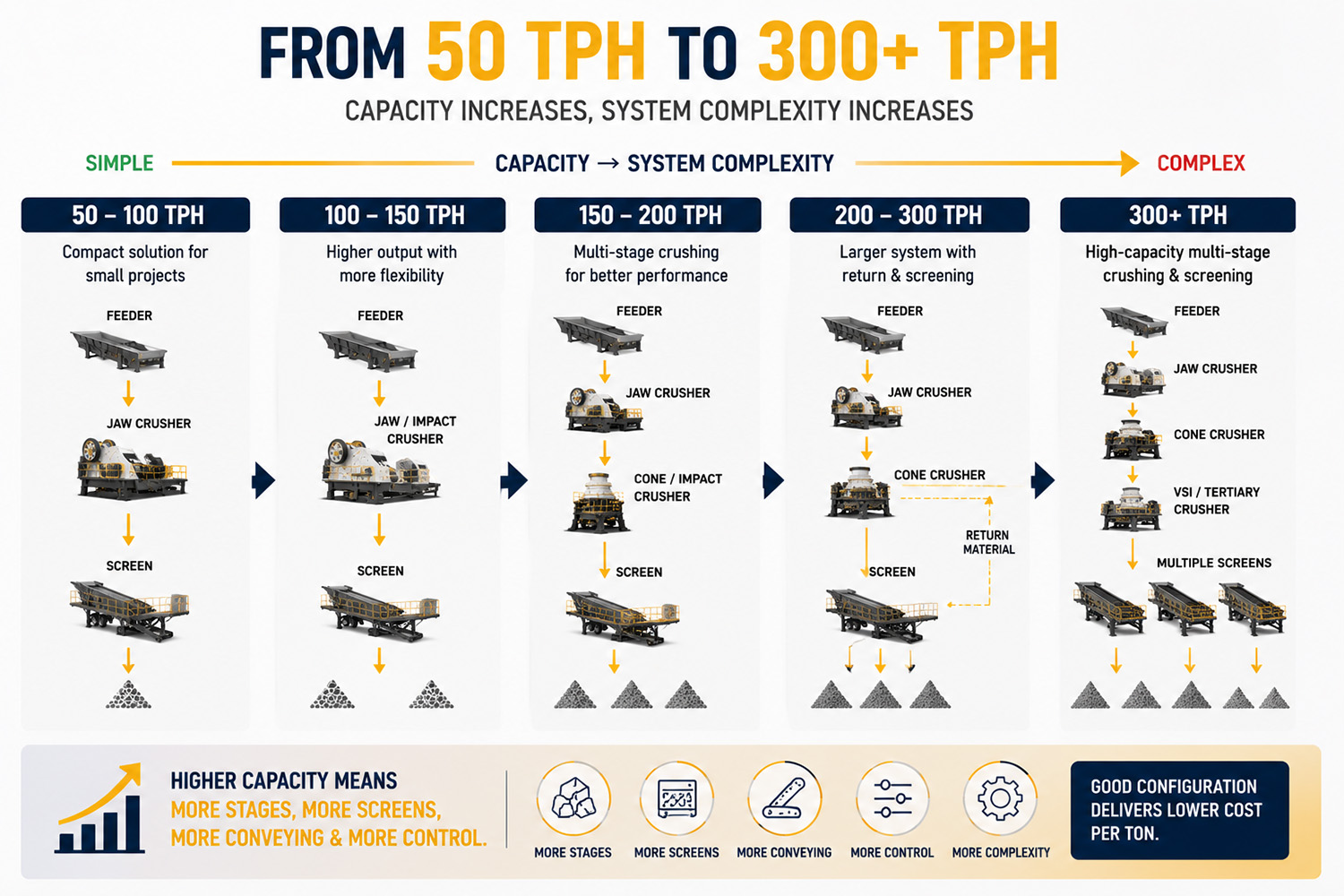
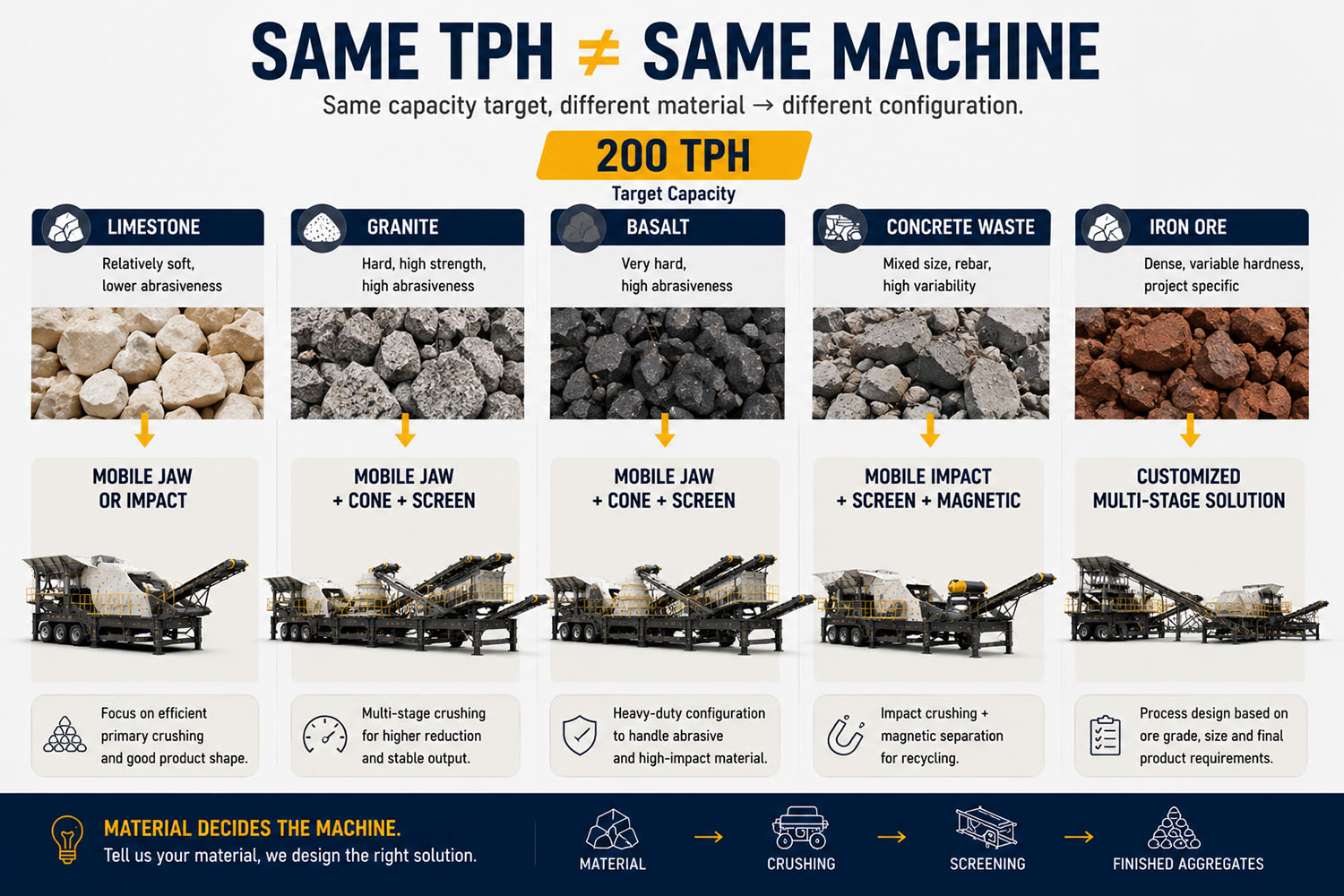
A 100 TPH, 200 TPH or 300 TPH mobile crusher configuration must be evaluated together with the material type, maximum feed size, feed size distribution, moisture, clay content, crusher setting, required final products and daily operating hours. The same nominal-capacity machine can produce very different actual output when processing limestone, granite, basalt, recycled concrete or iron ore.
| Capacity Question | Why It Matters |
|---|---|
| What output do you need per hour? | Helps determine crusher size, feeder capacity, screen size and conveyor capacity |
| What is the maximum feed size? | Determines the required crusher inlet and primary crushing arrangement |
| How many hours will the plant operate daily? | Helps evaluate daily production targets and avoid unnecessary oversizing |
| Do you expect future expansion? | Helps decide whether to allow for modular expansion, additional screening or another crushing stage |
1.3 Material Characteristics
Material is one of the most important inputs for crusher selection. Before comparing mobile crusher prices, define what you need to process and how that material behaves during crushing.
| Material | Key Characteristics to Confirm | Configuration Direction |
|---|---|---|
| Limestone | Strength, moisture, clay content, feed size and target aggregate shape | Mobile jaw or impact crushing may be considered depending on feed size and product requirements |
| Granite | High hardness, abrasiveness, feed size and required aggregate sizes | Often requires primary jaw crushing followed by cone crushing and screening |
| Basalt | Hardness, abrasiveness, wear-part demand and product specification | Often requires a hard-rock crushing process with suitable secondary crushing and screening |
| Concrete / Demolition Waste | Steel content, contamination, rebar, feed consistency and recycled aggregate requirements | Impact crushing, magnetic separation and screening may be important |
| Iron Ore | Ore hardness, abrasiveness, moisture, mineral processing requirements and feed size | Requires a project-specific process design that may include primary crushing, secondary crushing and beneficiation integration |
The most important technical factors are hardness, abrasiveness, moisture and clay content. Hard and abrasive material may require a more robust crusher configuration and higher wear-part planning. Wet or clay-rich material may need pre-screening, different feeding arrangements or additional process consideration to maintain stable production.
What material are you processing? Limestone, granite, basalt, river stone, concrete waste and iron ore may require very different mobile crushing configurations, even when the required TPH is similar.
1.4 Tracked vs Wheeled Mobile Crusher
The mobility system also affects mobile crusher cost. Buyers usually choose between tracked mobile crushing plants and wheeled or trailer-mounted mobile crushing plants based on terrain, transport method, relocation frequency and site conditions.
| Consideration | Tracked Mobile Crusher | Wheeled Mobile Crusher |
|---|---|---|
| On-site movement | Self-propelled movement within quarry, mine or uneven work areas | Usually transported or towed between locations |
| Typical terrain | Quarry faces, mountainous sites, rough ground, remote mines and uneven terrain | Prepared sites, accessible roads and projects with suitable towing conditions |
| Relocation frequency | Suitable where frequent repositioning is required within the site | Suitable where moves are less frequent or road transport is the main mobility requirement |
| Investment logic | May require a higher initial investment, but can add value through on-site flexibility | May offer a practical option for projects with suitable access and transport conditions |
HAMAC’s tracked crushing plants include tracked jaw crusher plants, tracked impact crusher plants, tracked cone crusher plants and tracked vibrating screening plants. For projects with good road access and trailer transport requirements, wheel-type mobile crushing plants can be evaluated as an alternative.
1.5 Power System
Power configuration affects both the initial equipment investment and the ongoing operating cost. Depending on site conditions and project requirements, mobile crushing plants can be designed around diesel power, electric power, diesel-electric systems or other available power arrangements.
| Power Consideration | Questions to Ask |
|---|---|
| Fuel availability | Is diesel readily available and cost-effective at the project site? |
| Grid electricity | Is a reliable electrical supply available at the site? |
| Operating hours | Will the machine operate occasionally, seasonally or continuously? |
| Environmental requirements | Are there local requirements related to emissions, noise, dust or energy consumption? |
| Future expansion | Will additional crushers, screens or conveyors be added later? |
1.6 Screening and Optional Modules
A mobile crusher quotation can vary greatly depending on whether it includes only crushing or a complete crushing and screening process. Screening and optional modules may increase the initial investment, but they can improve finished-product control, process efficiency, safety and operating flexibility.
| Optional Module | Purpose | Why It Affects Cost |
|---|---|---|
| Pre-screening system | Removes fines or unsuitable material before crushing | Adds screening equipment and conveyor arrangement |
| Finished-product screen | Separates aggregates into required product sizes | Requires screen decks, conveyors and product stockpile layout |
| Return conveyor | Returns oversized material for additional crushing | Creates a closed-circuit crushing process |
| Magnetic separator | Removes steel from recycled concrete or demolition waste | Adds a magnetic separation system and support structure |
| Dust suppression system | Helps manage dust in quarry, mining and urban recycling applications | Adds water spray, dust collection or related equipment |
| Remote monitoring / PLC control | Improves process visibility and operating control | Adds automation hardware, sensors and control integration |
2. Mobile Crusher Price: What Does the Quotation Actually Include?
When comparing mobile crusher prices, the most important question is not only “What is the machine price?” It is also “What is included in the quotation?”
A standalone mobile crusher, a crusher with a screen, and a complete mobile crushing and screening system should not be compared by headline price alone. Before comparing quotations, confirm that every supplier is quoting the same scope of supply, technical capacity and delivery terms.
| Quotation Item | What to Confirm |
|---|---|
| Main crusher | Crusher type, model, inlet size, chamber configuration and rated production range |
| Feeder and hopper | Feeder type, hopper size, grizzly section and ability to handle actual feed material |
| Chassis | Tracked or wheeled configuration, transport dimensions and mobility arrangement |
| Engine or motor | Power source, brand, rated power, electrical standard and fuel or electricity requirements |
| Conveyors | Main discharge conveyor, side conveyors, stockpile height and belt width |
| Screening system | Pre-screen, finished-product screen, number of decks and mesh sizes |
| Magnetic separator | Whether it is included, especially for recycled concrete and demolition waste |
| Dust suppression | Water spray, dust control interfaces or dust collection equipment |
| Control system | PLC, remote control, monitoring functions, safety protection and emergency stop system |
| Spare and wear parts | Initial spare-parts package, crusher wear parts, screen media and maintenance tools |
| Commissioning | Whether site installation, commissioning and performance testing are included |
| Training | Operator training, maintenance guidance and technical documentation |
| Shipping terms | EXW, FOB, CFR, CIF or other agreed Incoterms, destination port and packing scope |
Do not compare only the machine price. Compare the scope of supply. A lower price is meaningful only when the quoted capacity, crusher configuration, screening system, optional equipment, spare-parts package, delivery terms and after-sales support are comparable.
3. Typical Mobile Crusher Configuration by Capacity
The following configurations are planning references rather than fixed equipment packages or fixed price offers. Actual output and final configuration depend on material hardness, abrasiveness, feed size distribution, moisture, final product sizes, screening requirements, working hours and site conditions.
| Target Capacity | Typical Project Type | Typical Configuration Direction | Key Planning Point |
|---|---|---|---|
| 50–100 TPH | Small quarry, construction project, recycling operation, local road work | Compact mobile jaw crusher, compact impact crusher, mobile 4-in-1 crushing and screening plant, or crusher plus basic screening | Confirm feed size and whether one machine can produce the required final aggregate sizes |
| 100–150 TPH | Small-to-medium aggregate project, local commercial quarry, road construction | Mobile jaw crusher plus mobile screen, mobile impact crusher plus screen, or a coordinated two-machine solution | Evaluate whether screening and recirculation are needed for the final product specification |
| 150–200 TPH | Commercial quarry, road base production, medium-scale hard-rock aggregate operation | Mobile jaw crusher plus mobile cone crusher or mobile impact crusher, followed by mobile screening | Material flow, secondary crushing and finished-product control become increasingly important |
| 200–300 TPH | Large quarry, continuous aggregate production, infrastructure project | Primary mobile jaw crusher plus secondary cone or impact crusher, mobile screening plant and conveyors | Plan the full crushing process, recirculation, stockpiling and machine coordination |
| Above 300 TPH | Large quarry, high-volume aggregate production, mining project, multi-product operation | Multi-stage mobile crushing and screening line with coordinated feeding, crushing, screening and conveying | Compare mobile, modular and stationary alternatives based on project duration, site conditions and cost per ton |
HAMAC currently presents mobile crushing solution directions for 100 TPH, 150 TPH, 200 TPH and 300 TPH portable crushing plants, including configurations for soft rock and hard rock. These should be treated as configuration references; final selection should be based on actual project data.
For smaller integrated projects, HAMAC also provides a mobile 4-in-1 crushing and screening direction that combines feeding, crushing, screening and conveying in one system. HAMAC indicates a reference output of approximately 40–100 TPH for this type of integrated solution, depending on material characteristics and final configuration.
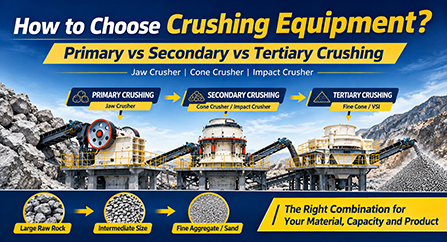
4. Mobile Jaw vs Impact vs Cone Crusher
Choosing the right crusher type is not about selecting the “cheapest” machine. It is about matching the crusher to the material, maximum feed size, crushing stage, final aggregate requirement and full production process.
| Equipment | Typical Role | Key Selection Consideration | Typical Project Direction |
|---|---|---|---|
| Mobile Jaw Crusher | Primary crushing | Maximum feed size, rock hardness, initial reduction requirement and downstream process | Large rock, quarry feed, road aggregate, mining feed preparation |
| Mobile Impact Crusher | Primary, secondary or tertiary crushing | Material characteristics, moisture, particle shape requirement and wear-part planning | Limestone, recycled concrete, soft-to-medium rock and shaped aggregate production |
| Mobile Cone Crusher | Secondary or tertiary crushing | Hardness, abrasiveness, desired product sizes and requirement for closed-circuit crushing | Granite, basalt, river stone, hard-rock aggregate and multi-stage crushing |
| Mobile Screen | Material classification | Required final products, screen area, number of decks and product gradation | Finished aggregate separation, scalping and closed-circuit production |
For limestone, the choice between a jaw crusher and an impact crusher depends on the process requirement. A mobile jaw crusher is commonly considered when the feed material is large and primary reduction is needed. A mobile impact crusher can be a strong option when limestone is relatively soft, the feed condition is suitable and the project requires good aggregate particle shape.
Crushing limestone? Do not choose a jaw crusher or impact crusher by price alone. Confirm your maximum feed size, target capacity, required final product sizes and whether you need crushing only or a complete crushing and screening system.
Read HAMAC’s mobile crusher selection guide for stone quarry projects to compare crusher types, site conditions and configuration directions.
5. Additional Costs Beyond the Mobile Crusher Price
The equipment quotation is not always the same as the final project cost. International buyers should evaluate the complete landed cost and project startup cost before making a purchasing decision.
| Additional Cost Item | Why It Should Be Included in Budget Planning |
|---|---|
| Ocean freight | Mobile plant dimensions, weight, shipping route, container or breakbulk method can affect freight planning |
| Inland transport | Transport from port to quarry, mine or project site may require route planning and local permits |
| Port charges and customs clearance | Port handling, local documentation and clearance procedures vary by destination |
| Import duties and taxes | Taxes, duties and local regulations differ by country and should be checked locally |
| Site preparation | Access roads, working area, stockpile zones, drainage and electrical preparation may be required |
| Installation and commissioning | Project startup may include mechanical setup, electrical connection, testing and operator training |
| Fuel or electricity | Power source and daily operating hours directly affect ongoing operating cost |
| Wear parts | Jaw plates, impact blow bars, liners, cone wear parts and screen media should be planned according to material abrasiveness |
| Maintenance | Lubricants, filters, belts, hydraulic components and preventive maintenance affect availability |
| Labor and training | Operators, loaders, maintenance staff and safety training must be considered |
| Environmental equipment | Dust suppression, noise control and water management may be required depending on local conditions |
A lower mobile crusher price does not automatically mean a lower total project cost. A properly configured plant may reduce material rehandling, avoid unnecessary haulage, improve product classification and reduce the risk of costly production interruptions.
6. Mobile vs Stationary Crusher: Which Is More Economical?
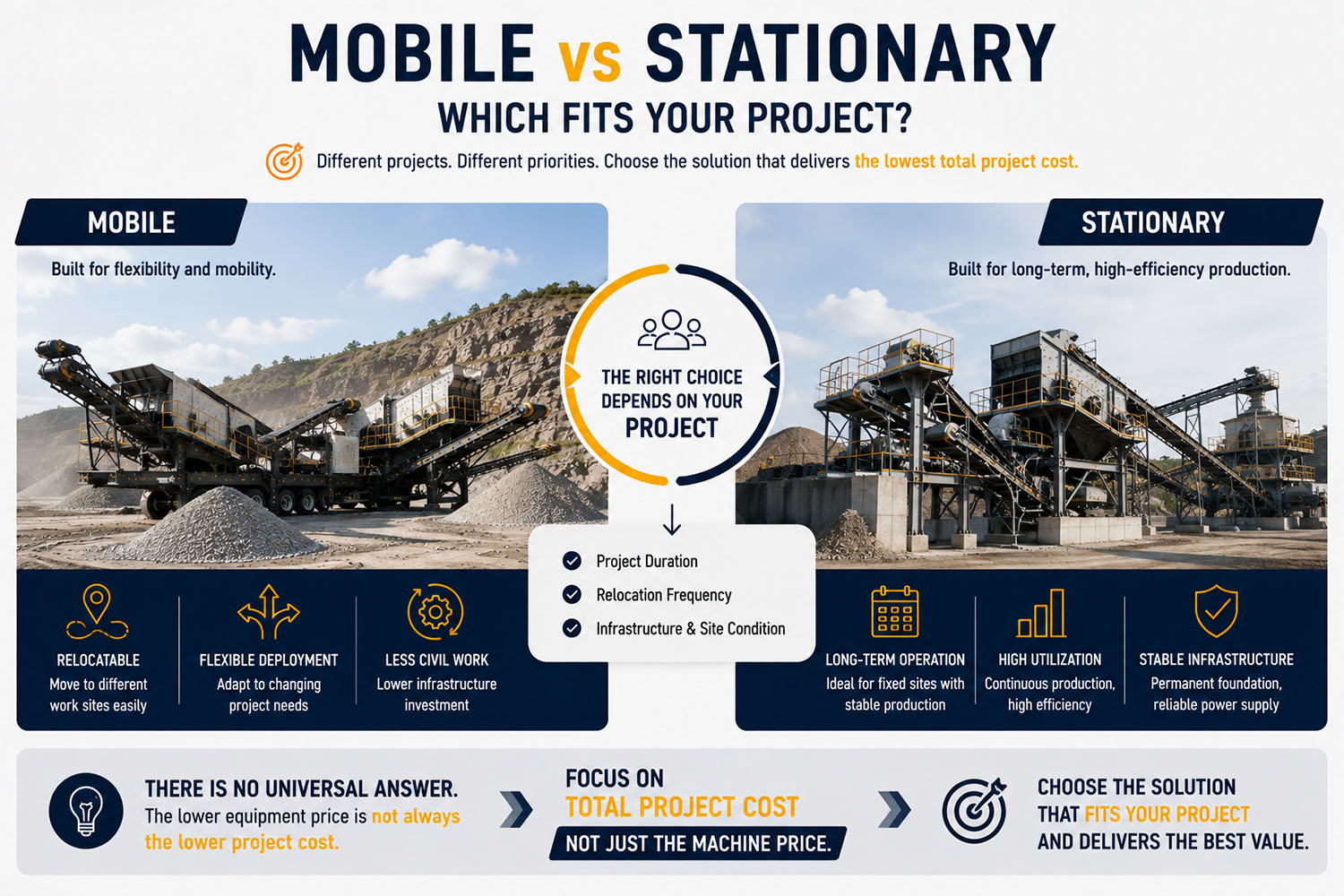
A mobile crushing plant is not always cheaper than a stationary crushing plant, and a stationary plant is not always the better long-term investment. The correct comparison is: which solution gives the lower total project cost for your production model?
| Project Factor | Mobile Crushing Plant | Stationary Crushing Plant |
|---|---|---|
| Relocation | Suitable for projects where the working face changes or equipment must serve multiple sites | Best suited to a fixed production location |
| Foundation and civil works | Usually reduces dependence on permanent site construction | Typically requires more permanent civil works and installation planning |
| Setup speed | Can support faster deployment for temporary, remote or project-based work | Requires a longer setup process but can support a stable long-term layout |
| Multiple sites | Can be relocated between quarry faces, contracts or project locations | Usually dedicated to one established production site |
| Project duration | Often attractive for short-to-medium term, contract or shifting-location projects | Often attractive for long-term, high-volume production at a stable site |
| Site conditions | Useful in remote, rough-terrain or infrastructure-limited locations | Best where land, power, civil works and long-term site planning are available |
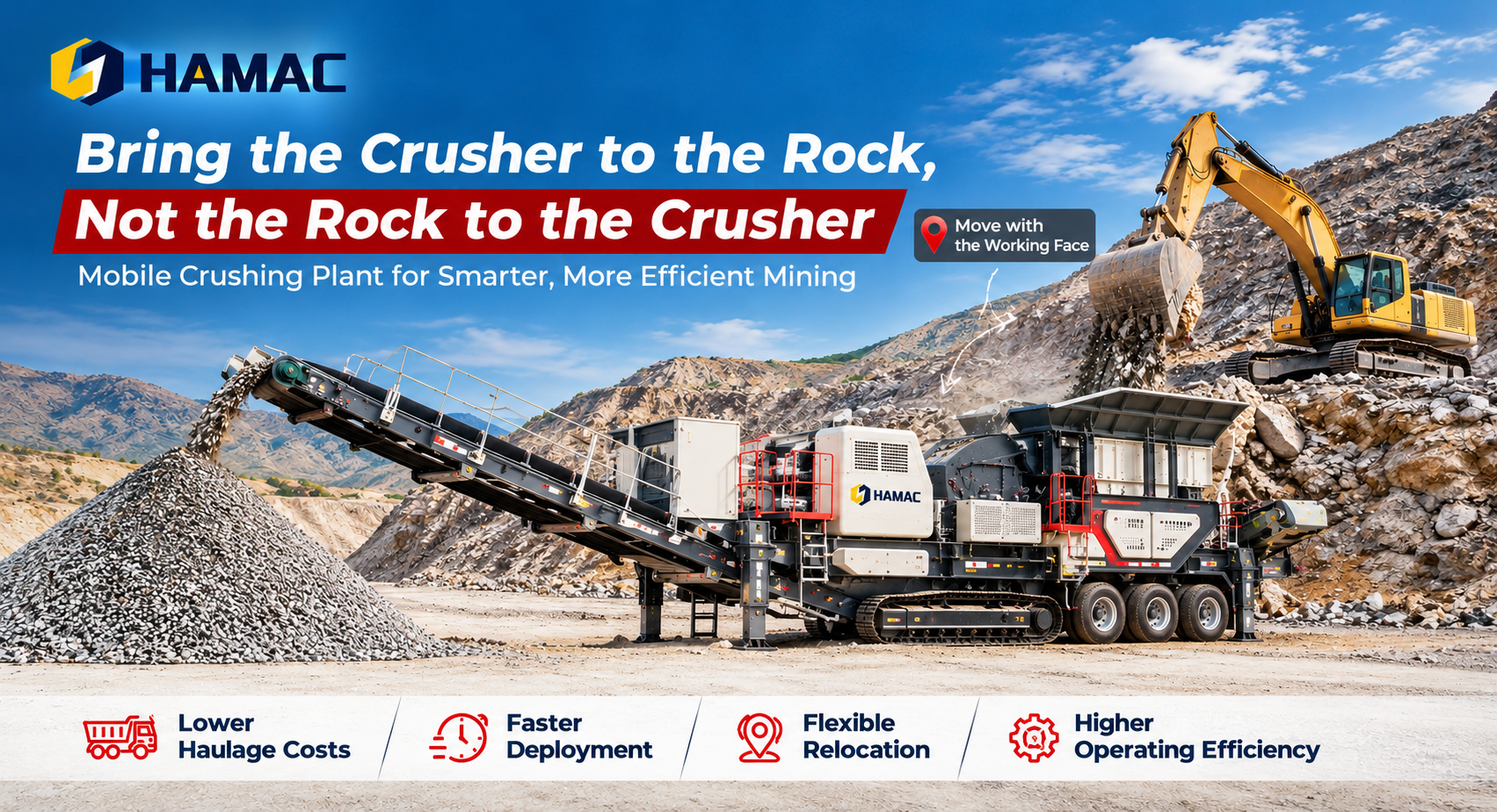
For a quarry with an advancing working face, moving the crusher closer to the material can reduce long-distance raw-material haulage. For a long-term, high-volume operation with a stable feed source and permanent infrastructure, a stationary crushing line may offer a different cost advantage.
See HAMAC’s guide to mobile crushing plants versus stationary crushing solutions for a practical comparison based on relocation, haulage, infrastructure and project duration.
7. How to Calculate Mobile Crusher Operating Cost
Purchase price is only one part of the investment decision. For quarry, mining, aggregate and recycling projects, a more useful management indicator is cost per ton.
Cost per Ton = Total Operating Cost ÷ Actual Saleable Production
Actual saleable production should be based on the material that meets your final product specification, not only the material fed into the crusher.
| Operating Cost Component | What to Track |
|---|---|
| Fuel cost | Fuel consumption per operating hour, local diesel price and actual utilization |
| Electricity cost | Power consumption, local electricity tariff, demand charges and operating hours |
| Wear parts | Jaw plates, liners, blow bars, mantles, concaves, screen media and replacement frequency |
| Labor | Operator, loader operator, maintenance staff and supervision requirements |
| Maintenance | Filters, lubricants, belts, hydraulic components, inspections and planned service |
| Downtime | Lost production caused by wear-part replacement, maintenance delays, blocked feed or equipment failure |
| Material handling | Loader cycles, truck haul distance, stockpile handling and rehandling requirements |
Example: if a plant has a daily operating cost of US$8,000 and produces 1,000 tons of saleable aggregate that meets specification, the operating cost is US$8 per ton. If poor feed preparation, excessive downtime or unsuitable screening reduces saleable production to 800 tons while daily operating cost remains similar, the cost becomes US$10 per ton.
This is why the lowest initial equipment price is not always the lowest-cost solution over the life of a crushing project.
8. Should You Buy or Rent a Mobile Crusher?
Some buyers searching for mobile crusher cost are still deciding whether to buy equipment or use a rental solution. The right choice depends on project duration, annual utilization, maintenance capability, relocation frequency, expected idle time and potential resale value.
| Situation | Direction to Evaluate |
|---|---|
| Short-term project or uncertain workload | Rental may reduce initial capital commitment and idle-equipment exposure |
| Frequent work across multiple projects | Compare rental cost with expected annual utilization and relocation requirement |
| Long-term quarry or repeated aggregate production | Purchasing may provide stronger equipment control and long-term asset value |
| Limited maintenance capability | Evaluate local support, service availability, operator capability and spare-parts planning |
| High expected utilization | Ownership may become more economical when the plant is used consistently over time |
Whether buying or renting, the same technical questions still apply: material, feed size, capacity, final products, mobility requirement, power system and available service support.
9. How to Compare Mobile Crusher Quotations
Before comparing supplier prices, make sure every quotation is based on the same project input and the same scope of supply.
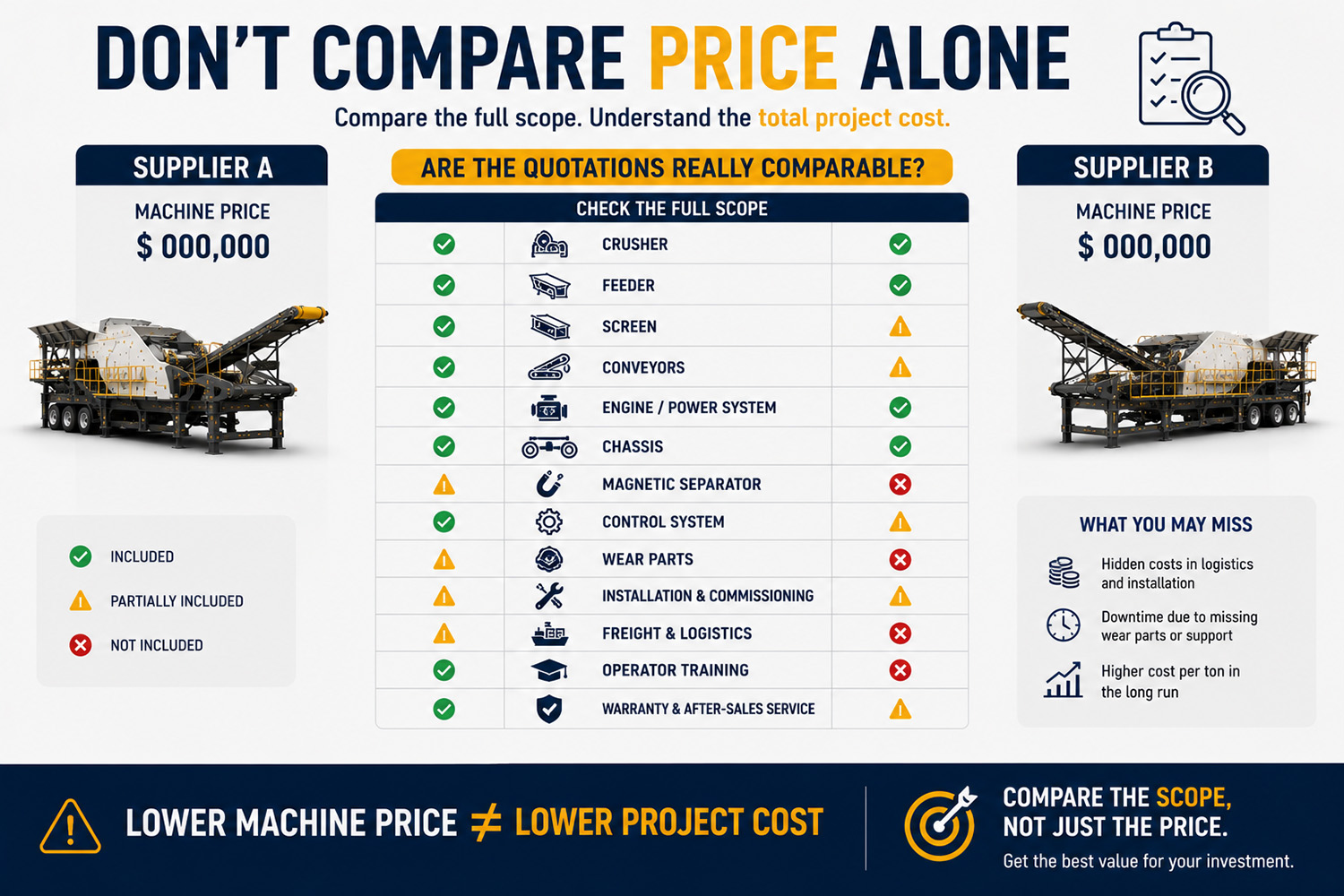
Do not compare only the machine price. Compare the complete scope of supply, expected production conditions, delivery terms and after-sales commitment.
10. How to Get an Accurate Mobile Crusher Price
An accurate mobile crusher budgetary quotation requires basic project information. The more complete the input data, the more useful the proposed configuration and quotation will be.
| Information Required | Why It Matters |
|---|---|
| Material to be processed | Helps determine crusher type, wear-part planning and crushing process |
| Maximum feed size | Helps determine crusher inlet size, feeder configuration and primary crushing requirement |
| Target capacity in TPH | Helps determine crusher size, screen size, conveyor capacity and overall plant scale |
| Required final product sizes | Helps determine crusher setting, screen configuration and need for recirculation |
| Number of final products | Helps define screening decks, discharge conveyors and stockpile layout |
| Site condition and terrain | Helps determine tracked or wheeled mobility and site deployment requirements |
| Working hours per day | Helps evaluate practical daily production and power planning |
| Power source preference | Helps define diesel, electric or other power configuration |
| Project location or destination port | Helps plan shipping terms, transport method and delivery scope |
| Existing equipment | Helps evaluate integration with existing feeders, screens, conveyors, loaders or stationary equipment |
What material are you processing? This is the best starting point for a mobile crusher recommendation. Then confirm your feed size, target capacity, final product sizes, site condition and delivery location.
11. HAMAC Mobile Crushing Solutions
Looking for a mobile crusher for a specific material and production target? HAMAC can recommend a suitable configuration based on your project requirements rather than asking you to select a machine model without enough technical information.
HAMAC’s mobile crushing solution range includes:
- Wheel-Type Mobile Crushing Plants
- Tracked Mobile Jaw Crusher Plants
- Tracked Mobile Impact Crusher Plants
- Tracked Mobile Cone Crusher Plants
- Tracked Mobile Screening Plants
- Mobile 4-in-1 Crushing and Screening Plants
- Modular Crushing Plants
- Mobile Crushing Plant Cases
For quarry, mining, aggregate, road construction, railway, recycled concrete and temporary crushing projects, the appropriate solution may be a mobile jaw crusher, mobile impact crusher, mobile cone crusher, mobile screen, integrated 4-in-1 plant or a complete multi-stage mobile crushing and screening line.
HAMAC can evaluate the material, feed size, target capacity, final products, terrain, relocation frequency, power supply and destination requirements to recommend a practical equipment configuration.
12. Frequently Asked Questions
How much does a mobile crusher cost?
A mobile crusher does not have one fixed price. Cost depends on the crusher type, required capacity, material characteristics, feed size, tracked or wheeled chassis, power system, screening requirement, optional modules, spare-parts package and delivery scope. A compact standalone crusher and a complete multi-stage mobile crushing and screening plant should not be compared by price alone.
How much does a 100 TPH mobile crusher cost?
The cost of a 100 TPH mobile crusher depends on the material, maximum feed size, crusher type, final product requirement, tracked or wheeled configuration, power package and whether screening is included. A 100 TPH limestone crusher solution may require a different configuration from a 100 TPH granite, basalt, recycled concrete or iron ore crushing project.
How much does a 200 TPH mobile crusher cost?
A 200 TPH mobile crusher quotation should be based on the complete process requirement. Depending on the material and final products, the solution may include a mobile jaw crusher, mobile impact crusher or mobile cone crusher, plus a mobile screen, return conveyor, magnetic separator, dust control system and other optional modules.
Is a tracked mobile crusher more expensive than a wheeled mobile crusher?
A tracked mobile crusher may require a different initial investment because it includes a self-propelled crawler chassis designed for on-site movement in quarry, mine or uneven terrain. A wheeled mobile crusher may be suitable where road access and trailer transport are available. The better choice depends on relocation frequency, terrain, transport method and total project cost.
Which mobile crusher is best for hard rock?
Hard-rock projects involving granite, basalt, river stone or similar abrasive materials often require a robust multi-stage crushing process. A mobile jaw crusher may be used for primary crushing, while a mobile cone crusher and mobile screening plant may be considered for secondary crushing, final product control and recirculation. Final selection depends on feed size, required capacity and finished aggregate specification.
Is a mobile crusher cheaper than a stationary crusher?
Not always. A mobile crusher can reduce permanent civil works, improve flexibility and reduce raw-material haulage when the working face moves or multiple sites are involved. A stationary crushing line may be more economical for long-term, high-volume production at one stable site with established infrastructure. Compare total project cost, not only the equipment purchase price.
What is included in a mobile crusher quotation?
A mobile crusher quotation may include the main crusher, feeder, hopper, tracked or wheeled chassis, engine or motor, conveyors, screening equipment, magnetic separator, dust suppression, control system, spare parts, commissioning, training and shipping terms. Always confirm the full scope of supply before comparing prices from different suppliers.
13. Request a Project-Based Mobile Crusher Quotation
Tell us your material, maximum feed size, target capacity, final product requirements, site conditions and project location. HAMAC can recommend a suitable mobile crushing configuration for your quarry, mining, aggregate, road construction or recycling project.
Get a Mobile Crusher Budgetary Quotation based on your actual project requirements, not a generic one-size-fits-all price.
Request a Mobile Crushing Solution
To speed up your evaluation, include the following information in your inquiry:
- Material to be crushed
- Maximum feed size
- Required capacity in TPH
- Required final product sizes
- Number of aggregate products required
- Tracked or wheeled mobility preference, if known
- Power source available at the project site
- Destination country and nearest port
- Photos or videos of the raw material and worksite, if available
Explore HAMAC Mobile Crushing Plants | Explore HAMAC Tracked Crushing Plants | View Mobile Crusher Project Cases