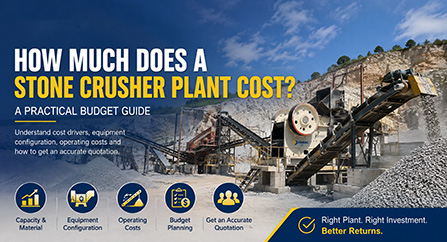




How Much Does a Stone Crusher Plant Cost? A Practical Budget Guide Based on Capacity, Equipment Configuration and Project Conditions
How much does a stone crusher plant cost? There is no single universal price for every crushing plant. The final budget depends on the required capacity, raw material, maximum feed size, final product sizes, number of crushing stages, equipment configuration, plant type, transportation, installation, civil works and environmental requirements.
For this reason, a project-based equipment configuration is more useful than a generic price list. Before asking about the price, buyers should first determine what type of crushing plant they actually need.
This guide explains how to estimate a stone crusher plant budget, select the right equipment by capacity, compare mobile and stationary solutions, calculate operating costs and prepare the information required for an accurate quotation.
Important: The examples in this guide describe typical equipment configurations, not fixed HAMAC quotations. Actual prices vary according to project requirements, destination, equipment scope and site conditions.
How Much Does a Stone Crusher Plant Cost?
A complete stone crusher plant can have very different investment requirements depending on its production target and process design. A small 30–50 TPH plant is not comparable with a 250–300 TPH commercial aggregate production line.
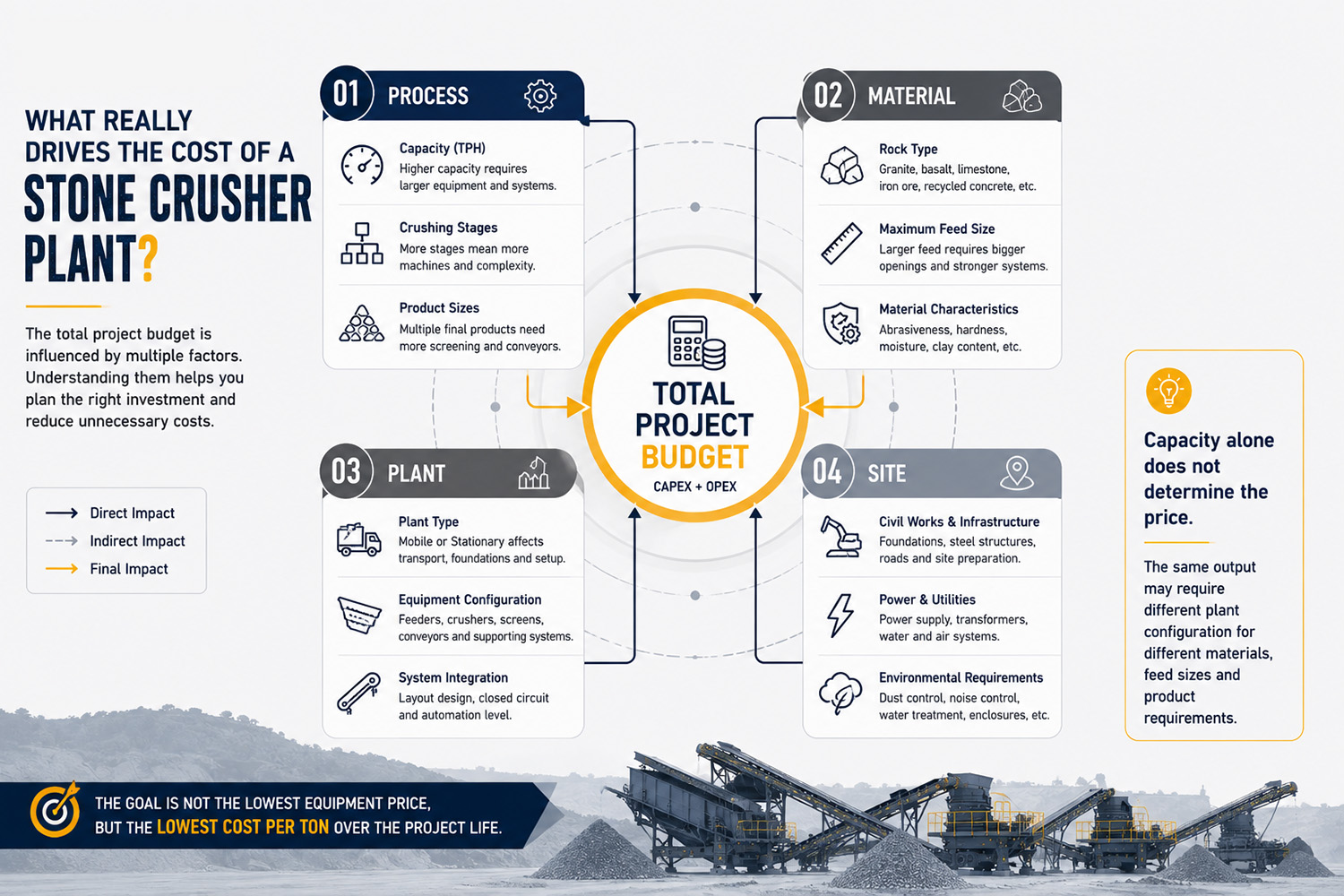
The total project budget is normally affected by the following factors:
| Cost driver | Why it affects the budget |
|---|---|
| Required capacity | Higher capacity usually requires larger crushers, feeders, screens, conveyors and supporting systems. |
| Raw material | Granite, basalt, limestone, river stone, iron ore and construction waste require different equipment combinations. |
| Maximum feed size | Larger feed material may require a larger crusher opening, stronger feeding equipment and additional pre-screening. |
| Final product sizes | Several finished products may require multi-layer screens, additional conveyors and a closed-circuit process. |
| Number of crushing stages | Primary, secondary and tertiary crushing require different machines and increase system complexity. |
| Plant type | Mobile and stationary plants have different requirements for transportation, foundations, installation and relocation. |
| Site conditions | Terrain, available space, power supply, access roads and drainage may affect construction and installation work. |
| Environmental requirements | Dust suppression, enclosure, water systems and dry collection equipment may be required by the project or local regulations. |
In other words, capacity alone does not determine the price. The same 200 TPH target may require a different plant configuration for limestone, granite, basalt or recycled concrete.
What Kind of Crushing Plant Do You Actually Need?
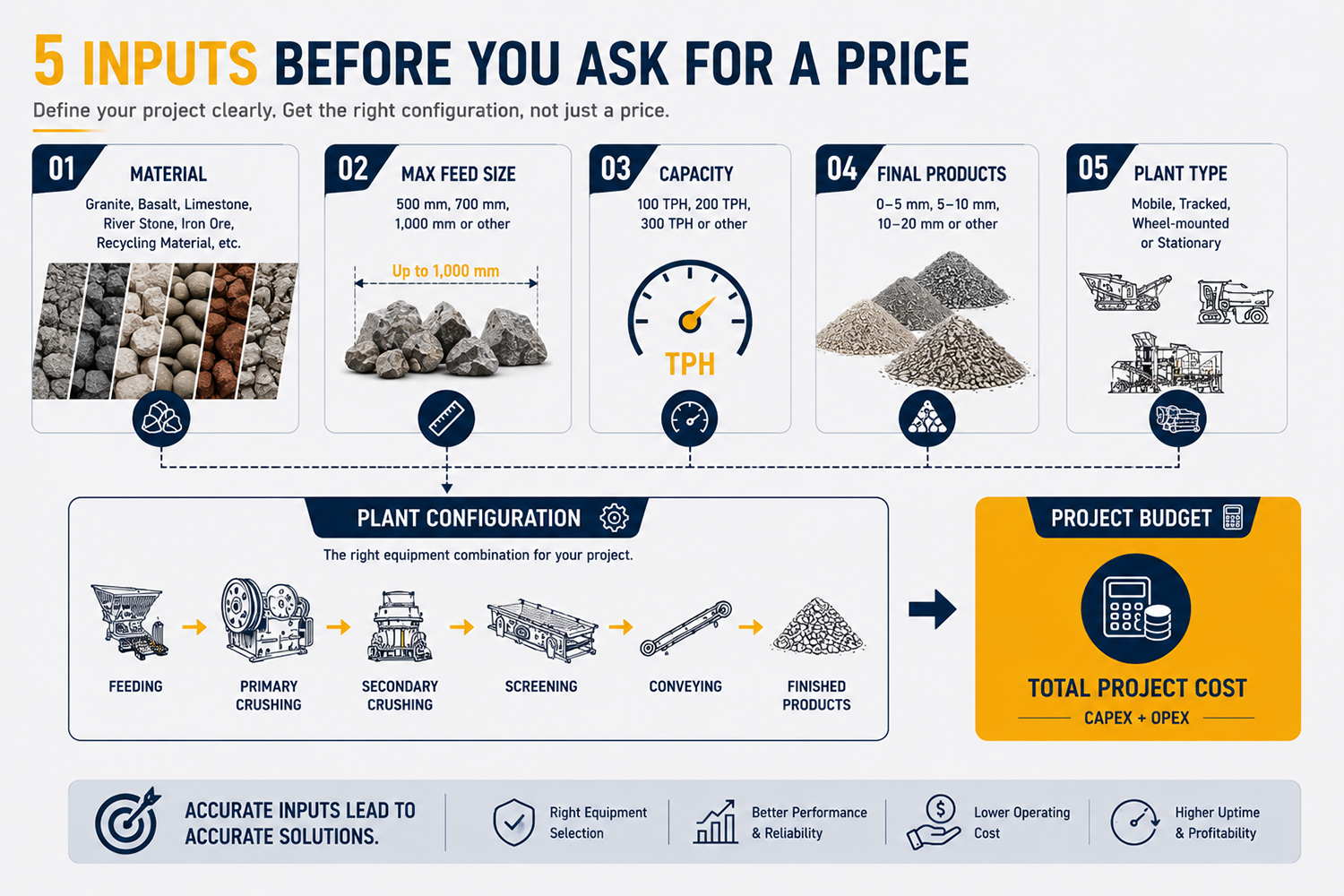
Before selecting a crusher, define the project requirements. A practical equipment recommendation should be based on at least five inputs:
| Project input | Example | How it affects equipment selection |
|---|---|---|
| Material | Granite, basalt, limestone, river stone or iron ore | Determines crusher type, wear-part requirements and crushing stages. |
| Maximum feed size | 500 mm, 700 mm or 1,000 mm | Influences the crusher opening and feeding system. |
| Required capacity | 100 TPH, 200 TPH or 300 TPH | Determines the scale of the complete plant. |
| Final products | 0–5 mm, 5–10 mm and 10–20 mm | Determines the number of screen layers and product conveyors. |
| Plant mobility | Mobile or stationary | Influences foundations, transportation, relocation and installation. |
Jaw crusher sizing also depends on material characteristics, maximum feed size, desired product size and feed rate. A crusher should not be selected by TPH alone. The maximum feed size and the required product curve must also be checked before finalizing the model.
For more information about HAMAC mobile and tracked equipment, visit the HAMAC tracked crushing plants page.
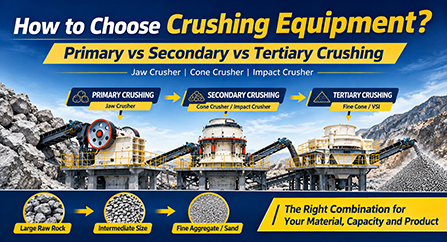
What Equipment Is Included in a Stone Crushing Plant?
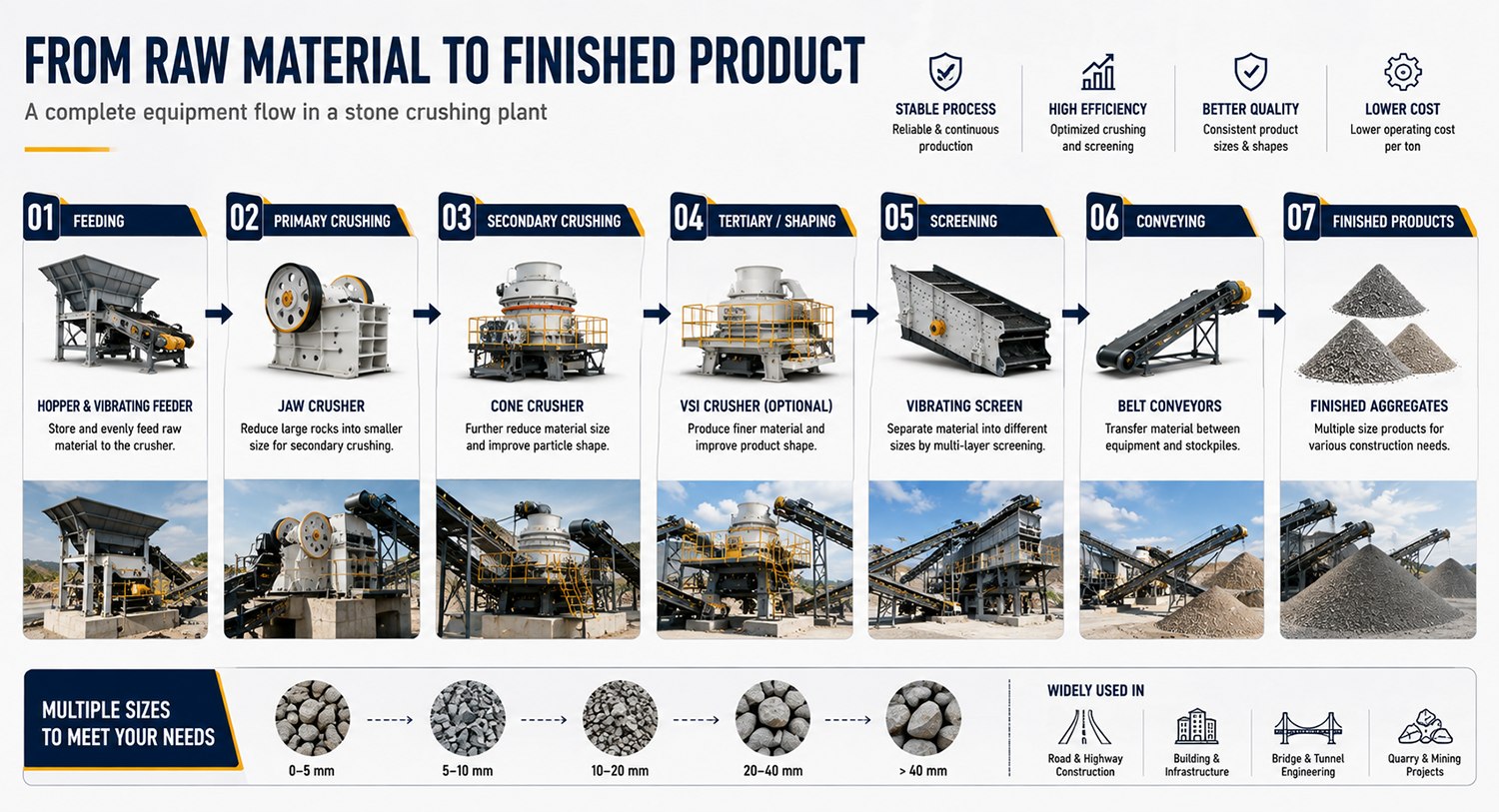
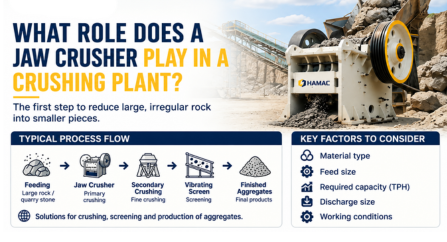
A complete stone crushing plant is a process system rather than a single machine. The equipment normally works in the following sequence:
| Process stage | Common equipment | Main function |
|---|---|---|
| Feeding | Hopper, vibrating feeder or grizzly feeder | Controls the material flow and removes or separates unwanted fines. |
| Primary crushing | Jaw crusher | Reduces large raw material into a size suitable for the next stage. |
| Secondary crushing | Cone crusher or impact crusher | Produces smaller aggregate and improves control of the product size. |
| Tertiary crushing or shaping | VSI crusher or fine cone crusher | Produces finer material or improves particle shape when required. |
| Screening | Vibrating screen | Separates crushed material into different finished products. |
| Conveying | Belt conveyors and return conveyors | Moves material between machines and returns oversize material in a closed circuit. |
| Supporting systems | Electrical control, steel structure, dust suppression and access platforms | Supports safe, stable and continuous plant operation. |
Depending on the raw material and product requirements, a plant may use only primary crushing and screening, or may require jaw crushing, secondary cone crushing, tertiary shaping and multiple screening stages.
Typical Stone Crusher Plant Configuration by Capacity
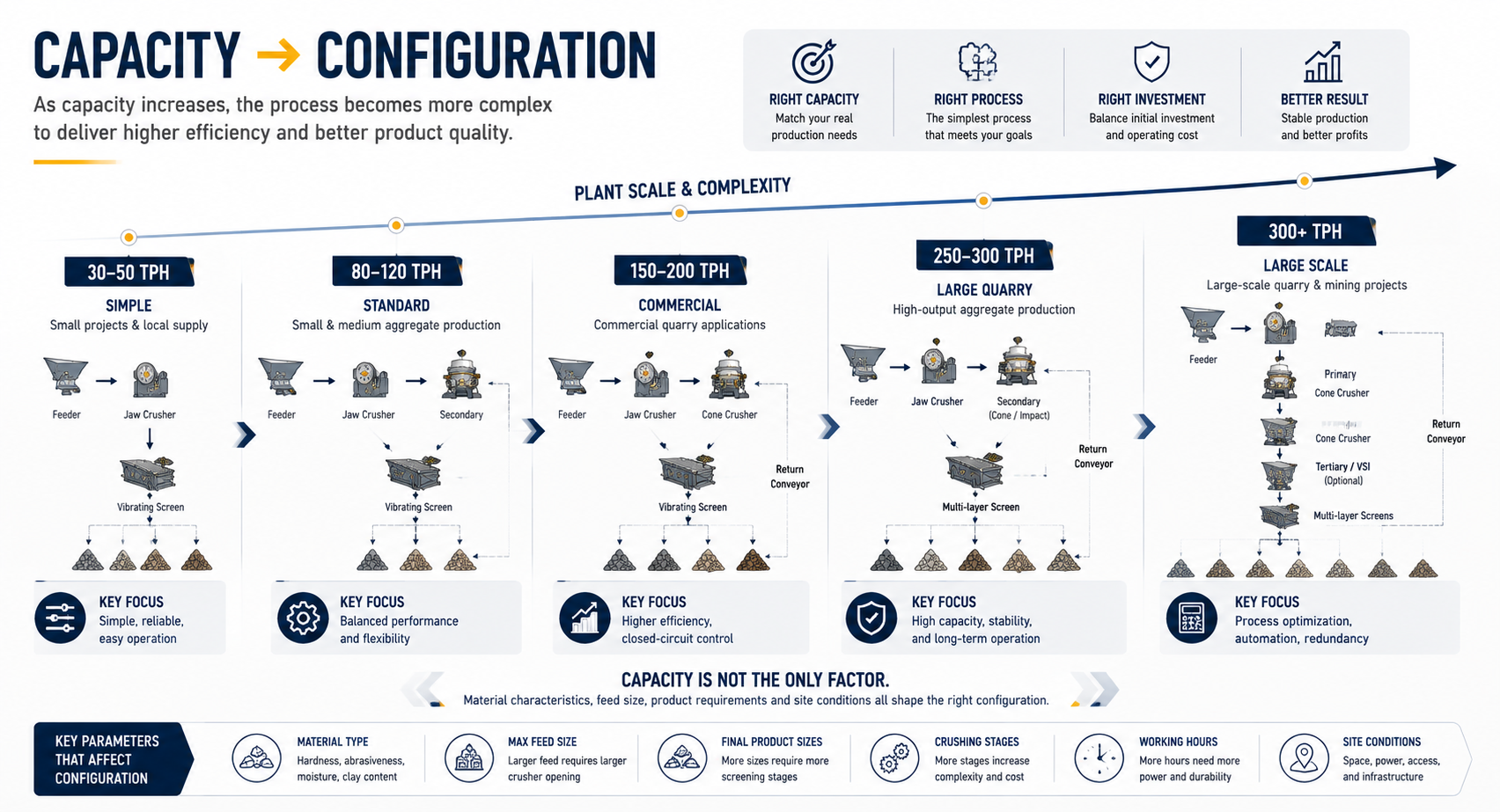
The following table provides typical configuration directions. It is not a fixed price list and should not be treated as a final equipment quotation.
| Target capacity | Typical application | Typical configuration direction | Main budget drivers |
|---|---|---|---|
| 30–50 TPH | Small quarry, local aggregate supply or construction project | Hopper or feeder + jaw crusher + vibrating screen + conveyors | Equipment size, mobility, screening requirements and site access |
| 80–120 TPH | Small and medium aggregate production | Feeder + jaw crusher + cone or impact crusher + screen | Secondary crushing, screen capacity, conveyors and power system |
| 150–200 TPH | Commercial quarry and hard-rock aggregate production | Feeder + primary jaw crusher + cone crusher + screen + return conveyor | Crushing stages, closed-circuit screening and overall plant integration |
| 250–300 TPH | Large quarry, highway aggregate or mining project | Primary jaw crusher + secondary cone or impact crusher + multiple screens + conveyors | Equipment capacity, screen area, automation, foundations and conveying distance |
| Above 300 TPH | Large-scale quarry and long-term aggregate production | Multi-stage crushing and screening, optional VSI shaping and redundant systems | Plant layout, infrastructure, automation, power distribution and maintenance access |
Capacity alone does not determine the price. The final equipment list also depends on the material hardness, abrasiveness, maximum feed size, moisture, clay content, required final products and working hours.
Example: 150–200 TPH Granite Aggregate Plant
Suppose a customer needs to produce 150–200 TPH of granite aggregate. Granite is generally harder and more abrasive than many soft-rock materials, so the equipment selection should focus on stable feeding, suitable crushing reduction and wear-part planning.
A typical process direction may be:
Hopper → Vibrating Feeder → Jaw Crusher → Cone Crusher → Vibrating Screen → Return Conveyor
| Equipment | Role in the process | Questions to confirm |
|---|---|---|
| Hopper and feeder | Provides stable and continuous feed to the primary crusher. | What is the maximum feed size? Is the material wet or clayey? |
| Jaw crusher | Performs primary reduction of large granite rocks. | What feed opening and discharge size are required? |
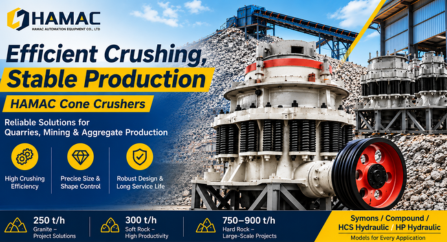
| Cone crusher | Performs secondary crushing for harder and abrasive material. | What final sizes and liner cavity are required? |
| Vibrating screen | Separates the crushed granite into different aggregate sizes. | How many finished products are required? |
| Return conveyor | Returns oversize material for further crushing in a closed circuit. | What is the expected circulating load and conveyor distance? |
If the project also requires manufactured sand, the configuration may need an additional VSI crusher, fine screening and possibly a washing system. The final choice should be based on the required product shape, fines content and finished sand specification.
For a project-specific design, customers can also review HAMAC crusher and screening plant articles and project and company updates.
How Material Type Changes Equipment Selection
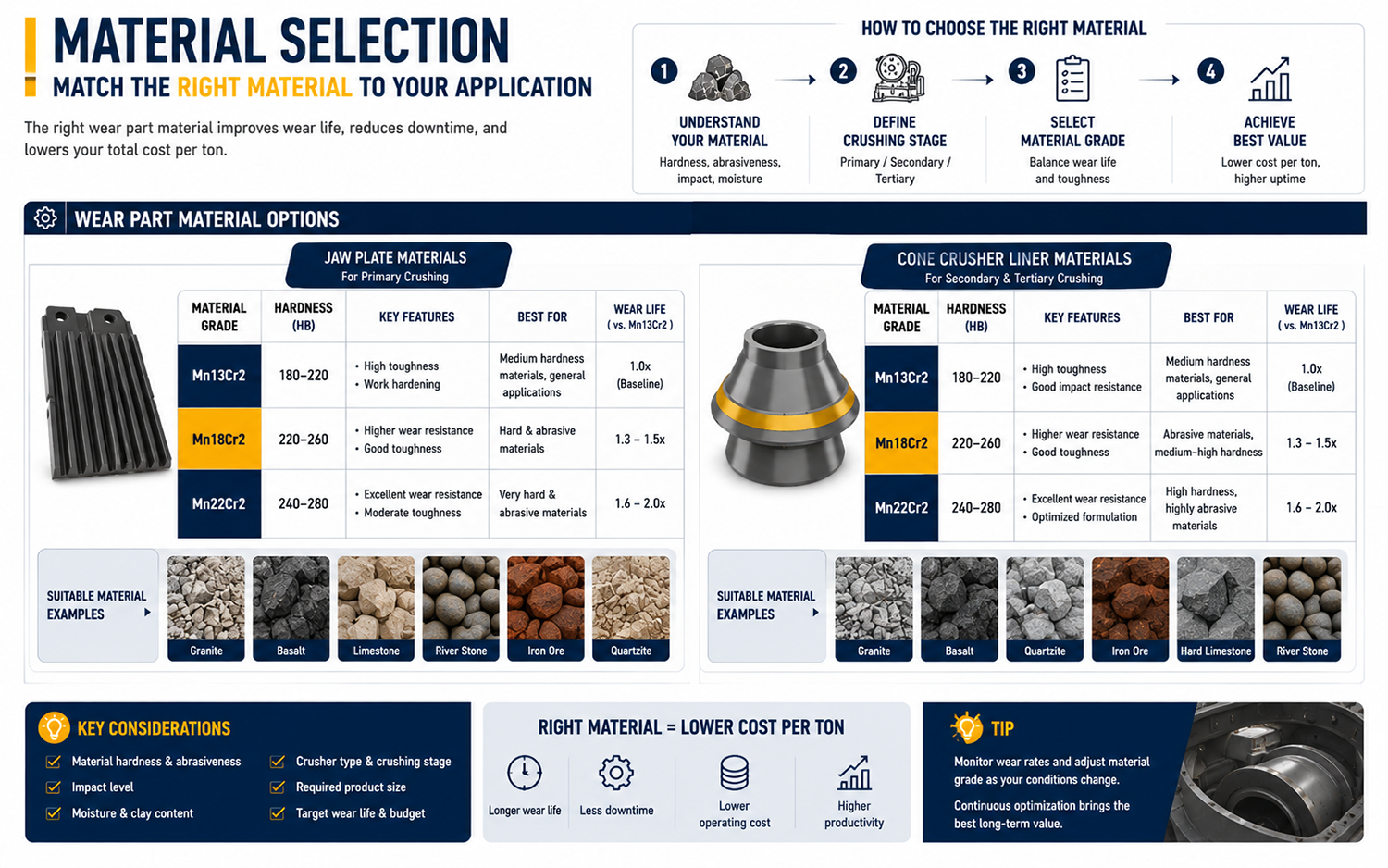
Different materials can require different crushing processes even when the target capacity is the same.
| Material | Typical characteristics | Possible equipment direction |
|---|---|---|
| Limestone | Often softer than granite and basalt; product shape may be important. | Jaw crusher + impact crusher or cone crusher + screen. |
| Granite | Hard and abrasive, with higher wear-part requirements. | Jaw crusher + cone crusher + screen. |
| Basalt | Hard, dense and abrasive material used for high-quality aggregate. | Jaw crusher + cone crusher, with optional shaping equipment. |
| River stone | Rounded feed, possible moisture and natural fines. | Grizzly feeder or pre-screening + jaw crusher + secondary crusher. |
| Iron ore | High density and possible downstream beneficiation requirements. | Jaw crusher + cone crusher with additional mineral processing equipment when required. |
| Construction waste | May contain steel, wood, soil and other unwanted materials. | Jaw or impact crusher + screen + magnetic separation and recycling equipment. |
The best configuration is not determined by the material name alone. Moisture, clay content, abrasiveness, feed size and final product requirements should be checked together.
Mobile vs Stationary Stone Crusher Plant
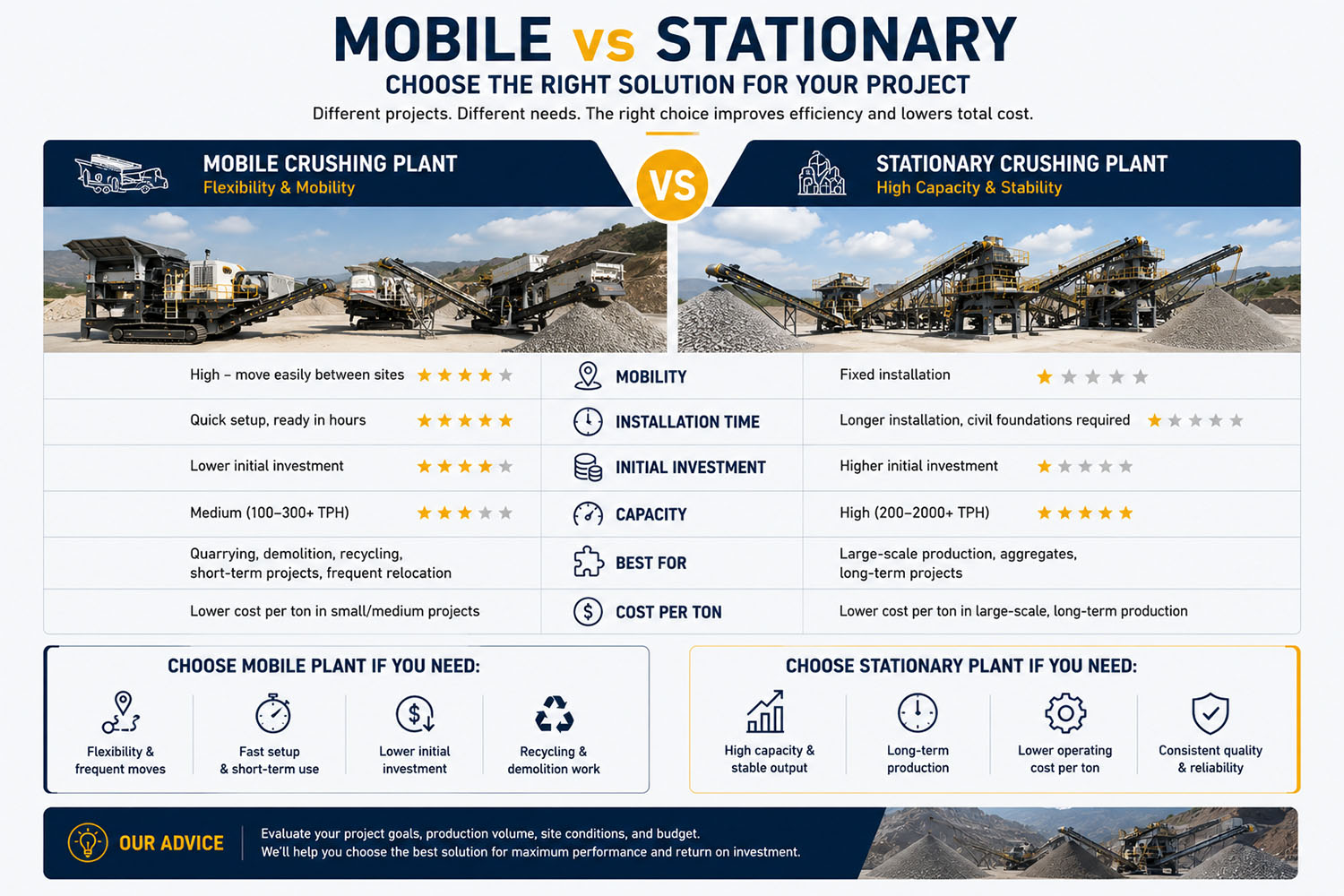
Mobile and stationary crushing plants should be compared according to the project life cycle, not only by the initial equipment price.
| Decision factor | Mobile crushing plant | Stationary crushing plant |
|---|---|---|
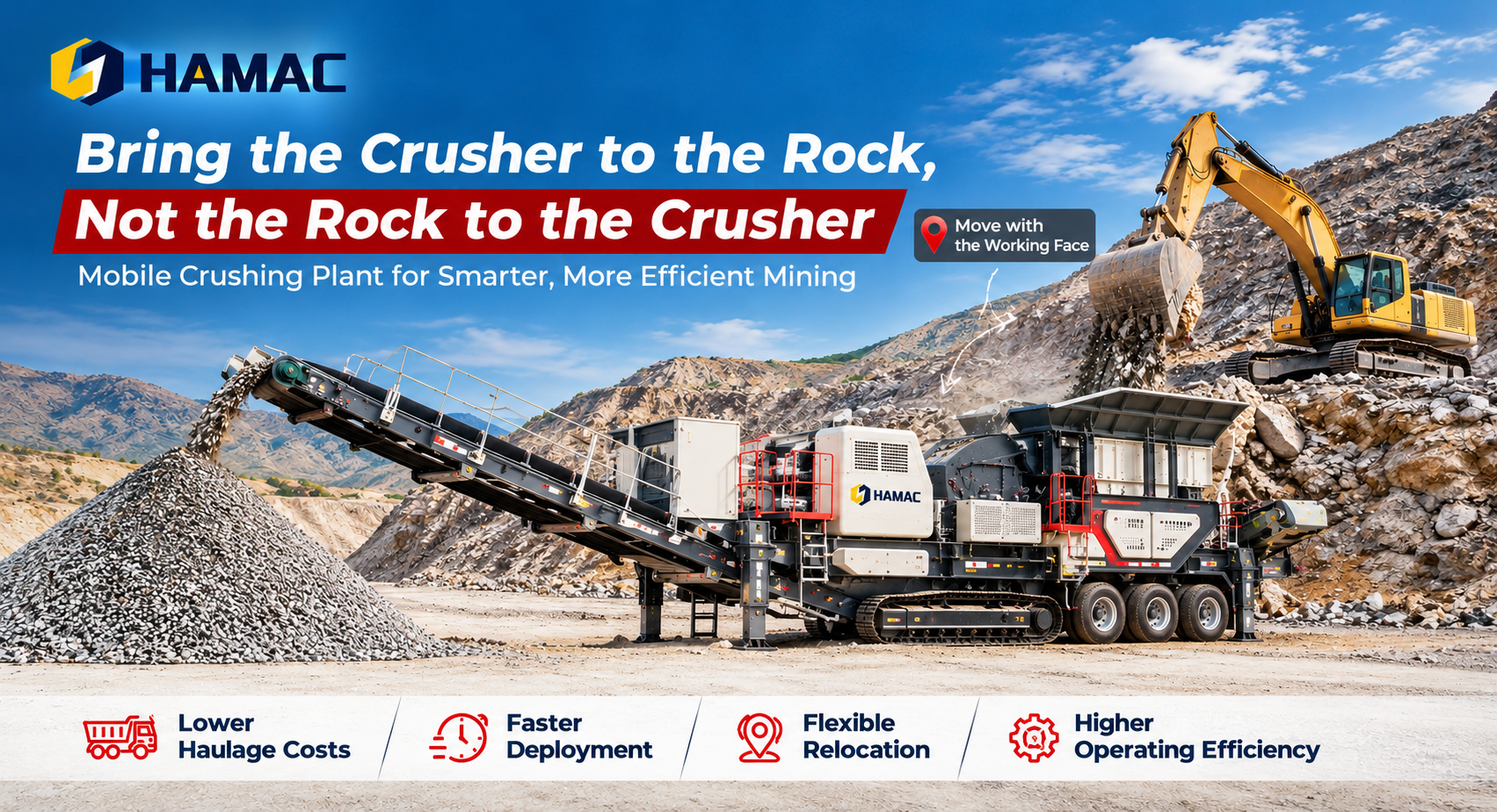
| Project location | Suitable for changing quarry faces, road projects and multiple sites. | Suitable for a fixed quarry or long-term production site. |
| Relocation | Designed for easier movement within or between working areas. | Relocation usually requires more dismantling and civil work. |
| Civil works | May reduce the need for permanent foundations, depending on the equipment. | Usually requires more detailed foundations, structures and site preparation. |
| Long-term production | Can be suitable when flexibility and relocation are important. | Often suitable for stable, continuous and large-scale production. |
| Transportation | Transport and relocation costs should be included in the project evaluation. | Initial delivery and installation are important; later relocation is more complex. |
| Best decision basis | Project duration, relocation frequency, site conditions and required flexibility. | Long-term output, available infrastructure, plant layout and production stability. |
A mobile crusher is not automatically cheaper than a stationary plant. The better option depends on project duration, relocation frequency, available infrastructure, required capacity and long-term production plans.
HAMAC's tracked crushing plants are designed for on-site processing and relocation within production sites or between sites. The HMC tracked vibrating screening plant page lists a processing capacity of 200–500 t/h, a maximum feed size of 200 mm, three screening layers and a total power of 68.5 kW for the listed MS-3618E configuration.
See the HAMAC tracked vibrating screening plant page for the published technical data and equipment details.
What Equipment Is Included in the Project Budget?
When comparing stone crusher plant prices, buyers should confirm whether the quotation includes the complete process system or only the main crusher.
| Budget category | Items to confirm |
|---|---|
| Crushing equipment | Jaw crusher, cone crusher, impact crusher or VSI crusher. |
| Feeding system | Hopper, vibrating feeder, grizzly and feed chute. |
| Screening system | Vibrating screen, screen decks, mesh panels and support structure. |
| Conveying system | Main conveyors, transfer conveyors, return conveyors and discharge chutes. |
| Electrical system | Control cabinet, cables, sensors, motors and site wiring. |
| Steel structure | Platforms, walkways, supports, chutes and maintenance access. |
| Civil works | Foundations, concrete works, drainage, site preparation and access roads. |
| Installation | Assembly, electrical connection, testing, commissioning and operator training. |
| Logistics | Freight, inland transport, port handling, insurance, customs and delivery. |
| Environmental equipment | Water spray, dry collection, enclosure, dust extraction and noise-control measures. |
| Initial spare parts | Jaw plates, cone liners, screen panels, conveyor belts and critical maintenance parts. |
Initial Investment vs Operating Cost
The cheapest equipment price does not always produce the lowest cost over the operating life of a crushing plant. Buyers should distinguish between initial investment and operating cost.
| Initial investment | Operating cost |
|---|---|
| Crusher, feeder and screen | Electricity or fuel |
| Conveyors and steel structures | Wear parts |
| Civil works and foundation | Labor |
| Transportation and installation | Lubrication and maintenance |
| Electrical and environmental systems | Loading, internal transport and downtime |
A useful operating-cost calculation is:
Operating cost per ton = Total operating cost ÷ Actual production
Actual production should be used instead of only the rated capacity. Blockages, unstable feeding, maintenance shutdowns, material changes and screen recirculation can reduce the actual output of the plant.
How to Calculate Stone Crusher Operating Cost Per Ton
To estimate the operating cost of a stone crushing plant, collect the actual operating data for a representative period.
| Data item | Recommended calculation method |
|---|---|
| Energy or fuel | Monthly electricity or fuel cost divided by actual tons produced. |
| Wear parts | Cost of jaw plates, cone liners, screen panels and belts divided by the tons processed during their service life. |
| Maintenance | Routine maintenance, lubrication, repairs and service labor divided by actual production. |
| Labor | Operator, mechanic and supervisor costs allocated to the crushing operation. |
| Downtime | Estimated production loss and additional labor caused by unplanned stoppages. |
For a complete cost model, buyers should also consider the final product quality. Excessive fines, poor particle shape or repeated recirculation may increase production costs even when the main crusher is operating.
10 Costs Buyers Often Forget
Many project budgets include the main crusher but omit other costs required to start production. Before approving a quotation, check the following items:
| No. | Frequently overlooked cost | Why it matters |
|---|---|---|
| 1 | Foundation and civil works | Fixed plants may require concrete foundations, drainage and site preparation. |
| 2 | Electrical infrastructure | Transformers, cables, control cabinets and power connections may be separate. |
| 3 | Steel structures and platforms | Safe access, maintenance platforms and supports add to the project scope. |
| 4 | Conveyors | Long conveying distances require additional belts, structures and transfer points. |
| 5 | Initial wear parts | Jaw plates, cone liners and screen panels should be available before commissioning. |
| 6 | Freight and inland transport | Equipment size, route conditions and project distance influence delivery costs. |
| 7 | Customs and import charges | These depend on the country, product classification and import conditions. |
| 8 | Installation and commissioning | Assembly, wiring, testing and operator training may not be included in the machine price. |
| 9 | Dust and environmental protection | Dust suppression or collection may be required at crushers, screens and transfer points. |
| 10 | Initial operating funds | Fuel, electricity, labor, spare parts and maintenance require working capital before stable production. |
Dust control should be considered during plant design. Common control approaches include wet suppression at material flow points, enclosure and dry collection systems at dust-producing locations, and road-surface control for fugitive dust.
What Can Increase or Reduce Your Crusher Plant Budget?
| May increase the budget | May reduce unnecessary investment |
|---|---|
| Higher target capacity | Choosing equipment according to the actual production target |
| Harder and more abrasive material | Matching the crusher type to the material |
| More crushing stages | Using the simplest process that meets the final product requirements |
| More final product sizes | Optimizing the number of screen layers and conveyors |
| Longer conveying distances | Optimizing the plant layout and reducing unnecessary material handling |
| Higher automation requirements | Using automation that improves safety and production control |
| Remote project location | Planning transport, spare parts and maintenance access in advance |
| Higher environmental requirements | Designing dust-control equipment into the original plant layout |
Oversizing the plant can increase equipment, power and infrastructure costs, while undersizing may cause bottlenecks, overload and insufficient production. The best design should balance required output, material characteristics, capital cost and operating cost.
How to Compare Stone Crusher Plant Quotations
Do not compare supplier quotations by the crusher price alone. First confirm that each supplier is quoting the same capacity, feed size, final product sizes and equipment scope.
A lower quotation may not represent a lower project cost if it excludes conveyors, electrical equipment, civil works, installation, freight, spare parts or environmental systems.
What Information Do We Need to Estimate Your Crusher Plant Cost?
To prepare a project-based crushing plant recommendation, customers should provide the following information:
| Required information | Example |
|---|---|
| Raw material | Granite, basalt, limestone, river stone, iron ore or construction waste. |
| Maximum feed size | 500 mm, 700 mm or 1,000 mm. |
| Required capacity | 100 TPH, 150–200 TPH, 250–300 TPH or above. |
| Final product sizes | 0–5 mm, 5–10 mm, 10–20 mm or other specifications. |
| Material condition | Hardness, abrasiveness, moisture and clay content. |
| Working schedule | 8 hours per day, 16 hours per day or continuous production. |
| Plant type | Mobile, tracked, wheel-mounted, modular or stationary. |
| Project location | Country, destination port and approximate site location. |
| Site information | Available space, power supply, access roads, terrain and drainage. |
| Existing equipment | Existing crusher, screen, feeder, conveyor or power system. |
The more complete the project information, the more useful the equipment recommendation and budget estimate will be.
From Equipment Selection to Complete Crushing Plant Design
HAMAC can provide individual crushing equipment as well as complete crushing and screening plant configurations. The recommended solution should be selected according to the raw material, maximum feed size, target capacity, final products, mobility requirements and site conditions.
Depending on the project, a complete solution may include:
Tracked crushing plants, jaw crushers, cone crushers, impact crushers, vibrating screens, feeders, belt conveyors, modular crushing plants and complete aggregate crushing and screening systems.
HAMAC's published tracked screening equipment information includes applications in aggregates production, recycling, highway construction, railway construction and airport building. The listed HMC equipment is designed for on-site material processing and can be used with different types of rock and mineral materials.
Explore HAMAC's tracked vibrating screening plant, review tracked crushing plant solutions or visit the HAMAC News Center for project and equipment updates.
Frequently Asked Questions
How much does a stone crusher plant cost?
There is no universal price. The final budget depends on capacity, material, maximum feed size, final product sizes, crushing stages, equipment configuration, transportation, installation, civil works and environmental requirements.
How much does a 100 TPH stone crusher plant cost?
A 100 TPH plant cannot be accurately priced by capacity alone. The supplier also needs the raw material, maximum feed size, final products, plant type, equipment scope and project location.
How much does a 200 TPH crushing plant cost?
A 200 TPH granite plant may require a different configuration from a 200 TPH limestone plant. The material hardness, abrasiveness, product sizes and crushing stages all affect the final equipment list and budget.
Is a mobile crusher cheaper than a stationary plant?
Not always. A mobile plant may reduce permanent civil works and provide better relocation flexibility, while a stationary plant may offer better long-term economics for a fixed quarry with stable production.
What equipment is included in a complete stone crushing plant?
A complete plant may include a hopper, feeder, jaw crusher, cone or impact crusher, vibrating screen, conveyors, electrical control, steel structures, dust-control equipment and initial spare parts. The exact scope depends on the project design.
What is the operating cost per ton of a stone crusher plant?
Operating cost per ton is calculated by dividing total operating costs by actual production. Energy, fuel, labor, wear parts, maintenance, loading and downtime should be considered.
What information is needed for a crusher plant quotation?
HAMAC needs the material type, maximum feed size, target capacity, final product sizes, material condition, working hours, plant type, project location, site conditions and existing equipment information.
Request a Project-Based Stone Crusher Plant Quotation
Do you need a 100 TPH, 200 TPH or 300 TPH stone crushing plant? Send HAMAC your project information so our team can recommend a suitable equipment configuration instead of providing a generic machine price.
Please provide:
Material type, maximum feed size, required capacity, final product sizes, working hours, mobile or stationary preference, project location and available site information.
Request a project-based crushing plant design and quotation from HAMAC.