



What Is the Role of a Jaw Crusher in a Crushing Plant? | HAMAC
What Is the Role of a Jaw Crusher in a Crushing Plant?
A crushing plant does not become productive simply because it has several crushers installed. Its performance begins with how reliably it receives and reduces large, irregular raw material — and this is where a jaw crusher for primary crushing plays its most important role. It takes the first impact from blasted rock, oversize quarry stone or run-of-mine ore, and turns it into controlled feed for the rest of the plant. Browse HAMAC's full jaw crusher range for primary crushing applications.
The First Machine That Sets the Pace of a Stone Crushing Plant
Imagine a quarry receiving freshly blasted granite. The loader brings stones with uneven shapes: some pieces are manageable, while others are large enough to damage a conveyor, block a screen or overload a secondary crusher.
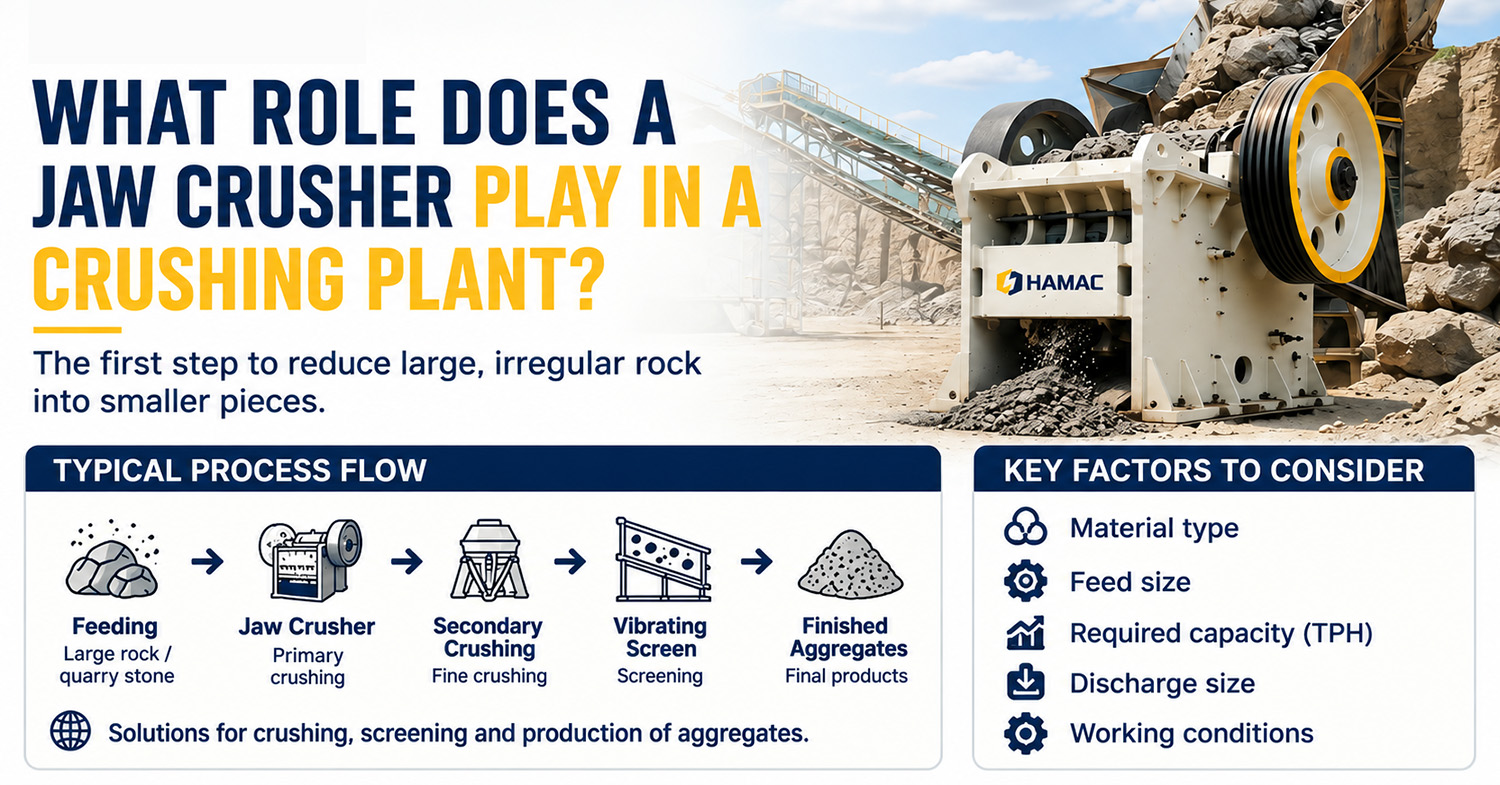
A primary jaw crusher is installed at the front of the line to receive this material. Through the repeated movement of the moving jaw against the fixed jaw, it compresses and breaks large rock into smaller pieces. The material then leaves through the discharge opening and moves by conveyor to the next stage. Models such as HAMAC's PE Series jaw crusher and European Tech. jaw crusher are commonly configured for this role.
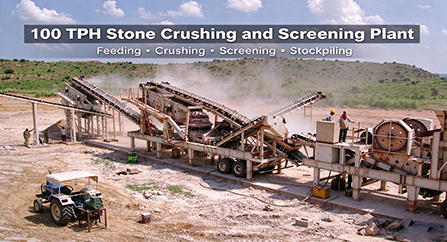
A typical crushing plant flow design looks like this:
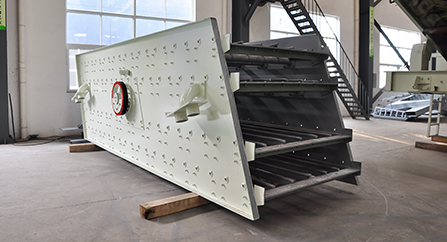
Raw Material → Hopper → Vibrating Feeder → Jaw Crusher → Conveyor → Cone/Impact Crusher → Vibrating Screen → Finished Products
In this sequence, the jaw crusher is not expected to make perfectly shaped final aggregate. Its job is to establish a stable beginning for the entire production process. If the first crushing stage is unstable, every downstream machine will work under unstable conditions.
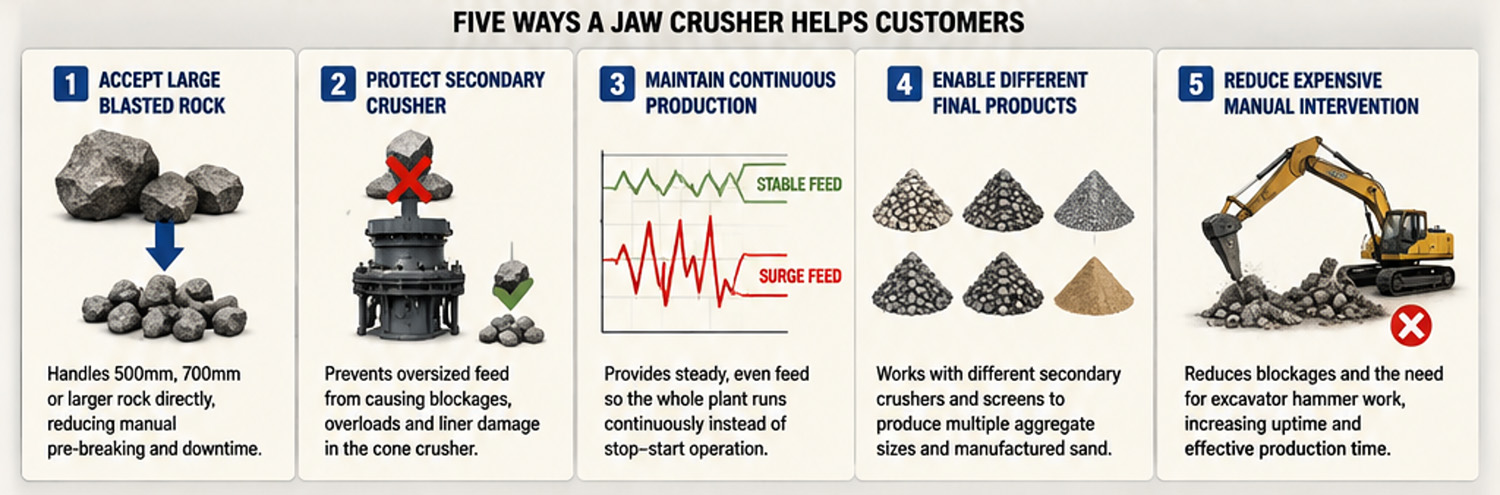
1. It Allows the Plant to Accept Large Blasted Rock for Primary Crushing
In a granite quarry, the material coming from the blasting area may include 500 mm, 700 mm or even larger rock pieces. A downstream cone crusher is not designed to receive these oversized rocks directly. If operators feed them into the wrong machine, they may face blockages, sudden overloads, damaged liners and unplanned shutdowns.
A jaw crusher for granite crushing gives the plant a practical "entry gate" for this material. The loader can feed large stone straight into the hopper, the vibrating feeder can regulate the flow, and the jaw crusher can gradually reduce the material to a size that the next crusher can accept.
For the customer, this means fewer situations where workers must stop the plant and manually break oversized stone with an excavator hammer before it can even enter the line. It also means the quarry can process more of the blasted material directly instead of spending extra shifts sorting and pre-breaking it on the ground.
2. It Protects the Secondary Crusher from Oversized Feed
Consider a hard-rock aggregate plant producing 0–5 mm, 5–10 mm and 10–20 mm aggregates. Its cone crusher is intended to make the secondary reduction, but the cone crusher needs a reasonably controlled feed size to work efficiently.
Picture the cone crusher receiving a 400 mm boulder that slipped through without primary crushing: the mantle jams, the machine trips on overload protection, and the operator has to open the chamber and clear it by hand before restarting. When a jaw crusher for secondary crusher protection reduces large raw rock first, that scenario is avoided — the cone crusher only sees material within its intended feed range and can keep running.
For the plant owner, this can reduce overload events and help liners last longer. Choosing the correct liner material also plays a role here — see our guide on jaw plate and cone crusher liner material selection for details. More importantly, the operator can maintain a steady feed rate rather than constantly slowing the loader or stopping the feeder every time an oversized rock shows up on the belt.
3. It Helps Maintain Continuous Production Instead of "Stop-Start" Operation
A crushing plant may be designed for 200 tonnes per hour, but that jaw crusher capacity tph target is difficult to reach if the crusher receives material in large surges. Picture a loader dumping a full bucket of mixed rock into the hopper, then driving off to reload — the jaw crusher is briefly overloaded, then runs half-empty for the next few minutes while it waits.
With a correctly matched hopper and vibrating feeder, the jaw crusher instead receives a steady, even material bed. The crusher works continuously, the discharge conveyor runs at a consistent load, and the secondary crusher downstream receives a smoother, more even flow instead of alternating bursts and gaps.
For the customer, this creates a more predictable shift on site:
| Without stable primary crushing | With a well-matched jaw crusher and feeder |
|---|---|
| Loader operator reacts to constant crusher overload alarms | Feed rate stays steady with minimal operator intervention |
| Conveyor suddenly overloaded by rock surges | Conveyor load stays consistent |
| Secondary crusher runs empty then gets slammed | Secondary crusher receives even, continuous flow |
| Screen performance fluctuates with feed changes | Screen performance becomes more stable |
4. It Makes It Possible to Build Different Finished Aggregate Products
A customer may start with raw basalt and want to sell several products from the same quarry: road base, 20–40 mm aggregate, 10–20 mm aggregate, 5–10 mm aggregate and manufactured sand for concrete.
The jaw crusher creates the first reduction stage, and from that same crushed stockpile the plant can route material into different downstream configurations depending on what the market is buying that week:
| Downstream configuration | Best for |
|---|---|
| Jaw crusher + cone crusher | Hard-rock aggregate production for road base and coarse aggregate |
| Jaw crusher + impact crusher | Concrete aggregate where better particle shape is important |
| Jaw crusher + cone crusher + VSI crusher | Manufactured sand production for higher-margin sales |
For the customer, this means the same rock source can support multiple saleable products instead of one coarse, low-value output. For a deeper breakdown of how these stages work together, see our guide on primary vs secondary vs tertiary crushing equipment selection.
5. It Reduces Costly Manual Intervention at the Front of the Plant
Without suitable primary crushing equipment, oversized rock can create a familiar site problem: a large stone gets stuck at the hopper outlet or a conveyor transfer chute, the whole line has to stop, and someone has to bring in an excavator with a hydraulic breaker to reduce it by hand before production can resume. This can cost hours of lost run time for a single rock.
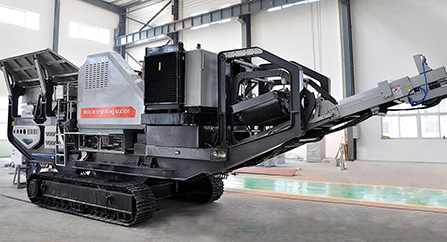
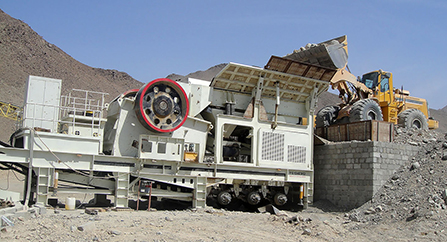
A properly selected jaw crusher for quarry and mining plants — with an adequate feed opening, a suitable chamber design and a correctly configured feeder — lets that same rock enter the system and get processed automatically instead of triggering a manual breakdown job. For projects that need this capability on the move, see HAMAC's mobile crushing plants, including wheel-type and tracked crushing plants.
For the customer, the value is not only higher tonnage. It is also fewer emergency call-outs for the breaker crew, less dependency on manual oversize breaking, and more actual operating hours squeezed out of every shift over the life of the plant.
Why the Jaw Crusher Is the Common Choice for Primary Crushing Equipment
In many small, medium and large crushing projects, the jaw crusher is the typical first-stage machine, for a few practical reasons:
| Feature | Why it matters for primary crushing |
|---|---|
| Large feed opening | Accepts big, irregular rock straight out of a blast or mining face |
| Compression crushing | Suits hard, abrasive rock such as granite, basalt, quartzite and many metal ores |
| Simple, well-understood structure | Jaw plates, toggle plate, bearings and drive are easy for site crews to inspect and maintain |
| Works in fixed and mobile setups | Same crushing principle used in stationary plants, semi-mobile stations, and tracked or wheeled mobile jaw crushers |
| Pairs with different second-stage machines | Hard-rock aggregate lines often follow it with a cone crusher; shape-sensitive lines follow it with an impact crusher |
This does not mean a jaw crusher fits every situation — very soft or sticky material, for instance, may call for a different first-stage approach — but for hard and abrasive rock it remains one of the most dependable primary crushing solutions, as also noted in this overview of mobile jaw crushers for pre-crushing.
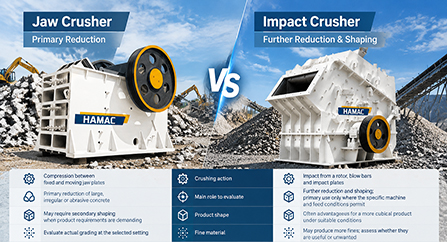
Jaw Crusher vs Cone Crusher vs Impact Crusher
| Equipment | Typical position | Main role | Better suited for | Should not be relied on for |
|---|---|---|---|---|
| Jaw crusher | Primary crushing | Receive large rock, initial size reduction | Large, hard, abrasive raw rock straight from blasting or mining | Producing highly cubical final-shape aggregate |
| Cone crusher | Secondary/tertiary crushing | Medium and fine crushing, size control | Hard rock, high-abrasion material, high-tonnage aggregate lines | Accepting oversized feed beyond its rated range |
| Impact crusher | Secondary crushing, sometimes primary | Impact-based crushing, better particle shape | Limestone, medium-hardness rock, recycled concrete, shape-sensitive aggregate | High-abrasion hard rock without accepting faster wear-part costs |
The right combination depends on the raw material, the target product, the required capacity and the customer's budget — not on which machine has the highest headline capacity on a spec sheet. For a step-by-step comparison, see our guide on cone crusher vs jaw crusher and jaw crusher vs impact crusher.
How Jaw Crusher Feed Size and Discharge Setting Affect Crushing Plant Capacity
A jaw crusher rated for a certain tph on paper does not guarantee that number on site. Several factors connect its performance to the plant's actual output:
| Factor | Effect on plant throughput |
|---|---|
| Feed opening vs. real rock size | Oversize rock beyond the opening causes bridging and blockages, cutting real running time |
| Feeding consistency | A well-matched hopper and vibrating feeder keep the chamber at a steady load instead of overload/idle cycles |
| Discharge setting (CSS) | Tighter setting = finer output but lower throughput and more wear; wider setting = higher throughput but coarser output |
| Pre-screening | Removing natural fines and soil before the crusher chamber frees up capacity for rock that actually needs breaking |
| Matching downstream capacity | If the jaw crusher outputs 250 tph but the conveyor or screen only handles 180 tph, the whole plant is capped at 180 tph |
How to Select the Right Jaw Crusher for Your Project: Data to Prepare Before Requesting a Quotation
Selecting a jaw crusher is not about picking a model number off a spec sheet — it starts with the data that describes your actual material and process needs. Before requesting a jaw crusher price quotation, prepare the following information for your supplier:
| Data to prepare | Why the supplier needs it |
|---|---|
| Material type (granite, basalt, limestone, iron ore, river stone, construction waste, etc.) | Determines crusher structure, wear-part material and downstream equipment |
| Maximum feed size — especially the largest occasional block, not the average size | Determines required feed opening and chamber design |
| Material hardness, compressive strength and abrasiveness | Affects wear-part life and structural requirements |
| Moisture content, clay content and stickiness | Determines whether pre-screening or a grizzly feeder is needed |
| Required jaw crusher discharge range or next-stage feed size limit | Ensures the jaw crusher output matches downstream equipment |
| Target capacity in tph, plus daily working hours | Determines crusher size and overall plant layout |
| Final product specifications and intended use | Guides the full downstream crushing and screening design |
| Plant type preference — stationary, wheel-mounted mobile, or crawler-type mobile | Determines the overall equipment format |
| Power configuration, fuel conditions, site space and transportation constraints | Affects equipment selection and installation planning |
| Existing equipment already on site (feeder, screen, conveyor, secondary crusher) | Ensures the new jaw crusher integrates with the current line |
With this information, HAMAC's engineering team can recommend a suitable jaw crusher model, put together a complete production line design plan, prepare an equipment configuration list, and issue a project-based quotation — rather than offering an isolated jaw crusher price that doesn't account for how the machine will actually perform in your specific line. See real project examples in our mobile crushing plant case studies.
Frequently Asked Questions About Jaw Crushers in Crushing Plants(FAQ)
Why is my jaw crusher producing less than expected capacity?
Common causes include uneven feeding, oversized rock beyond the feed opening, an unsuitable discharge setting, too many fines reaching the chamber, worn jaw plates, or a downstream bottleneck limiting real throughput.
Can a jaw crusher produce finished aggregate on its own?
In some low-spec, single-product applications yes, but most multi-product aggregate lines still need secondary crushing, screening and sometimes shaping equipment after the jaw crusher.
How often should jaw crusher plates be replaced?
There is no fixed schedule — replacement timing depends on material abrasiveness, actual tonnage processed, discharge setting drift and observed wear, so it is best tracked through regular inspection rather than a calendar. See our detailed jaw plate and cone crusher liner wear and maintenance guide for thickness thresholds and inspection schedules.
Can a jaw crusher handle wet or sticky material?
Lightly moist rock is generally fine, but high clay or moisture content can cause blockages in the chamber and downstream screens; pre-screening or a grizzly feeder ahead of the crusher usually helps.
What is the difference between a mobile jaw crusher and a stationary jaw crusher?
A mobile jaw crusher is mounted on a wheeled or crawler chassis for relocating between sites, while a stationary jaw crusher is installed in a fixed plant layout, typically for longer-term, higher-capacity operations. Learn more in our guide on how to choose a mobile crusher for a stone quarry.
A jaw crusher is not simply the first machine bolted into a crushing plant — it is the equipment that determines whether the entire line receives stable, correctly sized material to begin with. Matching it to the right material, feed size, discharge target and capacity is what turns raw rock into a reliable, saleable aggregate operation. Explore HAMAC's jaw crusher range or visit the HAMAC homepage to request a project-based quotation.