




Jaw Crusher Bearing Running Hot? Causes, Checks and Solutions | HAMAC
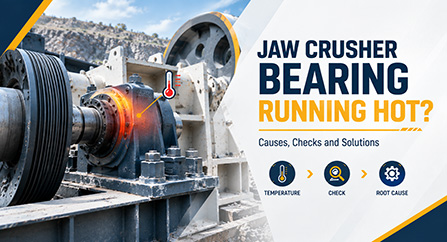
Is your jaw crusher bearing running hot? Do not automatically add more grease or order a replacement bearing. A high bearing temperature may be caused by insufficient lubrication, over-greasing, contaminated grease, damaged seals, excessive belt tension, misalignment, overload, vibration or blocked material flow.
The fastest way to find the cause is to compare the current temperature with the machine’s normal baseline, then check for abnormal noise, vibration, lubricant problems, belt load, feed overload and discharge restrictions.
This guide is written for quarry operators, mining companies, aggregate producers, mobile crushing plant operators, maintenance teams and equipment buyers who need a practical answer to the question: Why is my jaw crusher bearing overheating, and what should I do next?
For a broader review of low production, blockage, abnormal vibration, abnormal noise, bearing overheating and jaw plate wear, read HAMAC’s Jaw Crusher Troubleshooting Guide.
Is a Hot Bearing an Emergency?
A hot bearing does not automatically confirm bearing failure. However, a rapidly rising temperature, grinding noise, severe vibration, smoke, burning smell, grease leakage or repeated overload should be treated as a serious warning.
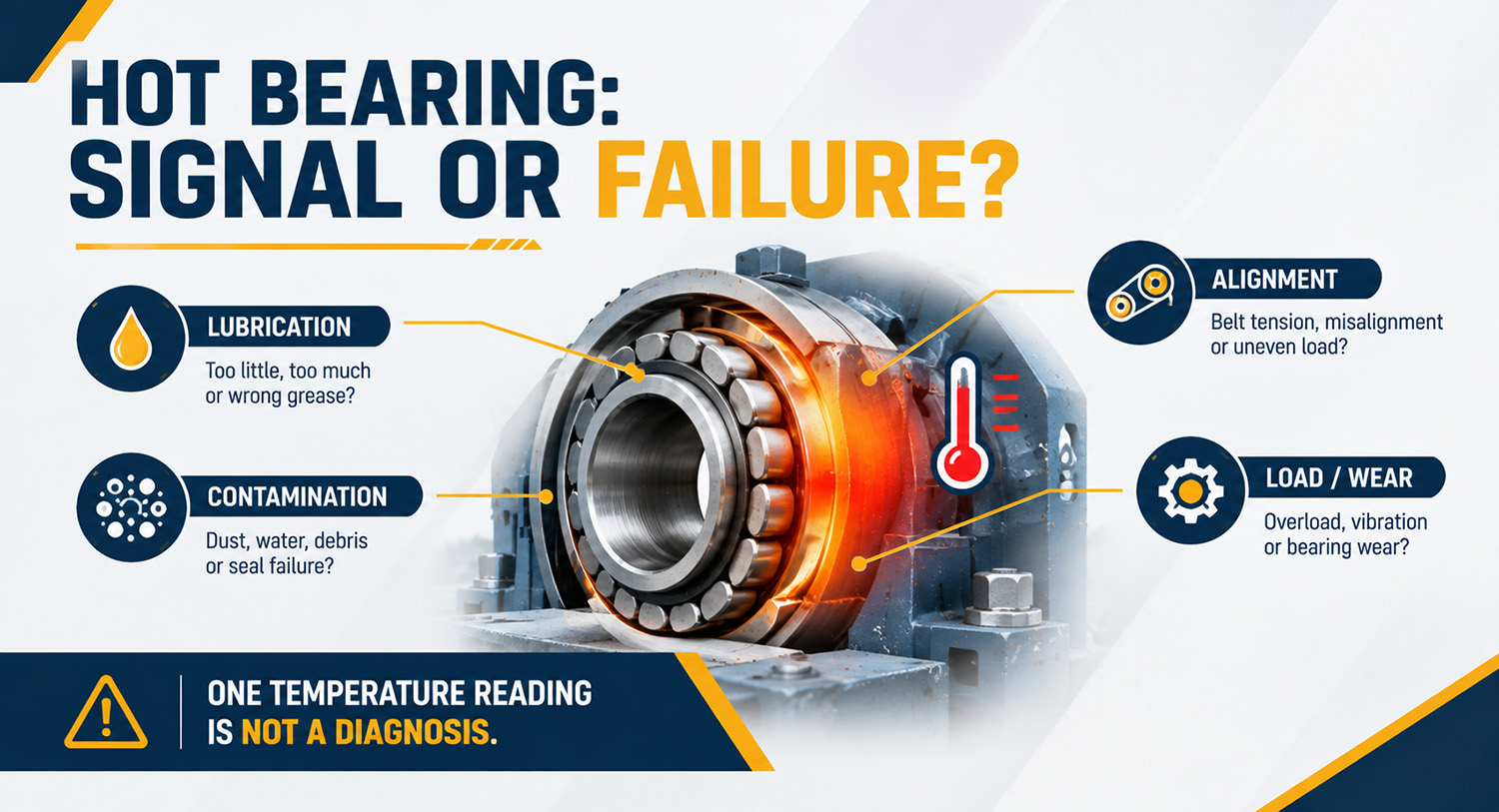
Do not judge the condition from one temperature reading alone. Compare temperature readings under similar material, feed rate, operating time and ambient conditions. The acceptable operating range must follow the specific crusher, bearing, lubrication and maintenance documentation.
| Observed Condition | Recommended Action |
|---|---|
| Temperature is slightly higher than normal but remains stable | Record the reading and inspect lubrication, seals, belt load and operating conditions. |
| Temperature continues to increase during operation | Arrange a controlled shutdown and inspect the likely cause before continuing production. |
| Temperature rises together with vibration or abnormal noise | Stop and isolate the crusher before further diagnosis. |
| Smoke, burning smell or severe grinding noise appears | Stop immediately according to the site shutdown and lockout/tagout procedure. |
| Grease contains metal particles or the bearing housing is visibly damaged | Do not continue normal operation. Arrange qualified mechanical inspection. |
Safety warning: Never inspect the bearing, belt, flywheel, crusher chamber or guards while the equipment is energized or capable of movement. Isolate electrical and mechanical energy sources and wait until all components have stopped completely.
What Should I Check First?
Follow this order: temperature trend, noise and vibration, lubricant and seals, belt and pulley condition, feed load and discharge flow. This sequence helps prevent unnecessary bearing replacement.
| Priority | Check | Why It Matters |
|---|---|---|
| 1 | Temperature trend | Shows whether the problem is stable, gradually worsening or rapidly developing. |
| 2 | Noise and vibration | May indicate bearing damage, misalignment, imbalance or loose components. |
| 3 | Lubricant and seal condition | Helps identify under-lubrication, over-greasing, contamination or leakage. |
| 4 | Belts and pulleys | Excessive belt tension or pulley misalignment can increase bearing load. |
| 5 | Feed and discharge flow | Oversized feed, overload, bridging and blocked discharge can increase mechanical stress. |
Common Causes of Jaw Crusher Bearing Overheating
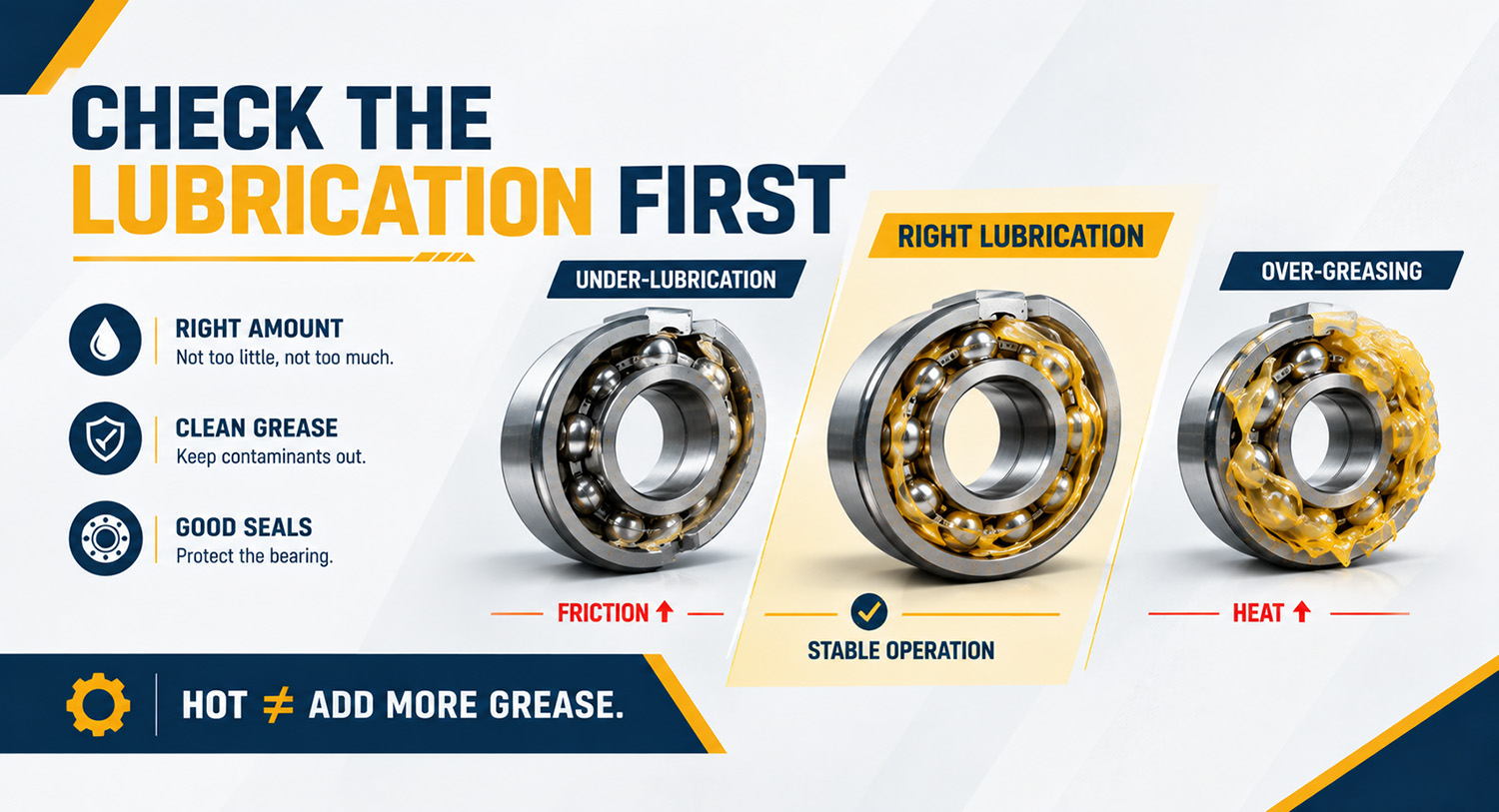
1. Insufficient Lubrication
Too little lubricant can increase friction, heat and wear inside the bearing. The problem may be caused by a missed lubrication cycle, a blocked grease passage, a damaged lubrication line, a failed automatic lubricator or grease leaking through a damaged seal.
Check whether the correct lubrication point is receiving grease and whether the grease is actually reaching the bearing. Inspect the lubrication fitting, hose, pump, distributor, relief passage and seal after the crusher has been safely shut down.
Do not use the lubrication schedule from another crusher model. Use only the lubricant type, quantity and interval specified in the applicable HAMAC equipment documentation.
2. Over-Greasing
Adding more grease is not always the solution. Excess grease can be churned by rotating bearing elements, increasing friction, internal pressure and operating temperature. It may also damage seals or prevent fresh grease from reaching the correct contact area.
If the bearing temperature rises shortly after lubrication, check whether the grease type and quantity are correct before adding more lubricant.
Practical rule: Do not continue pumping grease when abnormal back pressure, leakage or rapid temperature increase is observed. Stop the machine when required and follow the model-specific lubrication procedure.
For general information about the risks of over-greasing, see this bearing over-greasing maintenance reference.
3. Contaminated Grease or Damaged Seals
Dust, water, clay particles and fine rock can enter the bearing housing through a damaged seal, an unclean grease fitting or poor maintenance practices. Contaminated lubricant can accelerate wear and raise bearing temperature.
| Lubricant Condition | Possible Meaning | Recommended Direction |
|---|---|---|
| Normal colour and consistency | May be acceptable if the correct grease is being used | Continue scheduled inspection and record the condition |
| Very dark or burnt-looking grease | Possible high temperature, oxidation or contamination | Inspect temperature trend, load, seals and bearing condition |
| Milky or watery grease | Possible water ingress | Inspect seals, covers and water exposure around the bearing |
| Grease containing metal particles | Possible bearing, shaft or raceway wear | Stop normal operation and arrange qualified inspection |
| Grease leaking from the seal | Possible seal damage, over-greasing or bearing housing problem | Inspect the seal and lubrication passage after isolation |
4. Bearing Wear or Damage
A worn or damaged bearing may show several symptoms at the same time: rising temperature, grinding noise, vibration, irregular grease, repeated overheating or abnormal clearance.
Temperature alone cannot confirm bearing failure. A qualified inspection should combine temperature, vibration, noise, lubricant condition, visible damage, clearance and recent operating history.
If the bearing repeatedly overheats after lubrication and belt checks have been completed, do not keep restarting the crusher. Repeated operation can create secondary damage to the shaft, bearing housing and drive system.
5. Excessive Belt Tension or Pulley Misalignment
A jaw crusher bearing can run hot even when the bearing itself is healthy. Excessive belt tension or pulley misalignment can increase radial load on the bearing and raise operating temperature.
After shutdown and isolation, inspect:
- Belt tension and belt condition.
- Parallel alignment of the motor and crusher pulleys.
- Belt tracking and uneven wear.
- Cracks, glazing, burning or contamination on the belt.
- Material buildup on the pulley.
- Loose motor-base or drive-support components.
Correcting belt tension or pulley alignment may solve the overheating problem without replacing a serviceable bearing.
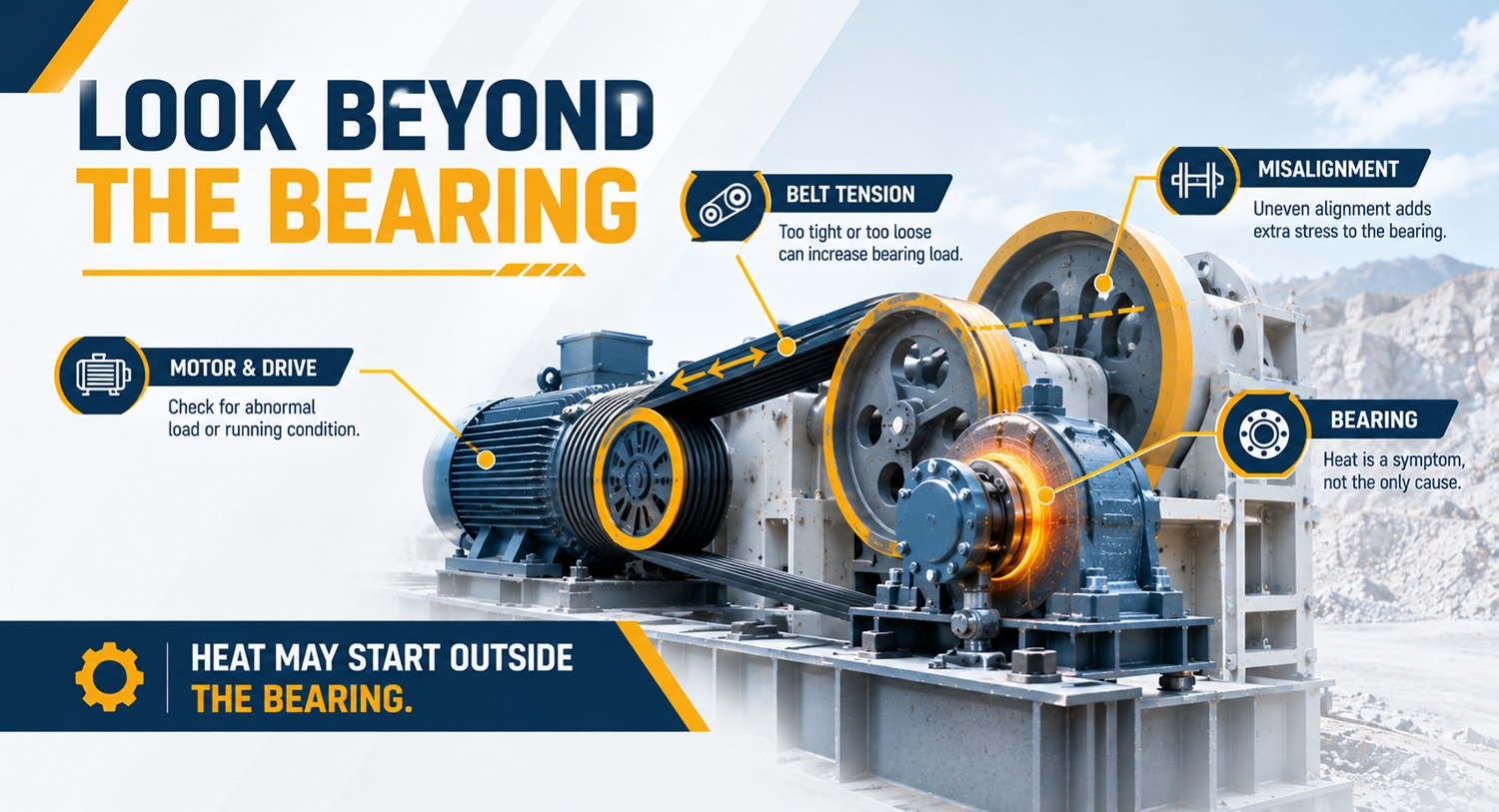
6. Misalignment or Incorrect Installation
Misalignment can distribute the load unevenly across the bearing. Incorrect installation, uneven tightening, damaged bearing seats, shaft wear or an unsuitable fit can create additional heat and shorten bearing life.
Pay special attention if one side of the crusher consistently runs hotter than the other side, or if the problem began immediately after a bearing replacement.
Do not attempt to correct shaft alignment, bearing clearance or bearing installation without the correct equipment, technical procedure and qualified personnel.
7. Oversized Feed, Overload or Crushing Chamber Blockage
Feed conditions can directly increase the mechanical load on the jaw crusher bearing. Oversized rock, sudden feed surges, bridging, wet material, clay and blocked discharge can force the crusher to operate under abnormal load.
HAMAC PE Series jaw crushers cover different feed openings, maximum feed sizes, capacities and motor powers. For example, the published maximum feed size ranges from approximately 210 mm on selected smaller models to approximately 1020 mm on the PE1200×1500 model, while reference capacities range from approximately 13 T/H to 800 T/H depending on model.
| Operating Problem | Possible Effect on the Bearing | First Area to Check |
|---|---|---|
| Oversized feed | Impact load and overload | Maximum rock size, blasting, breaking and feed preparation |
| Sudden feed surge | Rapid increase in crushing and drive load | Feeder control, hopper flow and loader operation |
| Bridging in the feed opening | Unstable load and repeated stoppage | Feed opening, hopper and oversized material |
| Wet or clay-rich feed | Packing, restricted flow and increased load | Material moisture, clay, chute and screen condition |
| Blocked discharge | Crusher backs up and runs under abnormal load | Discharge chute, conveyor, screen and stockpile |
For stable material feeding, see the HAMAC Vibrating Feeder.
8. Excessive Vibration, Imbalance or Loose Components
If temperature and vibration rise together, inspect the complete drive and support system instead of focusing only on the bearing.
Possible sources include:
- Loose fasteners or bearing-housing components.
- Flywheel or pulley material buildup.
- Uneven or off-centre feeding.
- Worn bearing or shaft damage.
- Support or chassis problems.
- Structural cracks or damaged guards.
- Unbalanced rotating components.
Do not restart the machine if the vibration is severe, unexplained or increasing. Arrange a qualified inspection before returning to production.
9. Poor Cooling, Dust Ingress or Harsh Operating Conditions
High ambient temperature, dust accumulation, water exposure, poor sealing and long periods of continuous high-load operation can make a bearing run hotter than normal.
Review the operating environment if the temperature rises during hot weather, after heavy rain, during continuous production or when the crusher is working in a high-dust area.
Keep the area around the bearing housing clean, but do not use high-pressure water directly on seals, bearing housings or electrical components unless the equipment procedure specifically allows it.
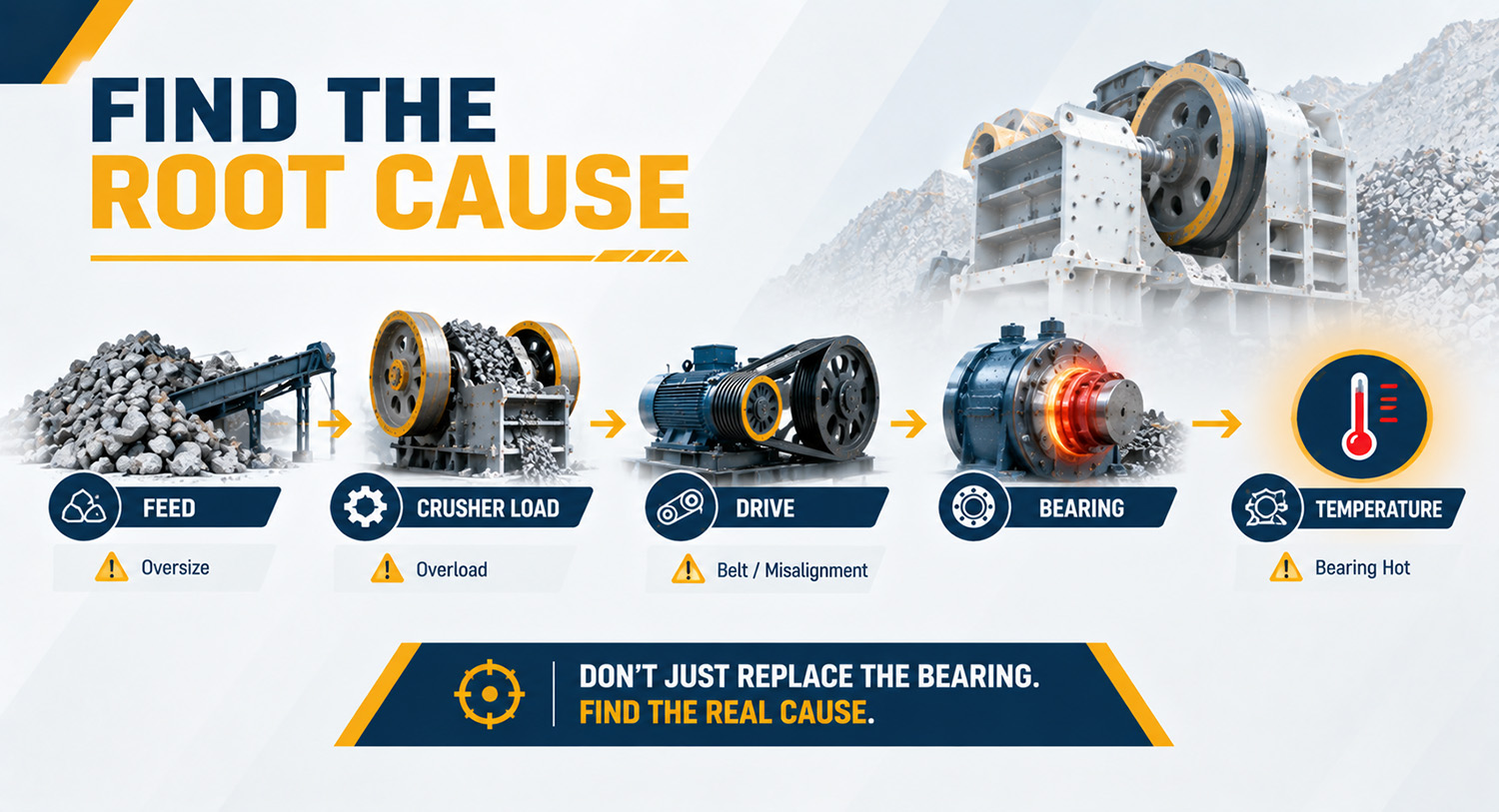
Symptom-to-Cause Diagnosis
| Observed Symptom | Likely Cause | What to Check First |
|---|---|---|
| Bearing heats up soon after greasing | Over-greasing, wrong grease or blocked relief passage | Grease type, quantity, leakage and lubrication procedure |
| Bearing heats up with grinding noise | Bearing damage, contamination or insufficient lubrication | Stop, isolate and inspect lubricant and bearing condition |
| One side is much hotter than the other | Uneven load, misalignment, local lubrication or bearing damage | Compare both bearing locations, belt alignment and feed distribution |
| Temperature rises during heavy feeding | Overload, oversized feed, blockage or restricted discharge | Feed size, feeder rate, motor load and material flow |
| Temperature and vibration increase together | Bearing wear, imbalance, loose parts or misalignment | Stop and arrange qualified mechanical inspection |
| Temperature rises after changing the quarry material | Higher hardness, abrasiveness, density, moisture or feed size | Material properties and operating conditions |
| Temperature remains high after a bearing replacement | Installation, alignment, lubrication, belt load or root-cause problem | Review the complete installation and operating process |
What Can Be Fixed on Site?
Some causes can be corrected through operating and maintenance adjustments, while others require qualified technical inspection. Do not remove guards, dismantle the bearing or enter the crusher chamber without complete shutdown and energy isolation.
| Situation | Possible Direction | When to Request Technical Support |
|---|---|---|
| Lubrication schedule was missed | Check the equipment manual and apply the specified lubricant correctly | If temperature does not stabilize or abnormal noise is present |
| Grease leakage is visible | Inspect the seal and lubrication point after shutdown | If leakage continues or the seal and housing are damaged |
| Belt is loose, damaged or misaligned | Stop and isolate the drive system | For correct alignment, tension adjustment or repeated belt failure |
| Feed contains oversized or sticky material | Improve feed preparation and control the feed rate | If overload, bridging or bearing heating continues |
| Discharge conveyor or screen is blocked | Stop, isolate and clear the material safely | If the blockage repeats or structural damage is suspected |
| Temperature rises with vibration or grinding noise | Stop normal operation | Arrange qualified bearing and drive inspection |
| Metal particles are found in grease | Do not continue normal production | Arrange bearing, shaft and housing inspection |
When Should the Bearing Be Replaced?
A hot bearing does not automatically mean that it must be replaced. Replacement should be based on the combined evidence from temperature, vibration, noise, lubricant condition, clearance, visible damage and maintenance history.
The Bearing May Not Need Immediate Replacement
- The temperature is slightly higher but becomes stable.
- There is no grinding noise or severe vibration.
- The grease is clean and compatible with the equipment.
- The problem is traced to belt tension, feed overload or discharge blockage.
- The crusher returns to normal after the root cause is corrected.
Arrange Professional Inspection
- The temperature continues to rise during comparable operation.
- One bearing remains significantly hotter than the other.
- Grease contains water, metal particles or burnt material.
- The bearing produces grinding, whining or knocking noise.
- Vibration increases at the same time as temperature.
- The bearing overheats again after lubrication or replacement.
Replacement May Be Required
- Visible bearing damage, spalling, pitting, burning or severe wear is confirmed.
- Clearance is outside the applicable equipment requirement.
- The shaft, bearing seat or housing is damaged.
- A qualified inspection confirms that the bearing cannot continue operating safely.
Replacing the bearing without correcting the original cause may lead to repeated overheating and another unexpected shutdown.
How to Prevent Repeat Bearing Overheating
| Maintenance Focus | Practical Action | Record to Keep |
|---|---|---|
| Lubrication | Use the specified grease, quantity and interval | Grease type, date, quantity and operator |
| Sealing | Inspect for dust, water and grease leakage | Seal condition and contamination signs |
| Temperature | Measure at consistent locations and operating conditions | Temperature trend and ambient condition |
| Vibration and noise | Record changes before they become severe | Noise description and vibration trend |
| Drive system | Check belt tension, pulley alignment and belt wear | Adjustment and replacement history |
| Feed system | Control oversize, surges and off-centre feeding | Maximum feed size and overload events |
| Discharge system | Keep the chute, conveyor, screen and stockpile flow clear | Blockages and downtime duration |
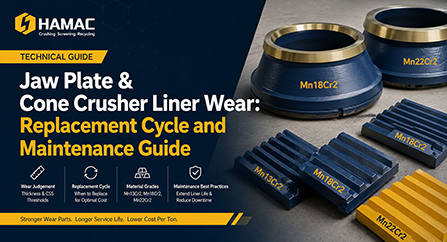
For jaw plate wear, replacement planning and the relationship between wear condition and crusher performance, read HAMAC’s Jaw Plate and Cone Crusher Liner Wear Guide.
What Data Should You Record?
Simple operating records can help distinguish a lubrication problem from a load, alignment or bearing problem. Record the following information whenever the bearing temperature changes.
| Data | Recommended Record | Why It Matters |
|---|---|---|
| Bearing temperature | Current temperature, normal temperature and measurement location | Shows the size and trend of the change |
| Temperature-rise speed | How long the machine runs before the temperature increases | Helps distinguish gradual degradation from a rapidly developing fault |
| Ambient condition | Approximate weather, dust and water exposure | Helps explain changes caused by operating environment |
| Lubrication | Grease type, quantity, date and method | Helps identify under-lubrication, over-greasing or wrong lubricant |
| Vibration and noise | When the sound or vibration occurs | Helps identify bearing, drive, imbalance or loose-component problems |
| Material | Rock type, moisture, clay and maximum feed size | Helps evaluate overload and changing feed conditions |
| Operating load | Motor current, overload events and feed rate where available | Shows whether the crusher is operating above normal load |
| Maintenance history | Recent bearing, belt, seal, shaft or pulley work | Helps identify installation and repeated-failure causes |
HAMAC Jaw Crusher Model and Capacity Reference
Jaw bearing load depends on the complete operating condition, not only the bearing itself. HAMAC PE Series models have different feed openings, maximum feed sizes, output ranges, capacities, engine powers and weights.
| Model | Maximum Feed Size | Output Range | Reference Capacity | Engine Power |
|---|---|---|---|---|
| PEX250×750 | 210 mm | 25–60 mm | 13–35 T/H | 30 kW |
| PE400×600 | 340 mm | 40–100 mm | 16–60 T/H | 30 kW |
| PE600×900 | 500 mm | 65–180 mm | 80–180 T/H | 55–75 kW |
| PE750×1060 | 630 mm | 80–180 mm | 110–320 T/H | 90–110 kW |
| PE900×1200 | 780 mm | 95–225 mm | 220–450 T/H | 110–132 kW |
| PE1200×1500 | 1020 mm | 150–300 mm | 400–800 T/H | 160–220 kW |
These are published reference values, not guaranteed site production. Actual performance depends on material hardness, abrasiveness, feed gradation, moisture, CSS, jaw plate condition, feeding stability, power supply and downstream equipment capacity.
For current model information, see the HAMAC PE Series Jaw Crusher.
Send HAMAC These Details for Faster Support
If your jaw crusher bearing is running hot, send HAMAC structured information instead of only reporting “the bearing is overheating.” The following details help identify whether the cause is lubrication, contamination, belt load, alignment, bearing wear, feed overload or restricted material flow.
| Information | Why It Helps |
|---|---|
| Crusher model and serial number | Identifies the correct machine configuration and applicable maintenance requirements. |
| Bearing location | Shows whether the issue is associated with a particular side or assembly. |
| Current and normal temperature | Shows the size of the deviation from the normal baseline. |
| Temperature-rise speed | Helps distinguish a gradual condition from a rapidly developing fault. |
| Grease type, quantity and last lubrication date | Helps identify under-lubrication, over-greasing or lubricant mismatch. |
| Noise and vibration description | Helps assess possible bearing damage, imbalance or misalignment. |
| Material type and maximum feed size | Helps evaluate overload, impact and changing operating conditions. |
| Photos and operating video | Helps review seals, grease leakage, belts, pulleys and the bearing housing. |
| Recent maintenance history | Helps identify installation, alignment or repeated-failure problems. |
Is your jaw crusher bearing running hot? Send HAMAC the crusher model, bearing location, temperature trend, lubrication details, material information and photos. Our technical team can help identify the likely cause and recommend the next step.
Request Jaw Crusher Bearing Technical Support
Frequently Asked Questions
Why is my jaw crusher bearing running hot?
The most common causes are incorrect lubrication, contaminated grease, damaged seals, bearing wear, excessive belt tension, misalignment, overload, vibration and restricted material flow. Check the temperature trend and abnormal symptoms before deciding whether the bearing must be replaced.
Can too much grease cause jaw crusher bearing overheating?
Yes. Over-greasing can increase internal pressure, friction and heat. Do not add more grease simply because the bearing temperature is high; confirm the correct grease type, quantity and interval for the specific crusher model.
What should I check first when the bearing temperature rises?
Check the temperature trend, abnormal noise, vibration, lubricant condition, seal condition, belt tension, feed load and discharge flow. Stop and isolate the crusher if the temperature rises rapidly or is accompanied by severe vibration, grinding noise, smoke or burning smell.
Can belt tension cause jaw crusher bearing overheating?
Yes. Excessive belt tension or pulley misalignment can increase radial load on the bearing and raise operating temperature. Inspect the belt and pulley system only after shutdown and energy isolation.
Should I replace the bearing immediately?
Not necessarily. A hot bearing may be affected by lubrication, contamination, belt load, alignment or overload. Replacement should be considered after checking temperature, vibration, noise, lubricant condition, clearance and visible damage.
What information does HAMAC need to diagnose the problem?
Send the crusher model, serial number, bearing location, current and normal temperature, temperature-rise speed, grease type and quantity, material type, maximum feed size, abnormal noise or vibration description, photos and maintenance history.
Related HAMAC Jaw Crusher Resources
- Jaw Crusher Troubleshooting Guide
- Jaw Crusher Low Production Causes and Solutions
- Jaw Plate and Cone Crusher Liner Wear Guide
- HAMAC PE Series Jaw Crusher
- HAMAC Vibrating Feeder
- Contact HAMAC Technical Support
Conclusion
A hot jaw crusher bearing is not always a failed bearing. Before replacing parts, check lubrication quantity, grease condition, seals, belt tension, pulley alignment, feed size, overload, vibration and discharge flow.
Correctly identifying the root cause can help reduce unexpected downtime, prevent secondary damage and extend the service life of the bearing, shaft, housing and drive system.
Contact HAMAC for Jaw Crusher Bearing and Crushing Plant Support