



How to Choose a Crusher for Granite, Basalt and Limestone | HAMAC
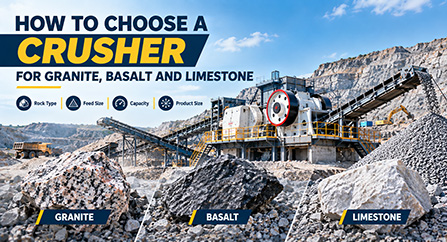
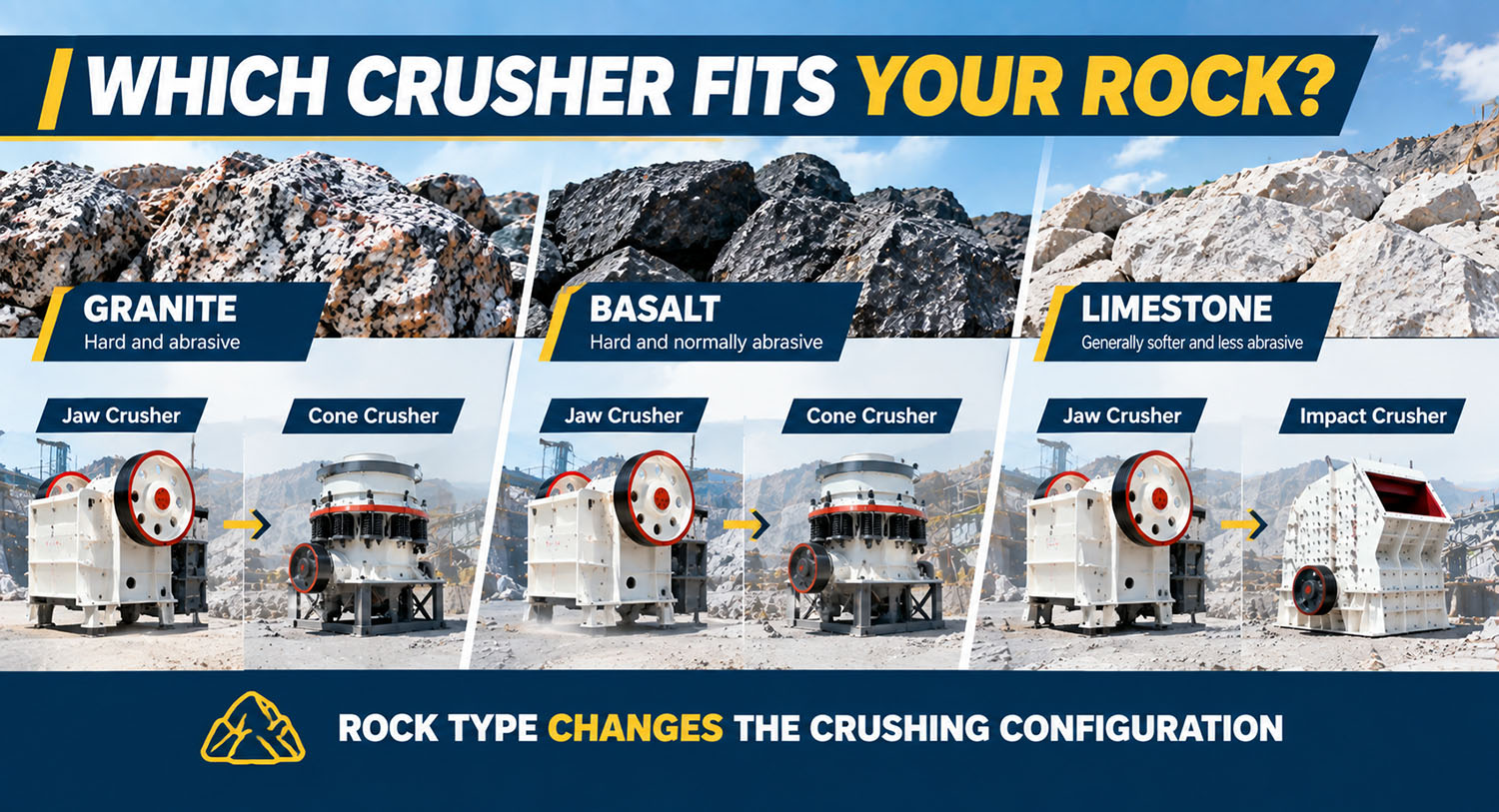
For granite and basalt, choose a jaw crusher for primary crushing and a cone crusher for secondary or fine crushing. For limestone, a jaw crusher and impact crusher are usually a practical combination.
The final selection should be based on four main factors: rock type, maximum feed size, required capacity and final product size.
For an explanation of primary, secondary and tertiary crushing, read HAMAC’s Primary vs Secondary vs Tertiary Crushing Guide.
Quick Crusher Selection
| Rock Type | Main Characteristic | Primary Crusher | Secondary Crusher | Optional Final Stage |
|---|---|---|---|---|
| Granite | Hard and abrasive | Jaw crusher | Cone crusher | Fine cone crusher or sand maker |
| Basalt | Hard and normally abrasive | Jaw crusher | Cone crusher | Fine cone crusher or sand maker |
| Limestone | Generally softer and less abrasive | Jaw crusher | Impact crusher | Impact crusher or sand maker |
This table shows typical equipment combinations. Actual rock hardness, abrasiveness, silica, clay and moisture may change the recommended configuration.
Best Crusher for Granite
Recommended configuration: Vibrating Feeder + Jaw Crusher + Cone Crusher + Vibrating Screen.
Granite is hard and abrasive. A jaw crusher accepts large rocks and completes the primary crushing stage. A cone crusher then uses compression to reduce the material to smaller aggregate sizes.
Compared with an impact crusher, a cone crusher is generally a more practical secondary crusher for continuous granite production because it avoids the rapid impact-part wear that may occur when processing abrasive rock.
| Primary crushing | Jaw crusher |
| Secondary crushing | Cone crusher |
| Screening | Vibrating screen |
| Manufactured sand | Optional sand-making machine |
Typical process: Vibrating Feeder → Jaw Crusher → Cone Crusher → Vibrating Screen → Optional Sand Maker
For primary crushing equipment, see the HAMAC PE Series Jaw Crusher.
For general geological information about granite, see the Encyclopaedia Britannica granite overview.
Best Crusher for Basalt
Recommended configuration: Vibrating Feeder + Jaw Crusher + Cone Crusher + Vibrating Screen.
Basalt is normally hard and abrasive. A jaw crusher is suitable for reducing large basalt rocks, while a cone crusher is generally suitable for continuous secondary and fine crushing.
An impact crusher may produce a good particle shape, but impact wear parts can wear faster when processing abrasive basalt. The wear cost should be evaluated before choosing an impact crusher for long-term basalt production.
| Primary crushing | Jaw crusher |
| Secondary crushing | Cone crusher |
| Fine aggregate | Fine cone crusher |
| Manufactured sand | Optional sand-making machine |
Typical process: Vibrating Feeder → Jaw Crusher → Cone Crusher → Vibrating Screen → Fine Cone Crusher or Sand Maker
For stable primary feeding, see the HAMAC Vibrating Feeder.
For general geological information about basalt, see the Encyclopaedia Britannica basalt overview.
Best Crusher for Limestone
Recommended configuration: Vibrating Feeder + Jaw Crusher + Impact Crusher + Vibrating Screen.
Limestone is generally easier to crush and less abrasive than granite and basalt. A jaw crusher can process the large feed material, while an impact crusher can complete secondary crushing and improve aggregate particle shape.
If the limestone feed is already small, a simplified process may be possible. However, limestone containing high silica, wet clay or excessive fines may require a different crusher, feeder or pre-screening arrangement.
| Primary crushing | Jaw crusher |
| Secondary crushing | Impact crusher |
| Screening | Vibrating screen |
| Smaller feed or simple process | Impact crusher or another suitable one-stage solution |
Typical process: Vibrating Feeder → Jaw Crusher → Impact Crusher → Vibrating Screen
For general geological information about limestone, see the Encyclopaedia Britannica limestone overview.
Cone Crusher or Impact Crusher?
| Comparison | Cone Crusher | Impact Crusher |
|---|---|---|
| Typical rock | Granite, basalt and other hard rock | Limestone and other less abrasive rock |
| Crushing method | Compression | Impact |
| Main wear parts | Mantle and concave | Blow bars and impact plates |
| Hard-rock wear cost | Usually more suitable | May be higher |
| Particle shape | Good when correctly selected and operated | Normally very good |
| Typical crushing stage | Secondary or tertiary crushing | Secondary crushing and shaping |
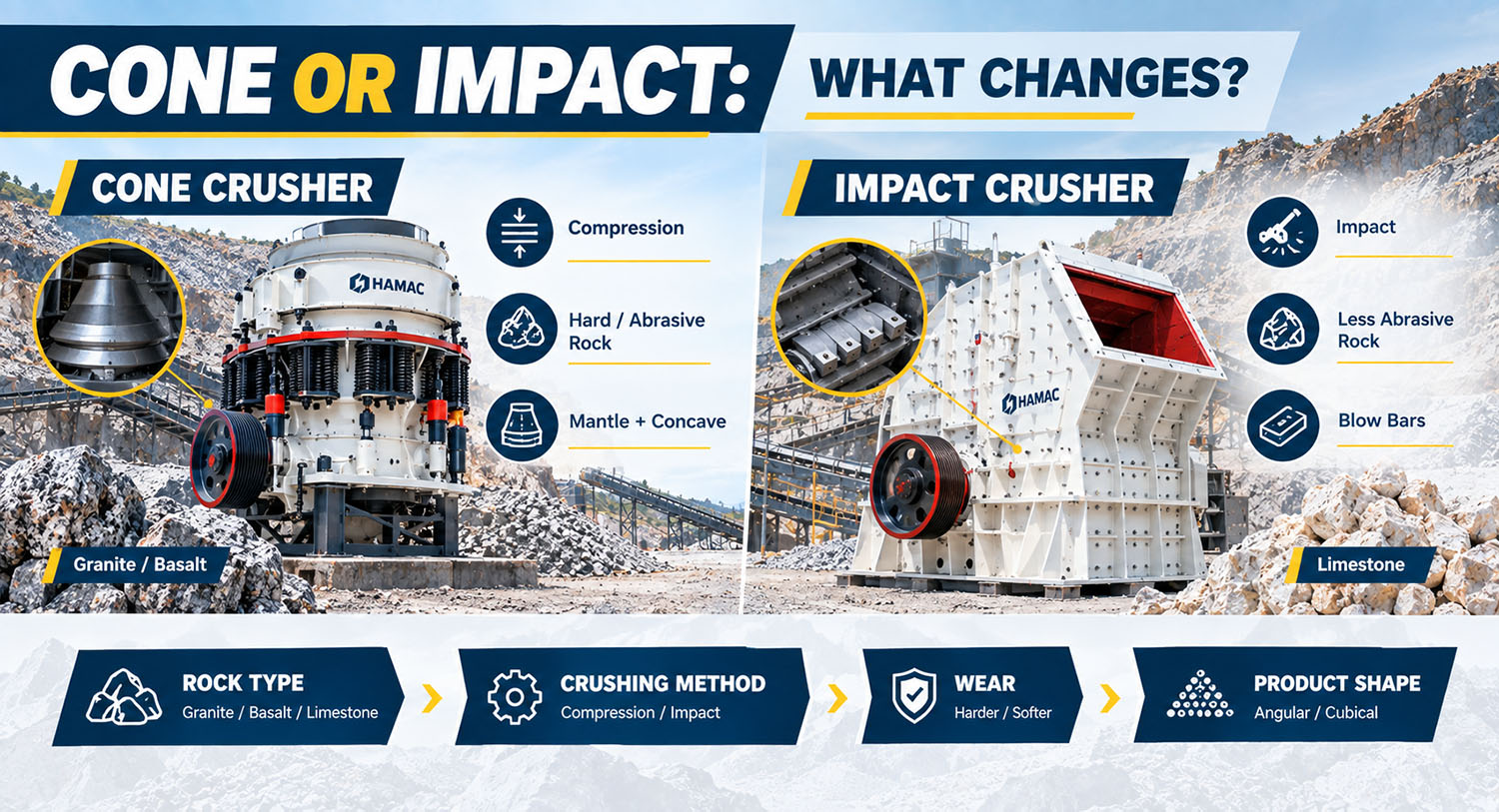
Choose a cone crusher for hard and abrasive rock. Choose an impact crusher for softer and less abrasive rock when particle shape is a major priority.
For more information about cone crushers in a crushing plant, read What Is the Role of a Cone Crusher?
Four Parameters to Confirm
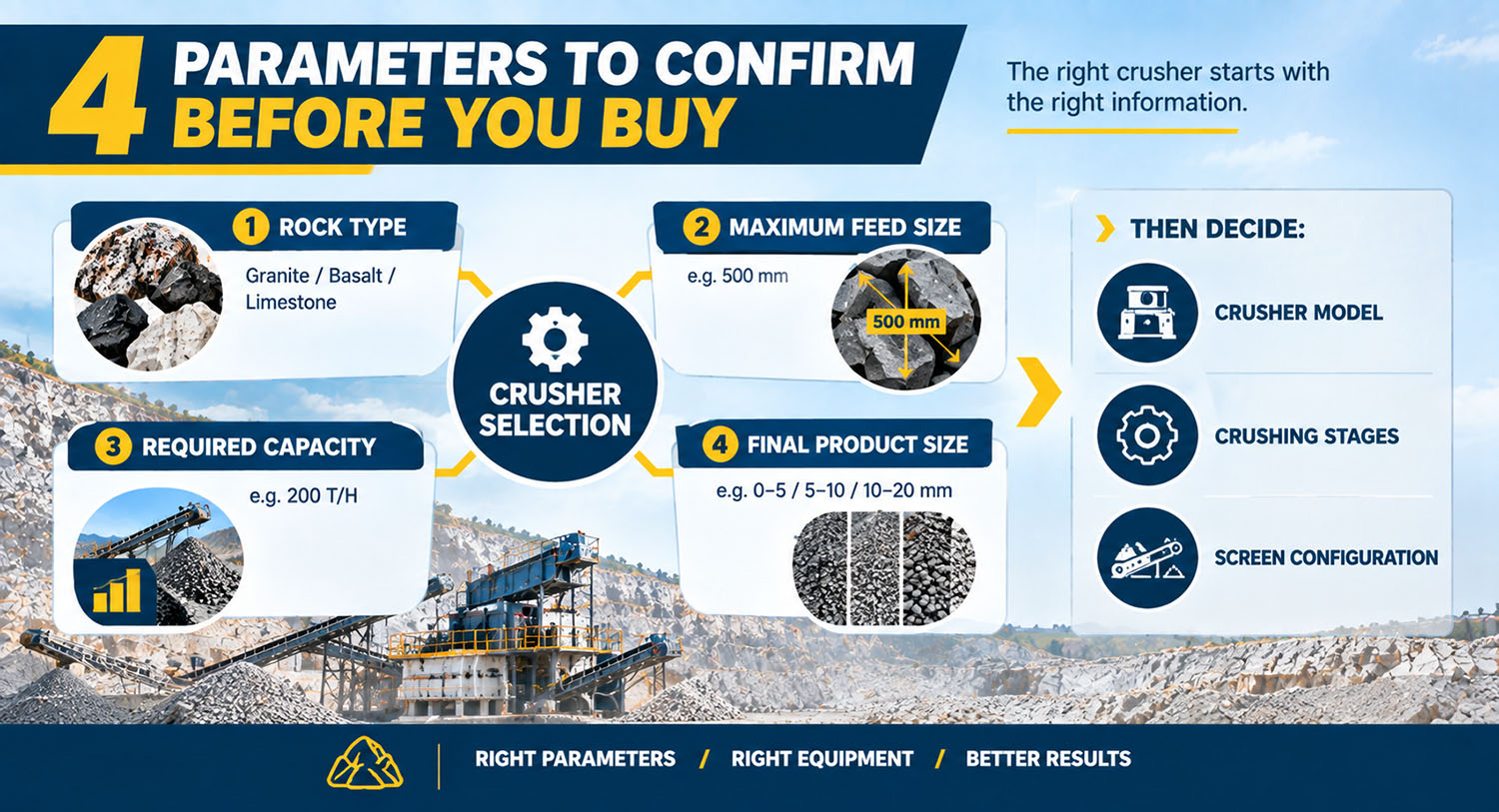
Do not select a crusher only by rock type or catalogue capacity. Confirm the following four project parameters first:
| Parameter | Example | Why It Matters |
|---|---|---|
| Rock type | Granite, basalt or limestone | Determines the suitable crushing method and wear parts. |
| Maximum feed size | 500 mm | Determines the required jaw crusher feed opening. |
| Required capacity | 200 T/H | Determines the crusher model and complete plant capacity. |
| Final product sizes | 0–5, 5–10 and 10–20 mm | Determines the crushing stages and screen arrangement. |
HAMAC Jaw Crusher Reference
HAMAC PE Series jaw crushers include models for different maximum feed sizes and capacities. The figures below are reference specifications and actual production depends on rock properties, feed gradation, CSS, moisture and downstream equipment.
| HAMAC Model | Feed Opening | Maximum Feed Size | Reference Capacity | Motor Power |
|---|---|---|---|---|
| PE400×600 | 400×600 mm | 340 mm | 16–60 T/H | 30 kW |
| PE600×900 | 600×900 mm | 500 mm | 80–180 T/H | 55–75 kW |
| PE750×1060 | 750×1060 mm | 630 mm | 110–320 T/H | 90–110 kW |
| PE900×1200 | 900×1200 mm | 780 mm | 220–450 T/H | 110–132 kW |
| PE1200×1500 | 1200×1500 mm | 1020 mm | 400–800 T/H | 160–220 kW |
For current specifications and model selection, visit the HAMAC PE Series Jaw Crusher product page.
For larger and modern primary-crushing options, see the HAMAC European Tech Jaw Crusher.
Fixed or Mobile Crushing Plant?
| Project Condition | Recommended Plant Type |
|---|---|
| Long-term quarry with stable production | Fixed crushing plant |
| Short-term construction project | Mobile crushing plant |
| Frequent relocation | Mobile crushing plant |
| Large production line with several final products | Fixed or modular crushing plant |
For mobile projects, read the HAMAC Mobile Crushing Plant Selection Guide.
You can also review the HAMAC Mobile Crushing Plant Solutions.
Simple Crusher Selection Rule
| If Your Material Is... | Choose... |
|---|---|
| Hard and abrasive granite | Jaw Crusher + Cone Crusher |
| Hard and abrasive basalt | Jaw Crusher + Cone Crusher |
| Softer and less abrasive limestone | Jaw Crusher + Impact Crusher |
| Hard rock requiring manufactured sand | Jaw Crusher + Cone Crusher + Sand Maker |
| Project requiring frequent relocation | Mobile Jaw Crusher + Mobile Cone or Impact Crusher |
Not sure which crusher is suitable for your material? Send HAMAC your rock type, maximum feed size, required capacity, final product sizes and site conditions. Our technical team can recommend a suitable crusher and production-line configuration.
Request a Crusher Selection Recommendation
Frequently Asked Questions
What is the best crusher for granite?
A jaw crusher is normally used for primary crushing, followed by a cone crusher for secondary or fine crushing. Add a sand-making machine when manufactured sand or improved particle shape is required.
What is the best crusher for basalt?
A jaw crusher and cone crusher combination is generally suitable for basalt because basalt is normally hard and abrasive.
What is the best crusher for limestone?
A jaw crusher and impact crusher combination is commonly used for limestone because limestone is generally softer and less abrasive than granite and basalt.
Should I choose a cone crusher or an impact crusher?
Choose a cone crusher for hard, abrasive rock such as granite and basalt. Choose an impact crusher for softer, less abrasive rock such as limestone.
Can one crusher process granite, basalt and limestone?
Some crushers can process all three materials, but wear cost, capacity and product quality may differ. Select the main crusher according to the material processed most frequently.
How do I select the correct crusher size?
Confirm the rock type, maximum feed size, required TPH and final product sizes. The crusher opening and rated capacity must match the complete production line.
Final Recommendation
Granite and basalt: Jaw Crusher + Cone Crusher.
Limestone: Jaw Crusher + Impact Crusher.
Final selection: Rock Type + Maximum Feed Size + Required TPH + Product Size.
Contact HAMAC for Granite, Basalt and Limestone Crushing Solutions