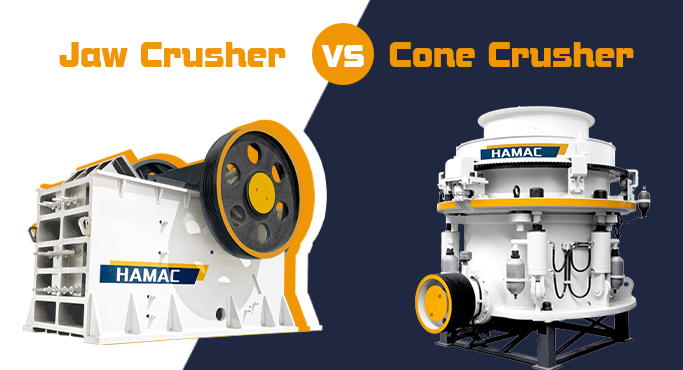
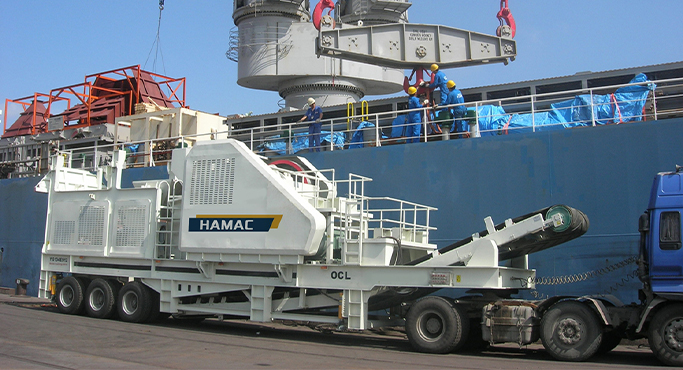
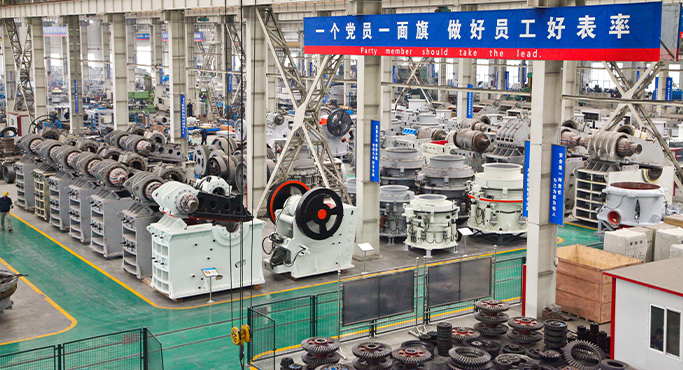
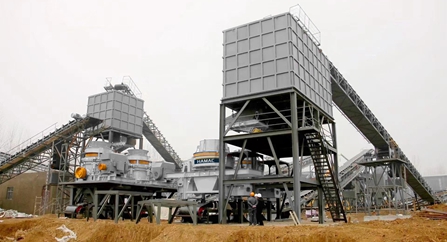
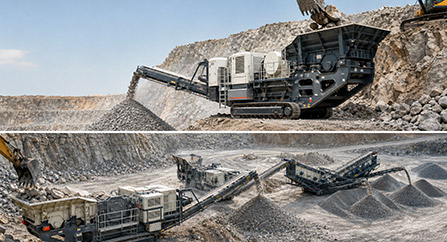
Mobile jaw crushers and mobile cone crushers are widely used in quarrying, mining, road construction and aggregate production. Although both machines crush stone, they have different working principles, feed requirements, output sizes and positions in a crushing plant.
The simplest way to understand the difference is this: a mobile jaw crusher is usually used for primary crushing, while a mobile cone crusher is normally used for secondary or tertiary crushing. The jaw crusher handles large raw stones at the beginning of the process. The cone crusher processes smaller material after primary crushing to produce more uniform aggregate.
Quick Answer: Mobile Jaw Crusher vs Mobile Cone Crusher
A mobile jaw crusher is the better choice when you need to crush large, hard and irregular raw materials such as granite, basalt, river stone and ore. It is usually the first crusher in a mobile crushing plant.
A mobile cone crusher is the better choice when you need to crush already-sized stone into smaller and more consistent aggregate. It is commonly used after a mobile jaw crusher in hard rock crushing plants.
Mobile Jaw Crusher Main Function
A mobile jaw crusher uses a fixed jaw plate and a moving jaw plate to break large stones through compression. It is designed to accept larger feeding sizes and reduce raw materials into smaller pieces for the next crushing stage.
Mobile jaw crushers are commonly used in granite quarries, basalt crushing projects, river stone processing, mining operations and hard rock aggregate production. They can also be used for some concrete recycling applications, especially when the feed material is large and irregular.
The material discharged from a mobile jaw crusher is usually coarse and may not have the final shape or size required by the market. For this reason, a jaw crusher is often followed by a cone crusher, impact crusher or screening plant.
Mobile Cone Crusher Main Function
A mobile cone crusher uses a rotating mantle inside a concave chamber to crush material through compression. It is mainly designed for secondary and tertiary crushing of medium-hard to hard materials.
A mobile cone crusher normally requires smaller and more consistent feed material than a mobile jaw crusher. It is often installed after a jaw crusher and is used to produce smaller aggregate sizes for concrete plants, asphalt plants, road projects and commercial stone production.
For granite, basalt and river stone projects, a mobile cone crusher can provide more uniform output and better gradation control than a jaw crusher. It is especially useful when the customer needs several finished products, such as 0–5 mm, 5–10 mm, 10–20 mm and 20–40 mm aggregate.
Comparison Between Mobile Jaw Crusher and Mobile Cone Crusher
|
Item
|
Mobile Jaw Crusher
|
Mobile Cone Crusher
|
|
Main Crushing Stage
|
Primary crushing
|
Secondary or tertiary crushing
|
|
Feed Size
|
Can accept large raw stones and irregular materials
|
Requires smaller and more controlled feed material
|
|
Output Size
|
Coarse output for further processing
|
Medium to fine aggregate with more uniform size
|
|
Suitable Material
|
Granite, basalt, river stone, ore and hard rock
|
Granite, basalt, river stone and pre-crushed hard rock
|
|
Typical Application
|
First crushing stage in quarry and mining projects
|
Aggregate shaping and fine crushing after a jaw crusher
|
|
Product Shape
|
Usually coarser and less uniform
|
More uniform aggregate and better gradation control
|
|
Feed Requirement
|
More tolerant of large and uneven feed material
|
Works best with screened and properly sized feed material
|
|
Common Plant Position
|
Beginning of the crushing process
|
After the mobile jaw crusher
|
Which Crusher Is Better for Granite and Basalt?
For hard materials such as granite and basalt, the best solution is often not choosing only one machine. A complete mobile crushing plant usually combines a mobile jaw crusher and a mobile cone crusher.
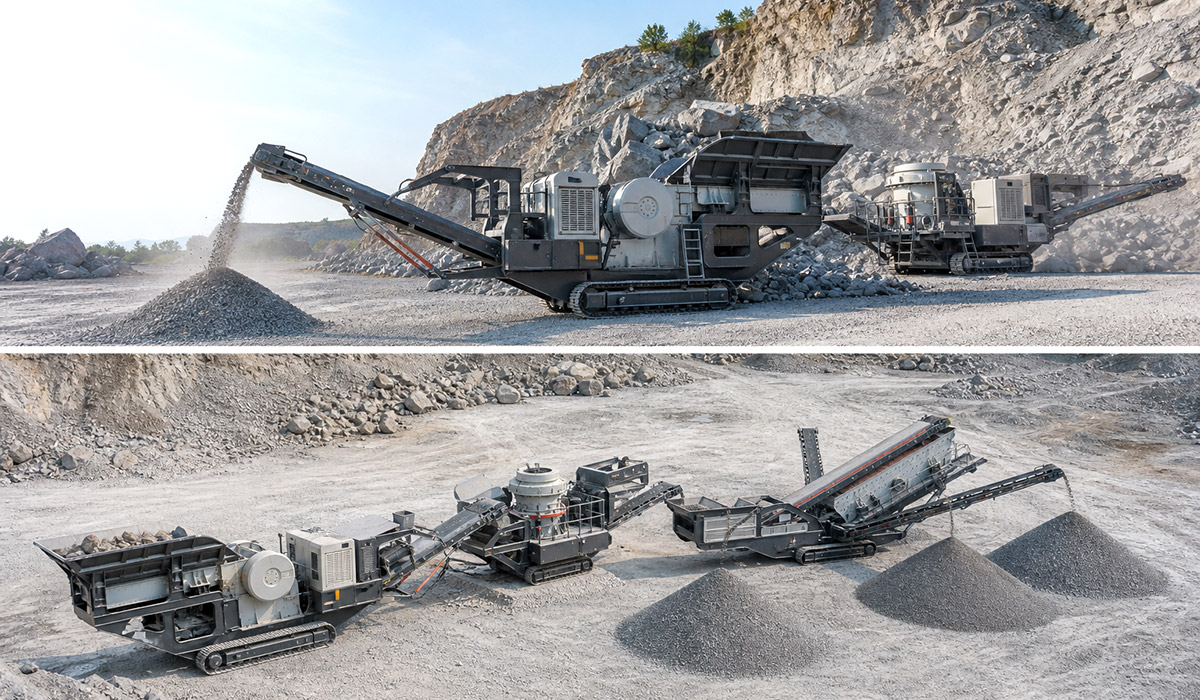
The mobile jaw crusher performs the first stage of crushing. It reduces large raw stones into smaller material. The mobile cone crusher then performs secondary crushing to produce smaller and more uniform aggregate. A mobile vibrating screen separates the final material into different sizes.
A typical hard rock crushing process can be: vibrating feeder, mobile jaw crusher, mobile cone crusher, mobile screening plant and belt conveyors. This configuration is suitable for quarry owners who need high-quality aggregate for concrete, asphalt, road construction and infrastructure projects.
When to Choose a Mobile Jaw Crusher
Choose a mobile jaw crusher when your project has large feeding materials, hard rocks, irregular stones or a need for primary crushing. It is a practical machine for starting a quarry crushing process or processing material directly from the blasting area.
-
You process large granite, basalt, river stone or ore.
-
You need the first crushing stage in a stone crushing plant.
-
Your feed material is irregular and not pre-screened.
-
You need a mobile machine that can work close to the quarry face.
-
You plan to add a cone crusher or screening plant later.
When to Choose a Mobile Cone Crusher
Choose a mobile cone crusher when you already have smaller feed material from a jaw crusher or another primary crusher. It is suitable for producing controlled aggregate sizes and improving the overall quality of hard rock products.
-
You need secondary or tertiary crushing for hard rock.
-
You require smaller and more uniform aggregate.
-
You produce aggregate for concrete, asphalt or road projects.
-
You need multiple finished sizes through a screening plant.
-
You process pre-crushed granite, basalt or river stone.
Typical Mobile Jaw and Cone Crusher Configuration
For a 100 TPH to 200 TPH granite or basalt crushing project, a common solution includes a tracked mobile jaw crusher, a tracked mobile cone crusher and a mobile vibrating screening plant.
|
Equipment
|
Main Function
|
Typical Output
|
|
Mobile Jaw Crusher
|
Primary crushing of large raw stone
|
Coarse crushed stone for secondary processing
|
|
Mobile Cone Crusher
|
Secondary crushing of pre-crushed hard rock
|
Medium and fine aggregate
|
|
Mobile Screening Plant
|
Separating finished products by size
|
0–5 mm, 5–10 mm, 10–20 mm and 20–40 mm aggregate
|
Frequently Asked Questions
Can a mobile cone crusher be used without a mobile jaw crusher?
In some applications, yes. If the feed material is already small and properly sized, a mobile cone crusher can work directly. However, for large quarry stones, granite or basalt, a mobile jaw crusher is usually required first because cone crushers have more limited feed-size requirements.
Which crusher has a larger feed opening?
A mobile jaw crusher normally has a larger feed opening and is better suited to handling large stones and oversized raw material. A mobile cone crusher is designed for smaller feed material after primary crushing.
Which crusher produces better aggregate shape?
A mobile cone crusher generally produces more uniform aggregate than a mobile jaw crusher. However, the final particle shape also depends on the material characteristics, crusher settings, screening configuration and overall plant design.
Can HAMAC provide a complete mobile crushing plant?
Yes. HAMAC can provide mobile jaw crusher plants, mobile cone crusher plants, mobile impact crusher plants, tracked screening plants, conveyors and complete crushing and screening solutions for quarry, mining, aggregate and recycling projects.
Choose the Right Mobile Crusher with HAMAC
To select the right mobile jaw crusher or mobile cone crusher, please provide your raw material, maximum feeding size, required capacity, final product sizes and project location. HAMAC can recommend a suitable crusher model and complete mobile crushing plant configuration based on your production requirements.
Contact HAMAC for a Mobile Jaw Crusher and Cone Crusher Solution